No Raksha Bandhan in our lane this year: How the passing of Shibu Soren has rekindled the truth about Jharkhand’s architect
SUMAN K SHRIVASTAVA Ranchi, August 11: “My whole mohalla didn’t celebrate Raksha Bandhan this year,” my maid told me today quietly,…
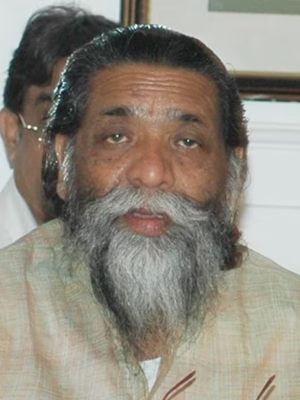
SHIBU SOREN
SUMAN K SHRIVASTAVA
Ranchi, August 11: “My whole mohalla didn’t celebrate Raksha Bandhan this year,” my maid told me today quietly, “because Shibu Soren is no more.”
It was a simple sentence, yet it carried the weight of an entire state’s grief. For many in Jharkhand, this was not merely the passing of a political leader — it felt like the loss of a family elder, the man whose life’s work shaped the very soil they stand on.
The Long Debate Over Jharkhand’s Real Architect
The debate over who can truly be called the ‘architect’ of Jharkhand has simmered for decades. The BJP has long credited Atal Bihari Vajpayee, under whose prime ministership the state was carved out of Bihar in November 2000. The Jharkhand Mukti Morcha (JMM) has always maintained that it was Shibu Soren — their own ‘Guruji’ — whose relentless struggle made Jharkhand a reality. And before Soren’s rise, there was Jaipal Singh Munda, the Oxford-educated tribal leader whose dream of a separate state for the tribal heartland was voiced as far back as the Constituent Assembly debates in 1946.
A Convergence of Visions — And One Man’s Relentless Struggle
History tells us that Jharkhand’s creation was a convergence of forces — Vajpayee’s political will, Jaipal Singh’s early vision, and the decades-long grassroots movement that Soren embodied. But history also tells us that movements are not just about dates and decrees; they are about people. And no one lived that struggle more intimately, or paid for it more dearly, than Shibu Soren.
Fighting Social Evils in the Santhal Heartland
Guruji’s fight began in the dusty interiors of Santhal Pargana, long before the idea of Jharkhand was a line in any manifesto. As a young man, he took on the oppressive Mahajani system — the cruel cycle of moneylending that kept tribal families in perpetual debt. He campaigned fiercely against the scourge of alcohol abuse that was hollowing out tribal society, often leading marches and awareness drives that brought him both admiration and enmity.

A Voice That Roared in Parliament
In Parliament, Soren’s speeches were anything but meek. His voice, steeped in the rhythms of Santhal idioms, could both charm and challenge the House. He thundered about the rights of his people and the necessity of a separate state, often locking horns with larger parties. When the BJP floated the idea of naming the new state ‘Vananchal’, Soren saw it as a dilution of Jharkhand’s identity and history. He resisted forcefully, ensuring that the state would be born under the name its people had fought for.
Nemra: A Village That Has Become a Pilgrimage
The days following his demise have been marked by a deeply personal, almost devotional, response. People from all corners of Jharkhand have made a beeline to Nemra, his ancestral village. There, Chief Minister Hemant Soren has been camping since the cremation, performing every ritual for his father with a quiet steadiness. Nemra has become a place of pilgrimage — mourners arrive in tractor trolleys, on motorcycles, even on foot, to lay a wreath, offer a prayer, or sit in silence before Guruji’s portrait.
A Condolence That Crossed Political Lines
Even political rivals have set aside old battles. Prime Minister Narendra Modi, in a heartfelt message, acknowledged Soren’s deep connection to Jharkhand’s people and his decades of service to the state’s tribal communities. He noted that while they came from different political traditions, he respected Soren’s commitment to his cause and his role in shaping Jharkhand’s history.

The Soul of Jharkhand
In that moment, the old arguments seemed to fall away. The state was not tallying political credits. It was remembering a man who, for better or worse, had been its living symbol.
Shibu Soren may not have signed the final document creating Jharkhand, but the truth is — without his voice, his marches, his jail terms, and his political stubbornness, there might have been nothing for anyone to sign. The swelling tide of emotion after his passing has done what decades of speeches could not: it has cemented, in the hearts of Jharkhand’s people, that Guruji was not just a leader of the state. He was the soul of it.
📜 Shibu Soren: Milestones of a Life in Struggle
- 1944 – Born in Nemra village, Santhal Pargana, into a tribal farming family.
- 1960s–70s – Leads grassroots campaigns against the Mahajani moneylending system and rampant alcoholism in tribal society.
- 1973 – Co-founds the Jharkhand Mukti Morcha (JMM), giving political shape to the statehood movement.
- 1980s–90s – Delivers fiery speeches in Parliament demanding a separate Jharkhand; fiercely opposes the BJP’s plan to name it Vananchal.
- 2000 – Jharkhand is carved out of Bihar; Soren hailed by supporters as the people’s architect of the new state.
- 2004 – Serves as Union Coal Minister in the UPA government.
- 2005–2010 – Holds the post of Chief Minister of Jharkhand three times, often during turbulent coalition politics.
- 2025 – Passes away, triggering unprecedented mourning across the state; Nemra becomes a pilgrimage site.