High Courts must deliver justice like emergency wards: Justice Surya Kant
Ranchi, Nov. 15: High Courts must respond to injustice with the speed and precision of a hospital emergency ward, Supreme Court…
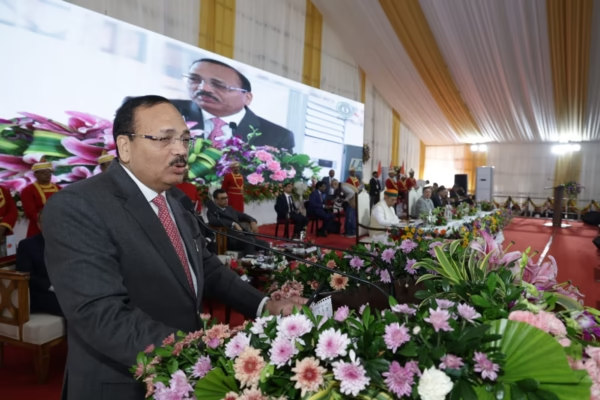
Ranchi, Nov. 15: High Courts must respond to injustice with the speed and precision of a hospital emergency ward, Supreme Court judge Surya Kant said on Saturday.
Speaking at the Jharkhand High Court’s Silver Jubilee celebrations here, he called for a judicial system equipped to act instantly when a crisis arises, much like medical teams that cannot afford delay when lives are at stake.
Surya Kant said the judiciary must embrace rapid, coordinated, and technology-enabled responses to ensure timely justice. “High Courts must design their institutional growth like modern hospitals plan their emergency services,” he said. This includes strengthening technological capacity, streamlining procedures, and building specialised expertise that allows courts to adapt quickly to new challenges. These reforms, he added, are essential for the next phase of improving access to justice in India.

ALSO READ: Jharkhand must live Birsa Munda’s dream, says CM Hemant Soren

High Courts as Engines of Legal and Social Reform
Surya Kant said High Courts have the power and responsibility to act as engines of social transformation. Their wide jurisdiction, constitutional authority, and closeness to the people allow them to shape legal development in ways that directly touch citizens’ lives. High Courts, he noted, sit “where the highest principles of justice meet the lived realities of ordinary people,” making them vital institutions for legal and social reform.
A Case That Changed His View of Judging
Looking back on his early days on the Bench, Surya Kant shared that his first case involved a cross-border custody dispute between two young children. What stayed with him, he said, was not the legal complexity but the quiet distress of the children caught between borders and courts. That moment taught him that judging is not only the application of legal doctrine but the responsibility to ensure that the protection of the law reaches those most vulnerable.


The Three Pillars of India’s Justice System
Surya Kant said India’s justice delivery system rests on three complementary pillars.
District Courts handle daily grievances and build public trust at the grassroots.
The Supreme Court guards constitutional boundaries.
High Courts serve as the bridge between citizens and the Constitution.
He highlighted that High Courts’ powers under Article 226 are wider than the Supreme Court’s jurisdiction under Article 32, because High Courts can protect fundamental rights as well as other legal rights. This broad authority, combined with their accessibility, makes High Courts essential to ensuring that legal protection is neither distant nor delayed.
Turning Rights Into Real Relief
Calling the High Courts the backbone of constitutional justice, Surya Kant said they transform abstract rights into meaningful relief that reflects local realities. Their judgments, shaped by regional context and cultural understanding, give justice a “human touch” and allow courts to push social change that is both inclusive and grounded in experience.
25 Years of the Jharkhand High Court
Surya Kant praised the Jharkhand High Court’s twenty-five-year journey as one marked by resilience, innovation, and commitment to constitutional values. He highlighted its major decisions protecting tribal land rights, workers’ dignity, environmental resources, and principles of intergenerational equity in mineral extraction. Even in its early years, he said, the Court turned institutional challenges into opportunities to strengthen the rule of law.
Tech Reforms Key to Modern Justice
The judge also applauded the Court’s progress in adopting technology, calling it essential for modern judicial administration. With steps such as e-filing, real-time case tracking, searchable digital databases, and tools for visually challenged litigants, the Court has made its processes more transparent, efficient, and citizen-friendly. “Technology is no longer optional,” he said. “It is a core component of today’s justice system.”
Preparing for Future Challenges
Looking ahead, Surya Kant said High Courts must prepare for rapid technological change, climate challenges, cyber offences, digital evidence, demographic shifts, and resource conflicts. Rising caseloads and delays, he said, demand new models, scientific understanding, and specialised training.
As Jharkhand High Court marks its 25th year, he said the contributions of its judges, officers, and lawyers have “added depth and harmony to the melody of justice.” He expressed hope that the Court’s legacy will continue for generations.