Jharkhand HC@25: Fire, authority and judicial reordering of Baba Baidyanath Dham
Advertisement Ranchi, Dec. 19: At dawn in Deoghar, when the first bells echo through narrow lanes and the scent of incense…

Ranchi, Dec. 19: At dawn in Deoghar, when the first bells echo through narrow lanes and the scent of incense rises from the stone courtyards, Baba Baidyanath Dham appears untouched by time. As one of the twelve Jyotirlingas of Lord Shiva, the shrine draws millions each year—most visibly during the Shrawani Mela, when saffron-clad devotees walk hundreds of kilometres to pour holy water on the linga.
Yet behind this ancient rhythm of faith lies a story far less serene. It is a story of power and privilege, of custom and contest, of law stepping into sacred space. For more than two centuries, the governance of Baba Baidyanath temple has been shaped not only by ritual and belief but by persistent courtroom battles.
The most turbulent chapter of this long history unfolded in the early years of the new millennium, when the Jharkhand High Court intervened decisively in temple affairs—provoking resistance so intense that it spilled out of the courtroom and onto the streets, culminating in fire and violence.
At the centre of this transformation stood Justice V.K. Gupta, the first Chief Justice of the Jharkhand High Court, whose firm and unyielding approach altered the administrative destiny of one of Hinduism’s most revered shrines.

From hereditary priesthood to an administrative vacuum
For much of its recorded history, the internal management of Baba Baidyanath temple rested with the Sardar Panda, the hereditary chief priest. Courts had long declared the temple a public religious trust, but daily authority remained embedded in tradition rather than institutions. Over time, disputes over succession, allegations of neglect, and recurring questions about the handling of offerings eroded the legitimacy of this arrangement.
By the late twentieth century, effective control had drifted towards the district administration, with the Deputy Commissioner of Deoghar managing the temple under the directions of the Bihar State Hindu Religious Trust Board. Yet this was an improvised solution. There was no permanent board, no clearly defined powers, and no transparent framework for managing the enormous inflow of pilgrims and offerings.
This fragile system, sustained more by habit than law, collapsed under the weight of public scrutiny in the early 2000s.

The PIL that opened the sanctum to the court
The turning point came with a Public Interest Litigation filed by advocate Ajit Kumar in 2001–2002. The petition focused not on theology but on governance: overcrowding, poor sanitation, inadequate security, and the absence of a coherent administrative structure at Baba Baidyanath Dham.
The High Court was no longer dealing with abstract questions of religious autonomy. It was confronting issues of public safety, accountability, and state responsibility.
On May 8, 2002, the Jharkhand High Court passed a landmark order. Recognising that piecemeal directions would fail, the court constituted an ad-hoc Temple Management Committee to take charge of the shrine’s affairs. This was not meant to be symbolic or advisory. It was designed as a functional administrative authority, directly answerable to the court.
At its helm stood the Deputy Commissioner, Deoghar, designated as the Chief Executive Officer (CEO) of the committee.
Designing the ad-hoc committee: structure as signal
The structure of the ad-hoc management committee reflected judicial intent. The High Court deliberately crafted it as a bridge between administrative authority, judicial oversight, and local representation. It was a 12-member body, comprising ex-officio officials and nominated members.
Its core included: the Deputy Commissioner, Deoghar, as Chief Executive Officer; the District Judge, Deoghar, to ensure legal propriety; the Superintendent of Police, Deoghar, responsible for security and crowd control;
and elected representatives of the area, including the sitting Member of Parliament and Member of the Legislative Assembly, as ex-officio members.
Other members were drawn from individuals considered suitable by the court to assist in temple administration.
The message was unmistakable. Baba Baidyanath Dham was no longer to be governed as a private preserve or an informal arrangement. It was to be treated as a public institution, demanding administrative discipline and legal accountability.
The Deputy Commissioner as CEO: power with purpose
Making the Deputy Commissioner the Chief Executive Officer was both deliberate and controversial. The court viewed the DC as the only authority capable of coordinating the multiple arms of the state—police, municipal bodies, health services, revenue administration—particularly during the Shrawani Mela, when Deoghar transforms into one of the largest pilgrimage centres in the country.
As CEO, the DC was entrusted with: the execution of committee decisions;
supervision of temple staff and functionaries;
ensuring compliance with High Court orders;
and management of infrastructure, security, and pilgrim facilities.
This concentration of authority marked a decisive shift—from priest-centric control to state-led administration, supervised by the judiciary.
Defining power: what the board could—and must—do
The High Court did not leave the committee’s role undefined. Through successive orders, most notably in Ajit Kumar v. State of Jharkhand & Ors. (January 31, 2003), it carefully laid down the powers and functions of the Management Board.
The board was entrusted with:
overall management and control of Baba Baidyanath temple and its associated shrines;
regulation of rituals and access, without interfering in essential religious practices;
maintenance of order, safety, sanitation, and hygiene within the temple complex;
planning and execution of renovation and improvement works;
and supervision of offerings, donations, and expenditure.
In a telling observation, the court even suggested the inclusion of a renowned architect on the board, acknowledging that heritage conservation and development required professional expertise, not just piety.
Offerings and accountability: ending sacred ambiguity
Few issues were as sensitive as the handling of offerings. For generations, offerings had sustained the livelihood of pandas, but they had also been the source of allegations of misuse and opacity.
The High Court confronted this directly. In its 2003 order, it directed that all offerings from all temples and places associated with Baba Baidyanath mandir—within or outside the temple premises—be collected and deposited into a common corpus of funds. These funds were to be used solely for temple purposes, including maintenance, development, and pilgrim amenities.
For the court, transparency was not optional. In a public religious trust, accountability was a legal obligation.
Justice V.K. Gupta: firmness at the foundation
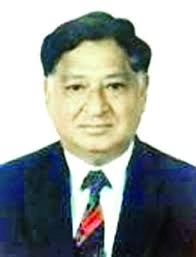
Much of the resolve behind these reforms flowed from Chief Justice V.K. Gupta. As the first Chief Justice of the Jharkhand High Court, he brought to the Baidyanath Dham cases a clear judicial philosophy: faith cannot place institutions beyond the reach of law when public interest is involved.
Justice Gupta repeatedly stressed compliance with court orders “in letter and spirit”, the need for institutional governance rather than personality-driven control, and the duty of the state administration to act decisively.
When the Panda Dharam Rakshini Sabha refused to nominate members to the board, the court did not wait. It modified the scheme, removed the vacant slots, and inducted new members, including the Advocate General of Jharkhand. Reform, the court signalled, would not be stalled by non-cooperation.
When resistance turned violent
Firm judicial intervention provoked fierce backlash. For many pandas, the new governance structure threatened not only tradition but economic survival. Protests escalated into a confrontation.
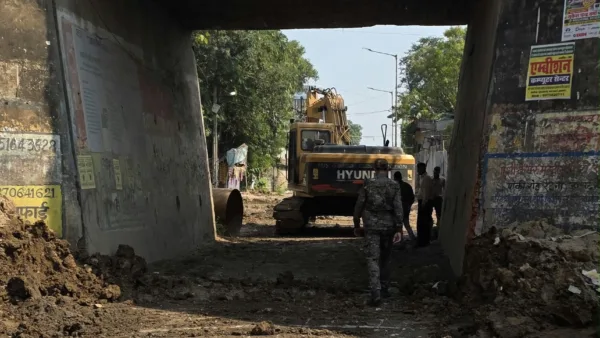
In 2003, at the height of the dispute, agitating priests attacked the Deputy Commissioner’s vehicle, pelting it with stones and attempting to set it on fire. The incident, widely reported in local newspapers, became a stark symbol of the anger against state control.
The flames, however, did not force retreat. Instead, they strengthened the judiciary’s conviction that ad-hoc arrangements were no longer sufficient.
Committee versus Trust Board: a new tug-of-war
The creation of the Jharkhand State Hindu Religious Trust Board in 2003 introduced fresh uncertainty. A new question arose: did the High Court-appointed committee answer only to the court, or was it subordinate to the Trust Board?
In August 2004, the High Court resolved the issue. It held that while the Management Committee would manage day-to-day affairs, the State Religious Trust Board would exercise supervisory powers over all religious institutions, including Baidyanath Dham. The board was directed to prepare annual budgets and place financial records before the court.
Baidyanath Dham was now firmly embedded within a statewide regulatory framework.
Why the courts stepped back
Despite clarity, it became evident that court-monitored ad-hoc governance had limits. Every disagreement returned to litigation. Every reform sparked protest. The High Court itself recognised that judicial supervision could not substitute for a comprehensive statute.
The solution, the court implicitly acknowledged, lay beyond the courtroom.
From order to Act: the 2015 legislation
That solution came with the Baba Baidyanath Dham–Basukinath Shrine Area Development Authority Act, 2015, enacted by the Jharkhand government and implemented in 2016. The Act replaced improvised arrangements with a statutory authority, vested with defined powers over management, development, and regulation of the shrine area.
It addressed infrastructure, urban planning, traffic management, public amenities, and the organisation of the Shrawani Mela. Most importantly, it replaced judicially supervised committees with a permanent institution backed by law.
From sanctum to statute
The journey of Baba Baidyanath Dham—from hereditary priesthood to statutory authority—was neither smooth nor peaceful. It passed through courtrooms, protests, and even fire. The interventions of the Jharkhand High Court, particularly under Chief Justice V.K. Gupta, forced a reckoning that centuries of tradition alone could not resolve.
What began as a PIL about mismanagement ultimately reshaped the governance of a sacred space. The 2015 Act stands as the culmination of that struggle—a reminder that even the most ancient shrines, rooted in faith and devotion, must eventually find their place within the rule of law.