
PESA is not just a law, it is our emotion, says Jharkhand CM Hemant Soren
Ranchi, Dec. 24: A day after the Jharkhand Cabinet approved the long-awaited PESA Rules, the mood at the Chief Minister’s residential…

Ranchi, Dec. 24: A day after the Jharkhand Cabinet approved the long-awaited PESA Rules, the mood at the Chief Minister’s residential complex on Wednesday was one of celebration, relief, and political affirmation. Traditional village heads, tribal elders, and civil society representatives from Scheduled Areas gathered to thank the state government for clearing the final procedural hurdle to implement the Panchayats (Extension to Scheduled Areas) Act, a law that has remained on paper in Jharkhand for decades.
Calling the moment historic, Chief Minister Hemant Soren said the approval of the PESA Rules marked the fulfilment of a long-standing promise to strengthen grassroots democracy and restore the authority of Gram Sabhas in tribal regions. “PESA is not just a law. Our emotions are attached to it,” he said, describing the decision as a step towards realising the vision of Jharkhand’s ancestors, freedom fighters, and tribal movements that demanded self-rule rooted in local traditions.
Celebration with Village Elders and Civil Society
The gathering saw participation from village chiefs, mukhiyas, and community leaders from across the Scheduled Areas, alongside representatives of civil society organisations that have campaigned for the implementation of PESA. In a symbolic gesture reflecting the cultural roots of the law, the Chief Minister joined the celebrations by playing the traditional drum, underscoring the link between constitutional reform and indigenous identity.
The Chief Minister described the occasion as the celebration of “PESA Day”, noting that the state government’s effort to bring the rules to their final stage had now been completed. With Cabinet approval secured, he said, the law was ready to be implemented on the ground.
Strengthening Gram Sabhas and Traditional Governance
At the heart of the PESA framework lies the empowerment of Gram Sabhas in Scheduled Areas, granting them decisive authority over local resources, development decisions, and governance processes. Emphasising this aspect, the Chief Minister said the rules would make village assemblies powerful decision-making bodies rather than symbolic institutions.

“With the implementation of PESA, Gram Sabhas in Scheduled Areas will get the right to take decisions. Traditional self-governance systems will be strengthened, and village communities will exercise control over land, water, forests, and natural resources,” he said.
He added that the law would help restore dignity and autonomy to traditional village heads and institutions, many of which had been sidelined over the years by bureaucratic processes that were disconnected from local realities.

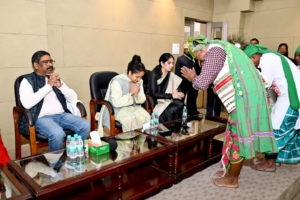
The event was attended by Rural Development Minister Deepika Pandey, MLA Kalpana Soren, Panchayati Raj Secretary Manoj Kumar, Director Rajeshwari B, along with mukhiyas, traditional chiefs, and PESA mobilisers from across Jharkhand.
‘Fulfilling the Dreams of Our Ancestors’
Linking the reform to Jharkhand’s political history, the Chief Minister said his government was committed to fulfilling the dream that the state’s ancestors, martyrs, and freedom fighters had for Jharkhand. Protecting water, forests, and land — core issues that have shaped tribal resistance movements in the region — remained a central priority.
“The decision to implement PESA is now taking shape. Our traditional village heads and chiefs will finally receive their rightful rights and entitlements,” he said, describing the move as a milestone for the development of Scheduled Tribal Areas.
ALSO READ: Jharkhand HC@25: When the Constitution entered the city
From Demand to Draft to Implementation
The Chief Minister acknowledged that the journey towards implementing PESA in Jharkhand had not been easy. The demand for framing rules under the Act had been pending for years, often stalled by political hesitation and administrative complexity.
“There were obstacles, but based on suggestions from public representatives, common people, and civil society, the draft was prepared and taken to its legal conclusion,” he said, expressing confidence that Jharkhand’s PESA Rules would set an example for other states with Scheduled Areas.
He also cautioned that while laws and rules may be well-framed, failures in implementation often prevent their intended outcomes. Stressing administrative accountability, he said the rights granted to Panchayats and Gram Sabhas under PESA must be honestly and sincerely implemented for the reform to succeed.
Securing the Future Through Empowerment
The Chief Minister framed PESA as part of a larger vision to secure the future of the coming generations in Jharkhand. Strengthening local governance, he said, was inseparable from improving socio-economic and educational systems in rural and tribal regions.
“Our state will progress only when our future generations are empowered and secure,” he said, adding that village-centric development was essential for the all-around growth of Jharkhand.
He reiterated his belief that the state could not be empowered unless its villages were strong, noting that the government was working to strengthen the rural economy alongside governance reforms.
A State in Transition
Referring to Jharkhand’s evolving political and social landscape, the Chief Minister said the state was moving towards a period of significant transformation. The government, he said, was focusing on employment generation, education, and targeted welfare measures, including initiatives aimed at supporting women and children from economically weaker sections.
Highlighting the Mukhyamantri Maiyaan Samman Yojana, he said nearly 50 lakh women in the state were becoming self-reliant, contributing to household stability and local economies.
At the same time, he acknowledged the constraints of limited resources and the challenges of governance. “We are preparing plans on how to move forward with limited resources,” he said. “I am not afraid of criticism, but I am afraid that our schemes might fail. That is why we believe in serious implementation.”
Voices from the Scheduled Areas
Village leaders from across Jharkhand’s Scheduled Areas welcomed the Cabinet’s decision, describing it as a turning point for local self-governance. Representatives from Gumla, Seraikela-Kharsawan, East Singhbhum, and other districts said the PESA Rules would give a new dimension to Panchayati Raj institutions in tribal regions.
They said the rules would empower village panchayats with decision-making authority, ensure respect for tribal customs, and finally translate years of demands into tangible rights on the ground.
“This initiative will ensure dignity and recognition for tribal communities in Scheduled Areas,” one village head said, calling the Cabinet approval a long-awaited step towards constitutional justice.
Looking Ahead
With the approval of the PESA Rules, Jharkhand now enters a crucial phase where political intent will be tested by administrative action. While celebrations mark the moment, the real challenge lies in translating the spirit of the law into everyday governance — ensuring that Gram Sabhas are not merely consulted, but truly empowered.
As Jharkhand prepares to operationalise PESA, the spotlight will remain on whether the promise of decentralised democracy can finally be realised in the Scheduled Areas of the state.