
Jharkhand HC@25: When merit was betrayed
Ranchi, December 25: Public service examinations are more than administrative procedures. In a constitutional democracy, they are gateways of trust—solemn assurances…
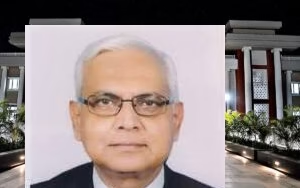
JUSTICE R K MERATHIA
Ranchi, December 25: Public service examinations are more than administrative procedures. In a constitutional democracy, they are gateways of trust—solemn assurances that talent and diligence will prevail over lineage and influence. When these gateways are compromised, the injury is not limited to individual aspirants; it strikes at the legitimacy of governance itself.
A Promise Made to a Young State
Jharkhand was born in 2000 with expectations as raw as the state itself. Two years later, the Jharkhand Public Service Commission (JPSC) was created to recruit the administrative backbone of the new state. For thousands of young men and women—many from modest backgrounds—the civil services examination was not merely an opportunity; it was a promise that the new state would be fairer than the old order.
Years of preparation followed. Families invested savings. Aspirants crossed age limits waiting for examinations to be held. Failure, though painful, was acceptable—if it came honestly.
What became unbearable was the growing suspicion that merit itself had been quietly rewritten.

The JPSC recruitment scam stands as one of the most serious breaches of that trust in Jharkhand’s history. What unfolded before the Jharkhand High Court over more than a decade was not merely a dispute over examinations, but a sustained confrontation with institutional corruption, social injustice, and delayed accountability. As the Court completes 25 years of its journey, this case emerges as a defining moment in its role as the constitutional sentinel of the State.
Early Warning Signs: When Allegations Became Unavoidable
The controversy began with a steady stream of complaints alleging large-scale malpractice, favouritism, manipulation, and financial irregularities in multiple examinations conducted by the JPSC, particularly the 1st and 2nd Combined Civil Services Examinations. These examinations were meant to recruit officers to some of the most influential services of the State—administrative, police, finance, and cooperative cadres.
During Governor’s Rule in 2008, the seriousness of these allegations led to recommendations for inquiry. Administrative disclosures that followed were deeply disturbing. Examination records, meant to be stored in sealed and secure rooms, were reportedly found scattered in open cartons. Financial irregularities were also flagged. The Vigilance Department’s preliminary inquiries found the allegations to be prima facie correct, pointing not to isolated lapses but to structural decay.

Public Interest Litigation: Citizens Invoke the Constitution
As faith in internal corrective mechanisms faded, the matter reached the Jharkhand High Court through a series of Public Interest Litigations. Among them, the PIL filed by Budh Deo Oraon became the cornerstone of judicial scrutiny. It sought a CBI investigation into appointments made through JPSC across sixteen examinations, contending that the State Vigilance Bureau was incapable of conducting an impartial probe due to the involvement of powerful political and bureaucratic figures.
ALSO READ: Jharkhand HC@25: When the Constitution entered the city
The Court firmly rejected the argument that the matter was a mere “service dispute.” It held that allegations of mass-scale corruption in public recruitment strike at the heart of constitutional governance and fall squarely within PIL jurisdiction. The ruling reaffirmed the Court’s role as a forum where citizens could challenge systemic wrongdoing affecting society at large.
Nepotism Under the Scanner: “Intolerable if True”
One of the most revealing aspects of the case was the pattern of alleged familial and personal advantage. The Court confronted the contention that there was no legal bar on relatives of influential persons participating in examinations. While accepting the proposition in theory, it rejected its misuse in practice.
In words that would echo far beyond the courtroom, the Court observed:
“It is not possible to swallow that only the near and dear ones of influential persons will be meritorious and will be selected on merit.”
This was not rhetoric but judicial disbelief rooted in evidence. Lists placed before the Court revealed that close relatives of JPSC officials—sons, daughters-in-law, brothers, brothers-in-law, and other associates—were allegedly selected and appointed across various services. Similar allegations were made regarding beneficiaries linked to ministers and other influential persons.
These allegations were still under investigation, yet the Court’s observation was unequivocal: if found to be correct, the situation would be intolerable.
ALSO READ: Jharkhand HC@25: Holding the line at Saranda
The 2012 Judgment: Fraud, Favouritism, and a Tainted Process
The defining judicial intervention came in 2012, when a Division Bench comprising Justice R.K. Merathia and Justice D.N. Upadhyay undertook a granular examination of the recruitment process. What emerged was alarming.
The Vigilance Bureau examined answer books and interview records. The Forensic Science Laboratory, Gandhinagar (Gujarat), confirmed cutting, overwriting, interpolation, and manipulation in both written papers and interview marks. Out of 172 selected candidates, 139 answer books were found suspicious. Even unsuccessful candidates were not spared—marks had been reduced, suggesting manipulation worked both to elevate favoured candidates and to push others out.
The Court recorded that interview boards were improperly constituted, mandatory disclosures regarding relatives were not made, records were withheld on the plea of “official secret,” and evaluators acted on instructions from coordinators and members. The Bench described the episode as a well-planned, large-scale criminal conspiracy involving cheating, forgery, abuse of power, and illegal monetary transactions.
Most significantly, the Court held that fraud vitiates everything. Citing settled constitutional doctrine, it observed:
Fraus et jus nunquam cohabitant—fraud and justice never dwell together.
Once the process itself stood tainted, the Court reasoned, it was neither possible nor desirable to separate tainted from untainted candidates.
Handing Over to the CBI: A Judicial Necessity
Against this backdrop, Justice Merathia and Justice Upadhyay ordered that all pending vigilance cases relating to the JPSC scam be handed over to the Central Bureau of Investigation. The decision was grounded not merely in mistrust of the state machinery, but in the constitutional necessity of restoring public confidence.
When the gatekeepers of recruitment themselves are under suspicion, the Court noted, the State cannot credibly investigate itself. The order marked a watershed, acknowledging that the damage extended beyond individual careers to the ethical fabric of public administration.
Fraud Versus Fair Play: Constitutional Principles Reasserted
The judgments repeatedly returned to a fundamental legal truth: justice and deceit cannot coexist. Candidates who benefit from a fraudulent process cannot seek shelter behind procedural innocence. If the process is corrupt, the beneficiary cannot be treated as blameless.
The Court clarified that constitutional protections such as Article 311 do not apply where appointments are void from inception. Entry into public service secured through fraud is no entry at all.
Marks That Told a Story: The Collapse of the “Scaling” Defence
Selected candidates argued that cutting and overwriting were normal consequences of scaling or moderation. The Court dismantled this defence. JPSC never claimed that alterations resulted from any approved scaling process. Forensic evidence confirmed deliberate manipulation.
Thousands of answer books were examined. Marks of successful candidates were increased; those of unsuccessful candidates reduced. Interview scores were altered. Evaluators admitted, in statements recorded under criminal law, that marks were enhanced at the behest of senior figures.
The Court concluded that once the foundation of evaluation is corrupted, the entire merit list collapses.
Public Interest Versus Human Cost
Faced with overwhelming evidence, the Court held the 2nd Combined Civil Services Examination to be prima facie vitiated. Yet, instead of cancelling the selection outright, it adopted a cautious approach, directing that selected candidates would not work or draw a salary pending investigation, with a limited humanitarian exception.
The balance was delicate, but the message clear: governance cannot safely rest in the hands of those selected through a corrupted process.
The Irony Deepens: Promotion Amidst Prosecution
As years passed, the saga acquired an unsettling dimension. Several candidates selected through examinations under judicial and criminal scrutiny were subsequently promoted to the Indian Police Service.
These promotions occurred while investigations remained pending and forensic evidence confirmed manipulation. Legally permissible, they nevertheless exposed a troubling gap between formal legality and substantive justice.
For honest aspirants who never made it past the examination gate, the spectacle reinforced a sense of irreversible loss. The damage extended far beyond recruitment, embedding itself into the architecture of governance.
The Long Wait: CBI Investigation and the Tyranny of Delay
Though the High Court handed the probe to the CBI in 2012, the promise of swift justice remained unfulfilled. The chargesheet came only in November 2024—twelve years later—naming 60 accused, including a former JPSC chairman, under conspiracy, cheating, and corruption laws.
Even then, prosecution awaited sanction. High Court orders in 2023 recorded unease that thirteen years had passed without closure. Delay, in this case, was not neutral. It reshaped lives.
The Invisible Casualties
Beyond courtrooms lie the true casualties—the meritorious candidates who crossed age limits, abandoned dreams, and never recovered lost years. The scam did not merely distort results; it restructured social mobility.
Closure Without Closure
On May 7, 2025, the Jharkhand High Court disposed of the long-pending PIL, observing that its purpose had been served. Formally, the litigation ended. Substantively, its consequences continue to ripple through Jharkhand’s administrative history.
What This Story Leaves Behind
The JPSC scam is not merely a tale of corrupted examinations. It is a study in how institutional failure, power asymmetry, and procedural delay can cause irreversible social harm.
The High Court’s interventions—especially the 2012 judgment—stand as a record of judicial clarity and constitutional courage. Yet the case also exposes the limits of courts when accountability arrives too late.
For a generation of aspirants, justice did not come in time to matter.
And that, perhaps, is the most enduring lesson of all.