
Ghatshila’s silent hills and Dharmendra’s loud truth in ‘Satyakam’ movie
Jamshedpur, Dec 27: In 1969, Indian cinema witnessed a rare moment of moral courage and artistic conviction with Satyakam, a film…
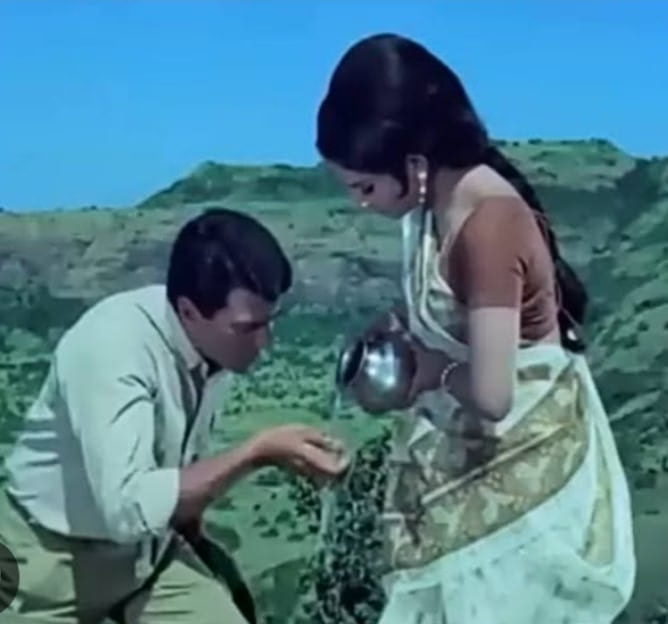
Jamshedpur, Dec 27: In 1969, Indian cinema witnessed a rare moment of moral courage and artistic conviction with Satyakam, a film that did not chase box-office applause but instead dared to speak of truth, integrity and quiet rebellion.
Directed by Hrishikesh Mukherjee, the film found its soul in Dharmendra’s unforgettable portrayal of an upright engineer who refuses to compromise his values in a corrupt system.
Also Read- Producers send legal notice to Akshaye Khanna over ‘Drishyam 3’ exit, bring in Jaideep Ahlawat
Over half a century later, Satyakam remains not just a film, but a conscience captured on celluloid.
Dharmendra’s Restrained and Powerful Performance
Dharmendra, often celebrated for his romantic charm and action-hero persona, revealed an entirely different dimension in Satyakam.
His performance was restrained, introspective and deeply human. There were no dramatic monologues or flamboyant gestures—only silence, dignity and inner turmoil.

The role demanded moral strength rather than physical bravado, and Dharmendra rose to the occasion with astonishing sincerity. In retrospect, Satyakaam stands as one of the finest performances of his career, a fact acknowledged even more poignantly after his death on November 24, when tributes poured in from across the film fraternity.
Hema Malini’s Tribute to the Actor Beneath the Star
Hema Malini, his co-star and later life partner, reflected on the film with deep emotion. In a tribute that resonated widely, she remarked that Satyakaam was “one of the best films Dharmendra ever did, a role where his eyes spoke more than words.”

She noted how the film revealed his inner discipline as an actor—an honesty that mirrored the character he portrayed.
Her words served as a reminder that beneath the star image was an actor capable of profound restraint and depth.
Also Read- Jharkhand HC@25: How a Santhal daughter finally inherited the land
Ghatshila: Landscape as a Silent Character
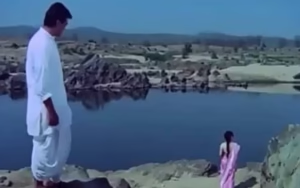
A significant part of Satyakam’s visual and emotional texture came from its outdoor locations, particularly Ghatshila, the quiet town in present-day Jharkhand where major portions of the film were shot.
Nestled amid rolling hills, forests and the Subernarekha river, Ghatshila lent the film a natural serenity that contrasted sharply with the moral ugliness depicted in the narrative.
The town’s landscapes framed Dharmendra’s character as a solitary figure—standing firm against compromise, much like the rocks and hills surrounding him.
A Town of Literary Legacy, Now Fading
Ghatshila itself holds an important place in India’s cultural memory as the birthplace of legendary writer Bibhuti Bhushan Bandopadhyay, whose works captured rural life with lyrical sensitivity.
Yet, as the years have passed, old residents lament that Ghatshila has lost much of its charm.
What was once a tranquil retreat for artists and thinkers now struggles under neglect, fading infrastructure and a loss of cultural visibility.
Also Read- Chhattisgarh Liquor Scam: ED names 59 more accused, files final prosecution complaint
Memories That Still Echo in Jamshedpur
Elderly cinephiles in nearby Jamshedpur still recall the excitement of those days. “When Satyakam was being shot in Ghatshila, people spoke of Dharmendra with awe,” recalls an old resident.
“He wasn’t just a star; he was a serious actor even then. The film felt different, heavy with meaning, ” the resident added.
Jamshedpur- based theatre artist Gautam Shankar remembers Satyakam as a masterclass in understated acting. “Dharmendra’s role in Satyakam was tremendous because it required courage to underplay,” he says.
“On stage, we are taught that silence can be more powerful than speech. Dharmendra proved that on screen. His performance still inspires theatre actors like us, ” added Shankar.
Another senior citizen from the steel city reflects, “In an era of escapist cinema, Satyakam dared to show that honesty comes at a cost. Dharmendra carried that burden on his shoulders with grace.”
Today, Satyakam endures as a cinematic testament to moral resistance and artistic integrity.
It also stands as a quiet memorial to places like Ghatshila, whose natural beauty once nurtured such meaningful cinema, and to an actor who, at his finest, chose truth over triumph.
In remembering Satyakam, people remember a Dharmendra who stood tall—not as a star, but as a man of principle.