PESA lollipop for tribals: Raghubar Das targets govt over rules
Ranchi, Dec. 30: Former Jharkhand Chief Minister and senior BJP leader Raghubar Das has sharply criticised the state government over its…
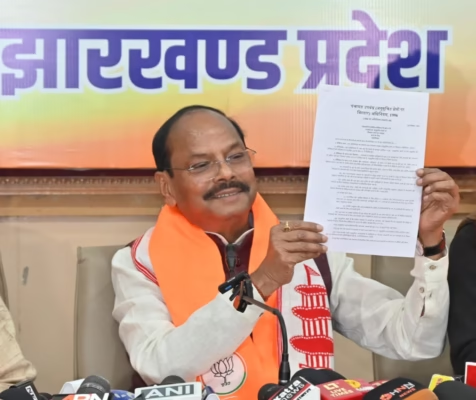
Ranchi, Dec. 30: Former Jharkhand Chief Minister and senior BJP leader Raghubar Das has sharply criticised the state government over its proposed PESA (Panchayat Extension to Scheduled Areas) Rules, alleging that the draft regulations dilute the spirit of the PESA Act, 1996, and weaken tribal self-governance.
Addressing a press conference at the BJP state office here, Das said the government was offering only a “lollipop” to tribal communities in the name of empowerment. He demanded the early release of the PESA Rules in line with the sentiments of people living in Scheduled Areas.
Rules Dilute Spirit of PESA Act
Raghubar Das said reports suggest the government has restricted the definition of the Gram Sabha, which runs contrary to the intent of the PESA Act. He stressed that in Scheduled Areas, the Gram Sabha must function in accordance with tribal customs, social structures, and traditional decision-making systems.
ALSO READ: President Murmu calls for tribal pride, education at Gumla Kartik Jatra
Referring to Sections 4(a), 4(b), 4(c), and 4(d) of the PESA Act, 1996, Das said these provisions clearly mandate that the formation, functioning, and representation of Gram Sabhas should be based on tribal traditions, socio-religious practices, and customary management of resources—provisions he claimed have been ignored.

Traditional Tribal Leadership Must Be Central
Placing the issue in perspective, Das highlighted the centuries-old leadership systems of tribal communities. He cited the Manjhi-Pargana system of the Santhals, Munda-Manki-Diuri among the Hos, Dhoklo-Sohor in the Kharia community, Hatu Munda, Padaha Raja and Pahan among the Mundas, Mahato, Padhavel (Raja) and Pahan among the Oraons, and Munda, Sardar, Napa and Dakua among the Bhumij community.
“These traditional institutions are the foundation of tribal self-rule and must be legally protected, not sidelined,” Das said.
Who Will Head the Gram Sabha?
Raghubar Das raised concerns over the absence of clarity on Gram Sabha leadership under the proposed rules. He questioned whether individuals outside the traditional tribal system or from different backgrounds could be appointed as chairpersons, calling the ambiguity a serious cause for concern among tribal communities.

Control Over Resources Under Question
Under the PESA Act, Das said, Gram Sabhas are empowered to manage minor minerals, sand ghats, forest produce, and water resources. He questioned whether these powers would actually be transferred or whether the state would continue to exercise control, reducing PESA to a symbolic reform.
Empowerment, Not Tokenism
Concluding his remarks, Das said PESA was enacted to strengthen tribal identity, traditional justice systems, and community control over natural resources, not to dismantle them.
“Passing diluted rules amounts to offering a lollipop, not real empowerment,” he said, urging the government to issue the PESA Rules in accordance with tribal sentiments and the constitutional spirit of the Act.
Former MLAs Ramkumar Pahan, Yogendra Pratap Singh, Ashok Bardaik and Ravi Munda were present at the press conference.