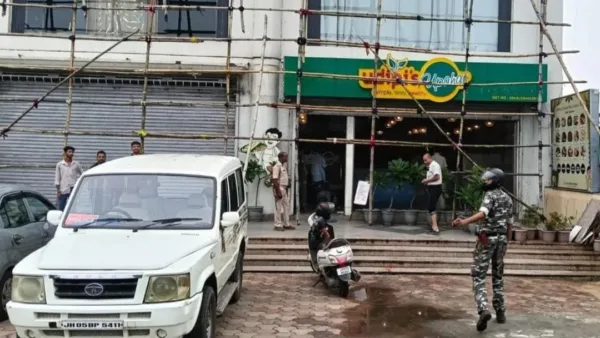
Jharkhand HC@25 | The judgment that froze Rajya Sabha poll and triggered a CBI probe
In Indian politics, institutions are often praised in calm times and questioned in turbulent ones. The Election Commission of India is…
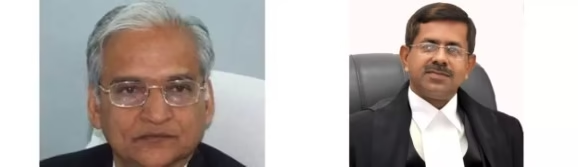
JUSTICE PRAKASH TATIA (L) AND JUSTICE APARESH KUMAR SINGH (R)
In Indian politics, institutions are often praised in calm times and questioned in turbulent ones. The Election Commission of India is no exception. Whenever elections become contentious—as they are today amid debates around SIR—the Commission finds itself accused of either doing too much or too little.
It is in moments like these that history becomes important.
One such moment arrived quietly in 2012, in Jharkhand, when the Election Commission did something few expected, and even fewer were comfortable with: it stopped a Rajya Sabha election midway and asked the President of India to cancel it altogether.
That decision, later upheld by the Jharkhand High Court, tells us something essential about what the Election Commission can do—and what it is meant to do—when democracy itself comes under strain.
An Election Nobody Trusted
The election was for two seats in the Rajya Sabha. The voters were MLAs, not ordinary citizens. That distinction matters. Rajya Sabha elections are indirect, elite, and deeply political. They are also vulnerable—less to popular emotion and more to quiet persuasion, pressure, and money.

Weeks before polling, senior national leaders warned that something was wrong. Members of Parliament such as Gurudas Dasgupta, Babulal Marandi, and Sharad Yadav wrote to the Election Commission. They spoke openly of horse-trading, of MLAs being targeted, of money flowing behind closed doors. The media echoed these fears.
This was not gossip. Jharkhand had seen it before.
On polling day, those fears turned real. A vehicle was intercepted. Inside it was ₹2.15 crore in unaccounted cash, allegedly meant to influence votes. The seizure was not accidental—it was the result of Election Commission-driven vigilance.

ALSO READ: Jharkhand HC@25: From stigma to statute, a verdict that reframed mental health rights
At that moment, the Commission faced a choice that lies at the heart of democratic power.
It could proceed mechanically: count the votes, declare the result, and let courts sort it out later.
Or it could act politically—but constitutionally—to protect the credibility of the system itself.
It chose the second path.
When the Commission Acted—and Politics Pushed Back
The Election Commission halted the counting and withheld the results. Then it went further. It recommended to the President of India that the election notification itself be rescinded so that a fresh election could be held.
The move shocked many. Candidates protested. A Congress candidate, Pradeep Kumar Balmuchu, challenged the decision. A party member filed a Public Interest Litigation claiming Jharkhand was being unfairly singled out.
The argument was simple and familiar:
Let the process finish. Deal with wrongdoing later.
This argument appears repeatedly in Indian politics. It values procedure over perception and completion over credibility.
The Jharkhand High Court refused to accept it.
A Political Judgment, Not a Technical One
The case was heard by a Division Bench of Chief Justice Prakash Chandra Tatia and Justice Aparesh Kumar Singh. Their judgment was long, but its message was unmistakable.
They did not treat the matter as a narrow legal dispute. They treated it as a crisis of democratic confidence.
The court spoke at length about the Rajya Sabha, reminding readers that it is not just another House of Parliament. It exists to balance power, protect federalism, and restrain reckless politics. When elections to such an institution are corrupted, the damage is not local—it is national.
The judges acknowledged that Parliament had already attempted to curb corruption through reforms such as the open ballot. But they stated plainly that no law can anticipate every form of political corruption.
That is where the Election Commission must step in.
Article 324: Authority When Politics Turns Ugly
Instead of hiding behind technical provisions, the court returned to the Constitution—specifically Article 324.
Drawing heavily from the Supreme Court’s landmark ruling in Mohinder Singh Gill (1978), the judges reaffirmed a principle that often makes politicians uncomfortable: the Election Commission is not meant to be helpless.
When laws are silent, slow, or insufficient—and when elections risk becoming a farce—the Commission is expected to act. Not later. Not cautiously. Immediately.
The Supreme Court had once warned that the Chief Election Commissioner must not “fold his hands and pray to God” when democracy is under threat. The Jharkhand High Court applied that warning directly to this case.
This was not about punishing one candidate.
It was about preventing a system from rewarding corruption.
ALSO READ: Jharkhand HC@25 | How bail twice changed the course of State politics
Why the Court Rejected “Let It Finish”
One of the strongest political points in the judgment was simple:
an election is not clean merely because votes were cast.
If money has polluted the environment—especially in an indirect election where even one vote can change outcomes—the result loses moral authority.
The court also dismissed the claim that candidates were entitled to a hearing before cancellation. It posed a larger question instead:
if an election is corrupted, are candidates the only affected parties—or is the public the real victim?
By choosing public trust over private grievance, the court made a political choice rooted in constitutional values.
The CBI Probe: Turning Power into Accountability
The most consequential part of the judgment came at the end.
The court did not stop at approving the cancellation. It directed the Election Commission to hand over the matter to the Central Bureau of Investigation.
This step transformed the episode. It signalled that electoral corruption is not merely a political issue but a criminal one. It acknowledged the limits of local enforcement when legislators are involved. And it ensured that the scandal would not be buried beneath fresh elections.
Sita Soren and the End of Legislative Impunity
The CBI investigation led to the Sita Soren case, forcing the Supreme Court to confront a long-avoided constitutional question:
Can legislators take bribes and still claim immunity?
According to the investigation, Sita Soren, a sitting MLA, had allegedly accepted a ₹50 lakh advance bribe to vote in a Rajya Sabha election. While such allegations had long circulated in political folklore, this time they moved beyond whispers and headlines into the criminal justice system.
Sita Soren challenged the prosecution by invoking legislative privilege, relying on a precedent that had distorted India’s democratic ethics for decades.
Breaking with a Dangerous Past
In 1998, the Supreme Court in P.V. Narasimha Rao v. State (CBI) had held, by a narrow majority, that legislators who accepted bribes but voted as promised were protected by parliamentary immunity. The ruling created a dangerous illusion—that bribery could be constitutionally shielded if linked to a legislative vote.
In 2024, the Supreme Court reopened that question.
It clarified that immunity under Articles 105(2) and 194(2) is functional, not absolute. It protects legislative speech and voting, not criminal acts committed for private gain. Accepting a bribe, the Court observed, serves no legislative purpose. It corrupts representation rather than enabling it.
The Court also held that bribery is complete upon acceptance or agreement, not upon the casting of a vote. The damage to democracy occurs the moment money enters the decision-making process.
Recognising the gravity of the issue, the Court referred the matter to a seven-judge Constitution Bench, asking whether bribery connected to a legislative vote can ever be a protected act.
Why This Chapter Matters
The Sita Soren case completes a constitutional journey that began in Jharkhand in 2012.
The Election Commission stopped a tainted election.
The High Court insisted on accountability through a CBI probe.
The Supreme Court began dismantling a doctrine that had normalised corruption behind the shield of privilege.
The message is simple but profound:
Votes are protected. Speech is protected. Bribes are not.
In an era when institutions are constantly questioned, this episode reminds us that democracy survives not because elections are completed, but because they are credible—and because some lines, once crossed, must be drawn clearly and firmly.