Jharkhand pitches balanced energy transition model at global stage
Ranchi, January 16: As Jharkhand engages with global leaders at the World Economic Forum (WEF) Annual Meeting 2026 in Davos and during…
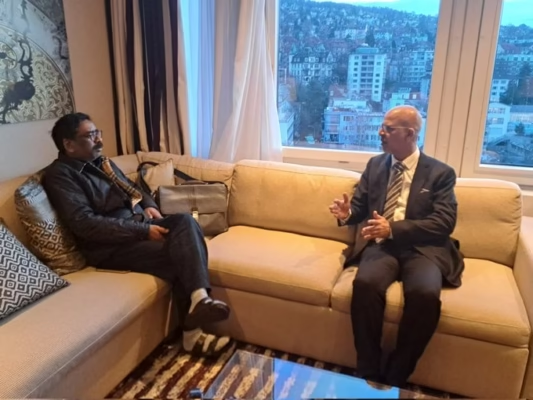
Ranchi, January 16: As Jharkhand engages with global leaders at the World Economic Forum (WEF) Annual Meeting 2026 in Davos and during an official visit to the United Kingdom, the state is presenting a pragmatic and future-ready vision for energy security and energy transition, led by Chief Minister Hemant Soren.
The state is positioning itself as a key player in the global energy transition by balancing its historic role in powering India with a responsible shift towards sustainability, clean energy and inclusive growth.
From coal heartland to clean-energy future
For decades, Jharkhand has been central to India’s energy and industrial growth. Its coal reserves, thermal power plants, transmission networks and steel hubs—such as Bokaro, Patratu and Chandrapura—have fuelled national development and infrastructure expansion.
Building on this legacy, Jharkhand is now adapting to a rapidly evolving global energy landscape. The state is pursuing a balanced transition pathway that safeguards energy security, jobs and economic stability, while steadily expanding renewable and low-carbon energy solutions.
Engagements at Davos
At Davos, Jharkhand will engage with global energy leaders, investors, technology providers and policy institutions to showcase opportunities in:
- Renewable energy deployment
- Grid modernisation and energy storage
- Clean fuels and industrial decarbonisation
- Energy efficiency and emerging technologies
The state’s strategy focuses on responsible diversification, leveraging existing energy infrastructure while accelerating investments in solar power and clean technologies.
‘Growth in Harmony with Nature’
Central to Jharkhand’s approach is its development philosophy of “Growth in Harmony with Nature.” The state emphasises a just and inclusive energy transition, recognising that communities and livelihoods have long depended on conventional energy sectors.
Key priorities include:
- Worker transition and reskilling
- Community participation
- Protecting local economies during the shift to cleaner energy
Jharkhand’s mineral wealth—critical for renewable energy systems, batteries, transmission infrastructure and clean manufacturing—also positions it as a strategic partner in the global transition. The state is aligning its energy policy with a critical minerals strategy, ensuring environmentally responsible extraction and long-term sustainability.

UK visit and Oxford address
Following Davos, Jharkhand’s UK engagements will explore collaboration in clean energy finance, technology transfer, institutional partnerships and capacity building, reflecting the shared India–UK commitment to climate action.
As part of the visit, Chief Minister Hemant Soren will address the Blavatnik School of Government, University of Oxford, on January 23, 2026, at 5 pm. He will speak on how a tribal-majority, resource-rich state can advance sustainable and green industrialisation, responsible mineral-based manufacturing, and inclusive, investment-driven development.
The discussion will also feature Alpa Shah, Professor of Social Anthropology and Fellow at All Souls College, and Maya Tudor, Professor of Politics and Public Policy at the Blavatnik School of Government.
Looking ahead
As Jharkhand marks 25 years of statehood and looks towards 2050, it is projecting a confident yet responsible energy vision—demonstrating that regions built on traditional energy strengths can lead global transitions through policy reform, industrial experience, global partnerships and ecological consciousness.
Through its engagements at Davos and in the UK, Jharkhand is presenting a credible, inclusive and globally relevant energy transition model—one that powers economic growth while respecting nature and future generations.