Kumbh, Sanatan and Modi’s cultural vision
r Rachna Kumari Prasad, Assistant Professor of Political Science at the University of Delhi, presents her latest book, Kumbh and Sanatan: Mirror…
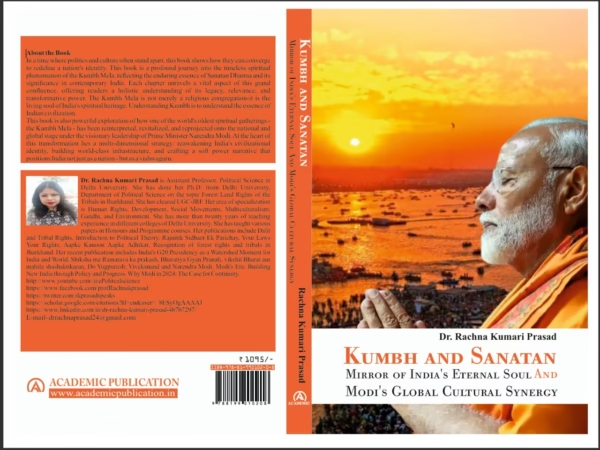

r Rachna Kumari Prasad, Assistant Professor of Political Science at the University of Delhi, presents her latest book, Kumbh and Sanatan: Mirror of India’s Eternal Soul and Modi’s Global Cultural Synergy, a comprehensive exploration of the Kumbh Mela as a civilizational, cultural, and global phenomenon.
Known for her scholarship on human rights, tribal rights, multiculturalism, Gandhian thought, and environmental politics, Dr. Prasad turns her academic lens toward one of India’s most enduring traditions. The book examines how the Kumbh Mela continues to shape Indian identity while evolving in contemporary India under changing political and global contexts.
Blending Civilizational Heritage with Modern India
With over two decades of teaching experience and a PhD on Forest Land Rights of Tribals in Jharkhand, Dr. Prasad has consistently bridged grassroots realities with broader civilizational narratives. Her earlier works on Dalit and tribal rights, political theory, and India’s G20 Presidency reflect this approach. In this book, she widens the scope by placing the Kumbh within both Sanatan heritage and India’s modern global outreach.
Six Chapters, Multiple Dimensions
The book is divided into six detailed chapters, each examining a different dimension of the Kumbh Mela:
- Chapter 1: Introduction explains the significance of the Kumbh as a symbol of India’s eternal spirit, presenting it as a convergence of faith, tradition, and transformation.
- Chapter 2: Kumbh – A Historical Legacy and Civilizational Force traces the festival’s mythological origins, including the Samudra Manthan, and its role as a space for philosophical exchange.
- Chapter 3: Sacred Confluence – The Cultural Compass for New India highlights the Kumbh’s influence on literature, music, poetry, and art, placing it within India’s pluralistic and syncretic traditions.
- Chapter 4: Kumbh Mela – A Mirror of India’s Soul portrays the festival as “India in miniature,” addressing themes such as environmental sustainability, digital-age heritage preservation, and social transformation.
- Chapter 5: Economic Footprint examines the Kumbh as a major economic driver, boosting trade, tourism, and infrastructure. The discussion on Maha Kumbh 2025 highlights new benchmarks in scale and economic impact.
- Chapter 6: Modi at the Helm situates the Kumbh within contemporary politics, arguing that Prime Minister Narendra Modi has reimagined it as a national and global cultural platform through infrastructure development, technology, and the vision of Vasudhaiva Kutumbakam.
Kumbh as Culture, Economy and Soft Power
One of the book’s major strengths is its holistic approach. The Kumbh is not presented merely as a religious gathering, but as a civilizational force encompassing spirituality, culture, economy, politics, and diplomacy. Dr. Prasad effectively connects mythology with modern governance and spirituality with global cultural diplomacy.
Her analysis of Modi’s role frames the Kumbh as a soft power instrument, reflecting both continuity of Sanatan Dharma and India’s aspirations as a global cultural leader.
Accessible Yet Scholarly
Written in an accessible style without sacrificing academic depth, the book appeals to scholars, students, and general readers alike. It offers valuable insights into how tradition and modernity coexist in New India, making it relevant for readers interested in India’s cultural diplomacy and civilizational journey.
A Timely and Insightful Work
Kumbh and Sanatan: Mirror of India’s Eternal Soul and Modi’s Global Cultural Synergy captures the Kumbh as a living tradition, reflecting India’s timeless spiritual ethos while adapting to the realities of the 21st century. The book shows that the Kumbh is not just about ritual bathing, but about identity, unity, spirituality, economic vitality, and global engagement.
For readers seeking to understand India’s cultural continuity and modern governance, this book offers an engaging and thoughtful read.

About the Author
Dr. Rachna Kumari Prasad is Assistant Professor of Political Science at Delhi University with over 20 years of teaching experience. She holds a PhD from Delhi University on Forest Land Rights of Tribals in Jharkhand and has cleared UGC-JRF. Her academic interests include human rights, tribal and Dalit studies, multiculturalism, Gandhian thought, development, and environmental politics. She has authored several books on political theory, rights, governance, and contemporary India, including works on India’s G20 Presidency and modern political leadership.
Book Link: https://www.amazon.in/dp/819923797X
X (Twitter): https://twitter.com/rkprasadspeaks
Email: drrachnaprasad24@gmail.com