Jharkhand HC says no to bail in Paharia case, flags denial of food, water in Sahibganj
Ranchi, Jan 29: In a powerful order highlighting the breakdown of law and administration, the Jharkhand High Court has refused anticipatory bail…
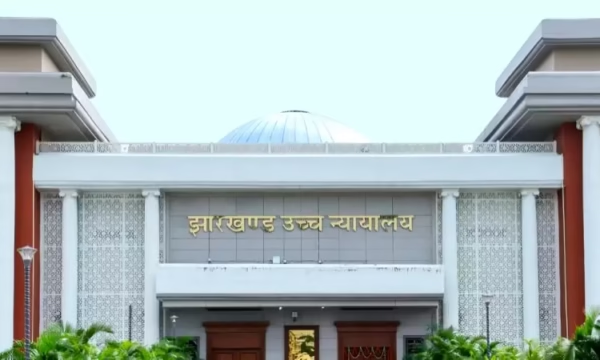
Ranchi, Jan 29: In a powerful order highlighting the breakdown of law and administration, the Jharkhand High Court has refused anticipatory bail to three accused in a case involving alleged systematic harassment and social boycott of the Paharia tribal community in Sahibganj district. The court also rejected a compromise attempt, observing that tribal families were pushed into submission due to fear, hunger and lack of state support.
The High Court refused to grant anticipatory bail to Safikul Shekh (25), Jalil Shekh (30) and Kashim Shekh (44), residents of Sirasin village in Sahibganj district, who were accused of being part of a group that allegedly enforced threats, intimidation and a social boycott against the Paharia tribal community.

The court noted that although the three were not initially named, multiple witness statements later identified their involvement, prompting the court to deny them relief.
From Holi Celebration to Social Boycott
The case arose from an incident during Holi celebrations in March last year, when members of the Paharia community in a Sahibganj village were allegedly stopped from playing music and celebrating the festival. What followed, the court noted, was far more serious than a local dispute.
According to the findings, the tribal community was allegedly subjected to collective punishment — shops were told not to sell them ration, doctors were warned against treating them, children were stopped from attending schools and Anganwadi centres, and access to government water sources was blocked. A government well was reportedly damaged to enforce compliance.
The High Court observed that these acts resulted in the denial of necessities such as food, water, healthcare and education, striking at the very foundation of the right to live with dignity.

ALSO READ: Income Tax raids at 45 locations linked to Baba Group in Jharkhand, Bihar
Witnesses Back Allegations
While some of the accused were not initially named, the court noted that multiple witnesses from different communities later identified them as part of a group that enforced the boycott through threats and intimidation. Several shopkeepers and medical workers stated that they were warned of fines if they helped the Paharia families.
The court said the evidence pointed to a situation where fear replaced law, and an entire community was pushed to the margins.

Strong Words for Police and Administration
The High Court expressed serious concern over the inaction of the police and district administration, noting that despite the gravity of the allegations and the passage of several months, no effective action had been taken.
Justice Sanjay Prasad remarked that the situation suggested the presence of a parallel power structure, where the accused acted as if they were above the law, while the tribal community remained unprotected.
Compromise Under Pressure Rejected
The court refused to accept a compromise petition, observing that the Paharia families appeared to have no real choice but to agree under coercion. The judge noted that compromise in cases involving systematic denial of constitutional rights cannot be treated as voluntary or valid.
Court Orders Immediate Safeguards
Taking a broader view of tribal welfare, the High Court directed the district administration and police to immediately ensure the safety of the Paharia community. Authorities were ordered to provide security, food grains, drinking water and other essential services, and to prevent any recurrence of such incidents.
The court also directed senior state officials to monitor the situation and ensure that tribal rights are protected not just in Sahibganj, but across the region.
A Message Beyond One Case
Legal observers say the order goes beyond a bail decision and sends a clear message that social boycotts, economic blockades and intimidation of tribal communities will not be tolerated, regardless of attempts to bury such cases through compromise.