
Jharkhand High Court throws out DVC appeal over ‘impersonation’ dismissal
Ranchi, February 20: In a significant ruling reinforcing the principles of natural justice, the Jharkhand High Court has dismissed an appeal filed…
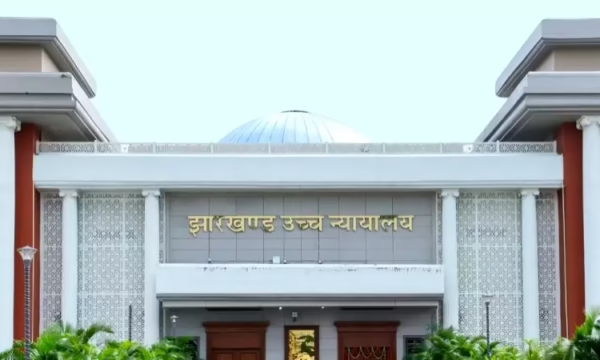
Ranchi, February 20: In a significant ruling reinforcing the principles of natural justice, the Jharkhand High Court has dismissed an appeal filed by Damodar Valley Corporation (DVC) and upheld an earlier order setting aside the removal of a long-serving employee accused of securing his job through impersonation.
A division bench comprising Chief Justice M S Sonak and Justice Rajesh Shankar held that the corporation’s failure to examine the complainant during the departmental enquiry fatally undermined the disciplinary proceedings, rendering the dismissal legally unsustainable.
Allegations Raised at Fag End of Service
The case stemmed from allegations made towards the end of the employee’s service career. After serving in DVC’s Soil Conservation Department since 1974 and being regularised in 1994, the employee was removed from service in December 2018.
The action followed a complaint claiming that he had obtained employment by impersonating his deceased elder brother. Acting on the complaint, the Disciplinary Authority ordered his removal, and the Appellate Authority affirmed the decision in June 2019.
Single Judge Quashes Removal
The employee challenged the dismissal before the High Court. In October 2024, a Single Judge quashed both the disciplinary and appellate orders, observing that the complainant — whose allegations formed the foundation of the charges — had never been examined during the enquiry.
The Court found that denying the employee the opportunity to cross-examine the complainant amounted to a serious violation of natural justice. As the employee had already retired, reinstatement was not directed; however, he was granted consequential service benefits along with 25 per cent of back wages from the date of termination until superannuation.

DVC’s Appeal and Legal Arguments
DVC challenged the ruling, arguing that judicial review under Article 226 of the Constitution is limited and that strict rules of evidence do not apply to departmental proceedings. The corporation relied on precedents of the Supreme Court of India to contend that findings based on available material should not be lightly interfered with by constitutional courts.
Division Bench Upholds Natural Justice
The Division Bench, however, rejected the appeal. It observed that while departmental enquiries are quasi-judicial and not governed by strict evidentiary standards, they must comply with fundamental principles of fairness.
Since the complainant was not produced for examination, the employee was deprived of a fair opportunity to challenge the allegations. The burden to prove impersonation lay squarely on the employer, the Court held, and that burden had not been properly discharged.

The Bench clarified that its ruling does not conclusively determine the employee’s identity. The judgment is confined to the procedural infirmities in the enquiry and should not be construed as a finding of fact on the allegation of impersonation.
With the appeal dismissed, the High Court has once again underscored that even in internal disciplinary matters, adherence to natural justice remains non-negotiable.