Jharkhand HC lawyer’s licence suspended after conviction in 14-yr-old assault case
Ranchi, April 4: The Jharkhand State Bar Council has suspended the licence of advocate Mahesh Tiwari for two years following his…

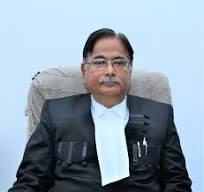
Mahesh Tiwari
Ranchi, April 4: The Jharkhand State Bar Council has suspended the licence of advocate Mahesh Tiwari for two years following his conviction in a 14-year-old case of assaulting a woman lawyer inside the Jharkhand High Court premises.
The action comes days after a Ranchi court, on March 30, convicted Tiwari in a case filed by Ritu Kumar, now President of the Jharkhand High Court Advocates’ Association.
Conviction After 14-Year Legal Battle
The case dates back to May 1, 2012, when Ritu Kumar, then a practising advocate, was allegedly assaulted by Tiwari inside the High Court premises.
According to the prosecution, Tiwari made objectionable remarks, physically assaulted her, attempted to hug her, slapped her, and pushed her to the ground. The incident occurred in the presence of other lawyers, who intervened.
After a prolonged legal battle, the court found him guilty under multiple IPC sections, including:

- Section 354 (outraging modesty) – 2 years’ imprisonment
- Section 506 (criminal intimidation) – 1 year
- Sections 323 & 504 – 6 months each
- Section 341 – 1 month
The court refused to grant probation, observing that a practising advocate is expected to maintain higher professional standards and that the act undermined the dignity of the legal profession.
ALSO READ: Jharkhand Salary Scam Spreads: Now, ₹15 cr fraud detected in Hazaribag
Court Relied on Victim’s Testimony
Judicial Magistrate Sarthak Sharma held that the victim’s testimony was credible and supported by eyewitnesses. The court rejected the defence’s claim of false implication due to professional rivalry.

It ruled that minor inconsistencies did not weaken the prosecution’s case, which was proven beyond a reasonable doubt.
Bar Council Suspends Licence
Following the conviction, the Jharkhand State Bar Council invoked Section 24-A of the Advocates Act, 1961, which deals with offences involving moral turpitude.
Based on legal provisions and Supreme Court rulings, the Council ordered that Tiwari’s licence to practice will remain suspended for two years from the date of conviction.
The Council also clarified that no prior notice was required, as suspension is a direct legal consequence of conviction.
Complaint Highlighted Conviction and Conduct
The action was triggered by a formal representation submitted by Ritu Kumar, who forwarded the conviction order and sought action.
In her complaint, she stressed that conviction under Section 354 IPC clearly amounts to moral turpitude, warranting disqualification.
She also cited past instances of alleged misconduct, including:
- A 2007 High Court incident where a judge recorded a disruption of proceedings
- A 2025 contempt case, where a bench found that Tewari used intemperate language and attempted to browbeat a judge
Though punishment in the contempt case was later remitted after an apology, the finding of guilt remained on record.
Wider Implications
The Bar Council has communicated its order to key authorities, including the Chief Justice of India, the Jharkhand High Court, and the Bar Council of India.
The case has drawn attention within legal circles as it combines criminal conviction, professional misconduct allegations, and Bar Council action, highlighting how offences involving moral turpitude can directly impact an advocate’s right to practice.
For Ritu Kumar, the conviction and subsequent suspension mark the end of a long legal struggle and a significant moment of accountability within the legal community.