CJI Surya Kant advocates ‘Swadeshi Jurisprudence’, calls for indigenous AI ecosystem in judiciary
New Delhi, June 7: Chief Justice of India (CJI) Surya Kant has underscored the need to develop a distinctly Indian, or “Swadeshi…
New Delhi, June 7: Chief Justice of India (CJI) Surya Kant has underscored the need to develop a distinctly Indian, or “Swadeshi Jurisprudence” rooted in the country’s constitutional values, institutional realities, linguistic diversity, and social conditions, rather than relying solely on imported legal and technological concepts.
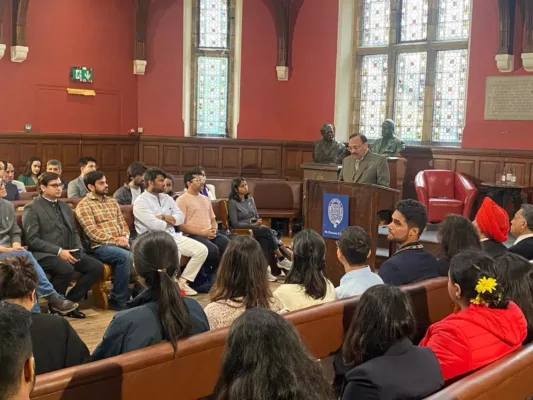
Delivering a lecture at the Oxford Union and the Oxford Law Society on the theme “Constitutional Promise to Digital Reality: Safeguarding Justice in the Age of AI and Technological Advancement,” the Chief Justice said that while courts across the world are increasingly embracing artificial intelligence (AI), India must evolve its own constitutional and jurisprudential framework suited to its unique context.
“The Supreme Court of India has consciously approached technology as an aid to human reasoning rather than as a substitute for independent judicial thought. Considerable emphasis, however, has been placed upon the development of what may be described as a distinctly Indian or ‘Swadeshi Jurisprudence’: one that remains attentive to our own constitutional values, institutional realities, linguistic diversity, and social conditions rather than relying solely upon imported technological models or assumptions,” he said.
Indigenous AI Ecosystem for Judiciary Under Development
The Chief Justice revealed that serious efforts are underway to establish an indigenous AI ecosystem for the Indian judiciary, including the development of Indian Large Language Models (LLMs) through collaboration among government agencies, academic institutions and AI experts.
“I am particularly pleased to share with you that, in addition to these ongoing technological initiatives, serious efforts are underway to explore the establishment of an indigenous AI ecosystem for the judiciary, including the development of our own Large Language Models through collaboration between governmental stakeholders, academic institutions, and leading experts in artificial intelligence,” he said.
He added that the objective is to create AI solutions tailored to India’s institutional requirements and constitutional realities.

Supreme Court Working on AI Regulatory Framework
Addressing concerns surrounding algorithmic bias, accountability and transparency, the CJI said the Supreme Court is developing a regulatory framework for AI deployment within the judicial system.
According to him, the framework will be based on key principles such as:
- Human oversight
- Constitutional compliance
- Fairness
- Transparency
- Explainability
- Accountability
- Data protection
AI systems deployed in the judiciary will also be subject to periodic monitoring and audits to identify errors, malfunctions and biases.

Judiciary Favours Responsible AI Adoption
Chief Justice Kant said the judiciary has adopted a presumption in favour of responsible AI adoption, viewing technology as a tool to improve access to justice and administrative efficiency.
“The idea is not to treat technology with undue apprehension, but to encourage courts across the country to actively identify opportunities where AI systems and tools can be deployed in a manner that improves access to justice, reduces delay, and enhances administrative efficiency,” he said.
Global Judicial Dialogue Must Preserve Constitutional Identity
Referring to AI-assisted judicial initiatives in countries including France, Argentina, Brazil, Singapore and the United Arab Emirates, the Chief Justice noted that courts worldwide are increasingly using AI for case management, legal research, document preparation and courtroom transcription.
However, he cautioned against equating global interconnectedness with uniformity.
“Despite the inherent similarities exhibited by various jurisdictions in embracing AI, we must be cautious not to mistake structural interconnectedness for algorithmic uniformity,” he said.
He emphasised that transnational judicial dialogue should facilitate the exchange of ideas while preserving each nation’s constitutional identity.
“The true objective of transnational judicial dialogue is not to flatten cultural nuances, nor is it to assemble a single, homogenised legal monoculture that ignores local history,” he observed.
Digital Reforms Have Expanded Access to Justice
The Chief Justice also highlighted India’s digital transformation in the justice sector, noting that reforms accelerated during the Covid-19 pandemic and have since become a permanent feature of the judicial system.
He said virtual hearings have significantly expanded access to justice by removing geographical barriers that previously limited participation in proceedings before constitutional courts.
Linking these developments to constitutional guarantees, he said:
“First, under Article 14, which commands Equality Before the Law, the institutionalisation of virtual hearings has become a powerful equaliser. Second, our understanding of Article 19, the guarantor of Free Expression, has expanded to encompass the right to witness justice in real time. Most significantly, Article 21 of the Constitution, which guarantees the Right to Life and Personal Liberty, has over the years been interpreted to include a meaningful right of access to justice.”
Key Technology Initiatives Highlighted
The Chief Justice highlighted several major technology-driven reforms introduced by the judiciary, including:
- e-Courts Project
- National Judicial Data Grid (NJDG)
- One Case One Data initiative, aimed at integrating case management systems and eliminating duplication of judicial records
Technology Must Serve Constitutional Values
Concluding his address, Chief Justice Kant stressed that technological advancement must remain aligned with constitutional principles.
“We must build a future where algorithms are guided by the light of equity, and where the digital reality we construct remains entirely faithful to the constitutional promise we inherited,” he said.