Supreme Court questions Patna HC’s ‘rarest of rare’ view in Anand Mohan remission case
THE JHARKHAND STORY NETWORK New Delhi, July 16: The Supreme Court on Thursday expressed serious concern over the Patna High Court’s observation…
THE JHARKHAND STORY NETWORK
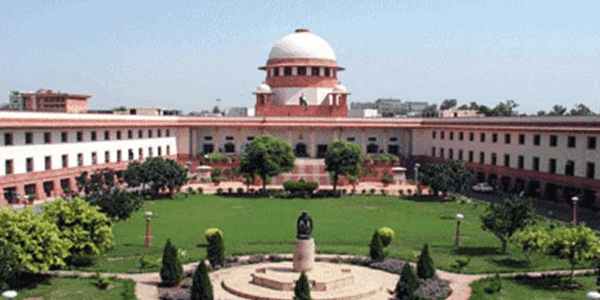
New Delhi, July 16: The Supreme Court on Thursday expressed serious concern over the Patna High Court’s observation that the murder of a public servant on duty did not fall within the “rarest of rare” category, saying such a view could embolden criminals and weaken the protection available to government officials performing their duties.
A Bench of Justice Dipankar Datta and Justice Sheel Nagu made the oral observations while hearing a petition challenging the Bihar government’s decision to grant premature release to former MP Anand Mohan, who was convicted in the 1994 mob lynching of then Gopalganj District Magistrate G. Krishnaiah. The court reserved its judgment after hearing the parties.
‘If this isn’t rarest of rare, then what is?’
During the hearing, the Bench questioned the reasoning adopted by the Patna High Court while commuting Anand Mohan’s death sentence to life imprisonment.
Justice Datta observed that describing the murder of a public servant on duty as not falling within the “rarest of rare” category could send a dangerous message.
“If shooting a public servant on duty at point-blank range is not ‘rarest of rare’, then what is?” the Bench remarked, adding that such observations could encourage criminals to believe they could escape with lesser punishment for attacking government officials.

The court also observed that the Bihar government should have challenged the High Court’s reasoning, although the State informed the Bench that the order had subsequently been upheld by the Supreme Court.
Questions over remission process
The Bench also examined whether Anand Mohan satisfied the conditions for premature release under Bihar’s remission policy.
Senior Advocate Ranjit Kumar, appearing for the Bihar government, submitted that the former MP was granted remission after completing the required period of imprisonment.

However, the Bench pointed to records indicating that when Mohan first applied for remission, he had completed 14 years of actual imprisonment but had not fulfilled the separate requirement of completing 20 years, including earned remission. The judges questioned whether his application could have been entertained at that stage.
Court flags concealment of pending criminal cases
Another major issue before the court was the alleged non-disclosure of pending criminal cases against Anand Mohan while his remission application was being processed.
The Bench noted that prison authorities had informed the Remission Board that no criminal cases were pending against him, although records indicated otherwise.
Justice Datta observed that the Remission Board might have taken a different decision had it been informed about the pending cases.
The Bihar government acknowledged that the jail authorities had failed to disclose the cases but urged the court to remit the matter back to the Remission Board for reconsideration instead of taking coercive action, citing Mohan’s age and the passage of time since his release.
Bench questions ‘rosy picture’ of conduct
The Supreme Court also criticised reports submitted by probation and prison authorities, observing that they painted an unduly favourable picture of Anand Mohan’s conduct without mentioning pending criminal proceedings.
Justice Sheel Nagu questioned why the Remission Board had not been informed about the pending FIRs, while Justice Datta remarked that the Board appeared to have been misled by incomplete information.
The Bench also expressed disapproval of arguments highlighting Mohan’s family background and the fact that he had authored a book while in prison, stating that such considerations could not outweigh the gravity of the offence.
Challenge to Bihar’s remission policy
The petition has been filed by Uma Krishnaiah, widow of slain IAS officer G. Krishnaiah, challenging both Bihar’s amendment to its remission policy and Anand Mohan’s premature release.
She has argued that the Bihar government amended its prison rules in 2023 by removing the bar on granting remission to convicts found guilty of murdering public servants on duty, thereby facilitating Mohan’s release.
The petition contends that the decision ignored relevant considerations, including prison conduct and criminal antecedents, and was contrary to public policy because it could demoralise public servants discharging official duties.
With the hearing now concluded, the Supreme Court has reserved its verdict on the legality of Anand Mohan’s premature release and the validity of the remission granted by the Bihar government.