Supreme Court quashes student protest FIRs nationwide, bars fresh cases
THE JHARKHAND STORY NETWORK New Delhi, September 1: The Supreme Court on Tuesday ordered that FIRs registered across the country in connection…
THE JHARKHAND STORY NETWORK
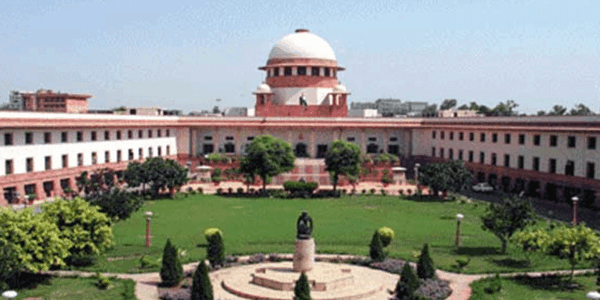
New Delhi, September 1: The Supreme Court on Tuesday ordered that FIRs registered across the country in connection with student protests held between July 20 and 25 should not be pursued or investigated and would stand closed, granting major relief to students who participated in the demonstrations.

The three-judge Bench headed by Chief Justice of India Surya Kant and comprising Justice Joymalya Bagchi and Justice V. Mohana invoked the Court’s special powers under Article 142 of the Constitution to pass the directions. The Court, however, permitted Delhi Police to proceed with a separate FIR against 2,873 individuals identified as having serious criminal antecedents.
Order extended across all states and UTs
Although applications seeking quashing of FIRs were filed by the Centre through Delhi Police and the governments of Bihar, West Bengal, Maharashtra and Assam, the Supreme Court extended the benefit of its order across the country.
The Court also directed that no fresh FIR should be registered by any State or Union Territory in connection with incidents arising out of the student protests between July 20 and 25.
The Bench made it clear that its directions were based on the peculiar facts and circumstances of the case and would not be treated as a precedent.

The Court said the order was being passed keeping in mind the future of students who had participated in the protests bona fide.
2,873 protesters kept outside blanket relief
The relief, however, does not cover all those involved in the protests.
The Court allowed Delhi Police to pursue a separate case against 2,873 persons who were present at the Jantar Mantar protests and were identified as having serious criminal antecedents.

Delhi Police had earlier informed the Supreme Court that it did not wish to pursue 13 FIRs registered in connection with the July protests but wanted permission to register one focused FIR against those with serious criminal backgrounds.
The proposed investigation is intended to determine the individual roles, if any, of those persons in offences connected with violence and damage to property during the protests.
Centre cites July 25 assurance
Solicitor General Tushar Mehta told the Bench that the applications were filed in pursuance of assurances given by the Central Government on July 25 that cases registered against protesters would be withdrawn and that no fresh FIRs would be registered over the same protest incidents.
The Centre’s move came ahead of a proposed September 5 protest march in Delhi announced by the Cockroach Janata Party (CJP), which had been demanding implementation of the assurances.
Following Tuesday’s order, CJP spokesperson Saurav Das informed the Court that the organisation had decided to withdraw the September 5 protest march.
States had sought quashing of 116 FIRs
The States of Bihar, West Bengal, Maharashtra and Assam had approached the Supreme Court seeking quashing of 116 FIRs related to the July student protests.
The applications referred to the Centre’s July 25 commitment that cases against protesters would be withdrawn if the agitation was called off. The Centre had separately sought quashing of Delhi Police FIRs while requesting permission to pursue the limited case against persons with serious criminal antecedents.
Compensation for families of students
The Bench also recorded the Solicitor General’s statement that the Centre would formulate, within three months, a policy for compensation to families of students who died by suicide following the cancellation of the NEET-UG 2026 examination.
The commitment formed part of the broader assurances given by the government during the negotiations with the protest organisers.
The Court’s order thus addresses both major issues that had remained at the centre of the dispute—criminal cases arising from the protests and the government’s proposed compensation framework.
September 5 protest withdrawn
CJP spokesperson Saurav Das told the Bench that the September 5 march would be withdrawn in view of the government’s assurances and the Supreme Court’s order.
The withdrawal marks a significant development following weeks of confrontation over the FIRs and the handling of the student protests.
The Supreme Court had, during an earlier hearing, indicated that it was considering invoking Article 142 to bring an end to the FIR-related complications. The Court had been told that ordinary closure of criminal cases could involve filing closure reports before magistrates, who have the discretion to accept or reject them.
Tuesday’s order effectively resolves that procedural difficulty by exercising the Supreme Court’s extraordinary constitutional powers.