NIT Jamshedpur seminar highlights values, responsibility in women’s education
PINAKI MAJUMDAR Jamshedpur, September 10: A two-day national seminar on “Women’s Education and Sanskar: Tradition, Transformation and Future Perspective” concluded at the…
PINAKI MAJUMDAR
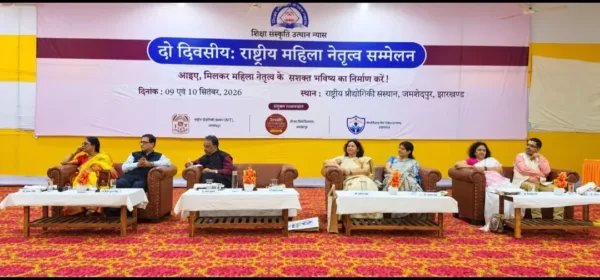
Jamshedpur, September 10: A two-day national seminar on “Women’s Education and Sanskar: Tradition, Transformation and Future Perspective” concluded at the National Institute of Technology (NIT) Jamshedpur on Thursday, with experts and academicians stressing the need to connect women’s education with Indian perspectives, values, wisdom, social responsibility and nation-building.
Organised on September 9 and 10, the seminar brought together scholars and experts to deliberate on the historical, social, cultural and contemporary dimensions of women’s education, as well as the challenges confronting women in a rapidly changing society.
Experts discuss Indian perspective on women’s education
The third session on the second day focused on “Women’s Education: Historical, Social Perspective and the Indian Perspective of Curriculum”.
Conducted by Dr Ekadashi Ji of Maharashtra, the session featured Prof. Savita Roy, Principal, Daulat Ram College, New Delhi, as the keynote speaker. She spoke on the historical and social evolution of women’s education and stressed the need to view curriculum from an Indian perspective.
Prof. Neelambari, Patron, Women’s Wing, Shiksha Sanskriti Utthan Nyas and former Vice-Chancellor of Saurashtra University, Rajkot, delivered the presidential address, while Dr Lalita Rana, Subject Coordinator, Jharkhand Province, Shiksha Sanskriti Utthan Nyas, proposed the vote of thanks.
Contemporary challenges facing women discussed
The fourth session, conducted by Momi Saikia of Guwahati, centred on “Contemporary Challenges and Solutions”.
International boxer and DPS Jamshedpur representative Arunima Mishra was the keynote speaker. She highlighted the challenges faced by women and emphasised the importance of self-confidence, resilience and balance.
Purnima Sahu, MLA, Jamshedpur East, delivered the presidential address, while Monika Abha of Amarkantak proposed the vote of thanks.
The valedictory session was conducted by Kavita Parmar, with Prof. Neelambari delivering the welcome address.
Prof. Saroj Sharma, Vice-Chancellor, Ranchi University, was the Guest of Honour, while Shivpoojan Pathak, Information Commissioner, Jharkhand State Information Commission, attended as the chief guest.
Women central to social and national development
Addressing the gathering, Pathak described women as central to the family, society and nation and underlined the significance of Matrishakti and Matribhakti.
He said that, from an Indian perspective, women were not merely the foundation of the family but also a powerful force in social and national development.
Pathak highlighted women’s contributions to social movements and various chapters of Indian history, asserting that the comprehensive development of society and the nation was not possible without women’s empowerment and participation.
Education should go beyond degrees and employment
In her presidential address, Prof. Savita Sengar, National Joint Secretary, Shiksha Sanskriti Utthan Nyas and Vice-Chancellor, Jharkhand State University, Ranchi, raised the fundamental question of what society seeks to achieve through women’s education.
She said education should not be confined to degrees and employment but should be connected with the broader dimensions of life.
Prof. Sengar stressed the distinction between freedom and unrestrained behaviour, observing that sanskar should not be viewed as a restriction but as an understanding of the consequences of one’s decisions and the responsibility that follows.
She emphasised the need to strike a balance between tradition and transformation while promoting knowledge, wisdom, equality and responsibility.
Referring to the challenges of the digital age, Prof. Sengar said the key issue today was not the availability of information but the ability to distinguish truth from falsehood and make informed choices.
NIT Jamshedpur director stresses values-based education
NIT Jamshedpur Director Prof. Gautam Sutradhar said women’s education was about much more than imparting knowledge and skills.
“Women’s education is not merely a means of imparting knowledge and skills; it is a powerful foundation for developing values, value-consciousness and social awareness. Women’s education rooted in the Indian perspective, with a harmonious balance between tradition and modernity, can lay a strong foundation for an empowered society and a developed nation,” he said.
He added that national-level deliberations of this nature could provide important guidance for redefining the broader objectives of education and making women’s education more effective in promoting social transformation and nation-building.