
Gandhi’s philosophy of non-violence offers a roadmap to global peace
DR RACHNA K PRASAD Despite unprecedented technological progress and scientific advancement, contemporary civilisation remains deeply enticed by the cult of violence…
DR RACHNA K PRASAD

Despite unprecedented technological progress and scientific advancement, contemporary civilisation remains deeply enticed by the cult of violence and armed conflict. Since 1945, more than 20 million people have perished in approximately 150 wars across the globe. Rather than investing in fundamental human needs like education, healthcare, and housing, global priorities lean heavily toward military preparedness: developed nations spend roughly twenty times more on military expenditures than on economic aid. Furthermore, a staggering 70 per cent of total global military spending is controlled by just six major military powers, while industrialised and developing nations account for 15 per cent each.
In this landscape of systemic insecurity, Mahatma Gandhi is often remembered merely as a saintly idealist or a distant historical icon. Yet, a rigorous examination of his work reveals a radical political strategist whose principles directly dismantle modern assumptions about power, security, and statecraft. Gandhi understood that true peace cannot be secured through military deterrence or imperial balance of power, both of which rely on coercion and fear.
Instead of advocating for passive submission to injustice, Gandhi engineered a sophisticated, battle-tested framework for actively transforming human conflict. As the 21st century confronts escalating globalised disputes, economic disparities, and existential nuclear threats, his counter-intuitive strategy offers a practical roadmap for building lasting global security.
Non-Violence Is Not Passivity—It Is a Dynamic Weapon of Power
Non-violence (Ahimsa) is frequently misunderstood as submissive, passive, or merely a state of harmlessness. In reality, Gandhian non-violence is an active, dynamic force designed to disrupt oppressive structures by mobilising soul force against brute force. Far from being a retreat from political reality, it is a deliberate, proactive technology for waging struggle effectively without resorting to physical force. As political scholar Professor Gene Sharp observed, non-violent action represents “the politics of ordinary people”—a systematic method for mass populations to achieve social and political change.

“Nonviolent action is a technique by which people who reject passivity and submission, and who see struggle as essential, can wage their conflict without violence. Nonviolent action is not an attempt to avoid or ignore conflict. It is one response to the problem of how to act effectively in politics, especially how to wield power effectively.” — Professor Gene Sharp
The strategic foundation of non-violent resistance rests on a profound insight: a ruler’s power is never absolute; it relies entirely on the consent and active cooperation of the governed. By systematically withdrawing that consent, non-violent action directly undermines the institutional foundations of oppressive power. Gandhi organised non-violent resistance into three interconnected forms of action. The first, Protest and Persuasion, involved public and symbolic activities such as marches, rallies, picketing, and vigils that sought to express opposition and awaken the moral conscience of society. The second,
Non-Cooperation, focused on the deliberate withdrawal of support from political, economic, and social institutions that sustained injustice or exploitation. The third, Non-Violent Intervention, went beyond protest by actively disrupting the status quo through methods such as civil disobedience, occupations, and blockades. Together, these approaches formed a comprehensive strategy for achieving political and social change without the use of violence.
True peace, in the Gandhian framework, is never the static acceptance of an unjust status quo. It is an energetic, creative process that replaces institutional coercion with active justice.

“Hate the Sin, Not the Sinner”—Lifting Love into a Mass Political Force
At the core of Gandhi’s philosophy is the conviction that every human being possesses a divine spark and shares a common origin and destiny. Because human nature is fundamentally divine, no person is beyond moral reform or spiritual transformation. Based on this premise, Gandhi elevated personal ethics into a collective political strategy designed to resist evil without attempting to destroy the human adversary.
This strategy hinges on a strict conceptual separation: “hate the sin, but not the sinner.” Resisting an evil policy or system does not require hating or liquidating the individual carrying it out. To destroy an opponent through physical brute force denies the universal human capacity for moral perfection and spiritual growth. By directing resistance exclusively at the unjust act rather than the human perpetrator, non-violent action converts conflict from a destructive clash of egos into a transformative moral dialogue.
“Gandhi was probably the first person in history to lift the love ethic of Jesus above mere interaction between individuals to a powerful and effective social force…” — Martin Luther King Jr.
This methodology transcended the Indian subcontinent. Martin Luther King Jr. explicitly adapted Gandhi’s approach during the Civil Rights Movement in the United States. Through historic campaigns such as the Montgomery Bus Boycott (1955), the Albany Movement (1961), the Birmingham Campaign (1963), and the March on Washington (1963), non-violent resistance proved its capacity to dismantle deeply entrenched racial injustice while preserving the possibility of ultimate social reconciliation.
You Cannot Feed a Hungry Man with Doctrine—Peace Demands Economic Justice
Gandhi explicitly rejected the idea that peace is merely the absence of active warfare. A society marked by poverty, structural inequality, and economic exploitation is inherently violent. For Gandhi, economic equality served as the “master-key” to constructing a sustainable, non-violent world order.
“Peace must have its roots in fraternity rather than in fear… a hungry man cannot be fed with doctrine.”
Drawing creative inspiration from John Ruskin’s Unto This Last, Gandhi recognised that the true wealth of a society lies in human companionship and mutual well-being, rather than the selfish accumulation of material goods. He issued a stark warning against unchecked consumerism and “growth phobia”—a blind obsession with industrial expansion that pollutes nature, alienates human beings, and forces nations into violent competition for limited global resources. Gandhi offered a human-centred economic alternative to modern civilisation, which he believed encouraged conflict through excessive materialism and capital-intensive development. He advocated labour-intensive development that emphasised full employment, local self-reliance, and meaningful work rather than excessive dependence on automation. He also stressed self-restraint over greed, encouraging individuals and societies to distinguish genuine needs from limitless consumer desires. At the same time, Gandhi promoted human-centred progress, where economic growth was balanced with ethical values, ecological sustainability, and human dignity. By addressing the economic roots of inequality and exploitation, Gandhi argued that lasting peace and global security depend not only on political solutions but also on creating a just and humane economic order.
Non-Violence Is Uncompromising in Thought, but Pragmatic in Action
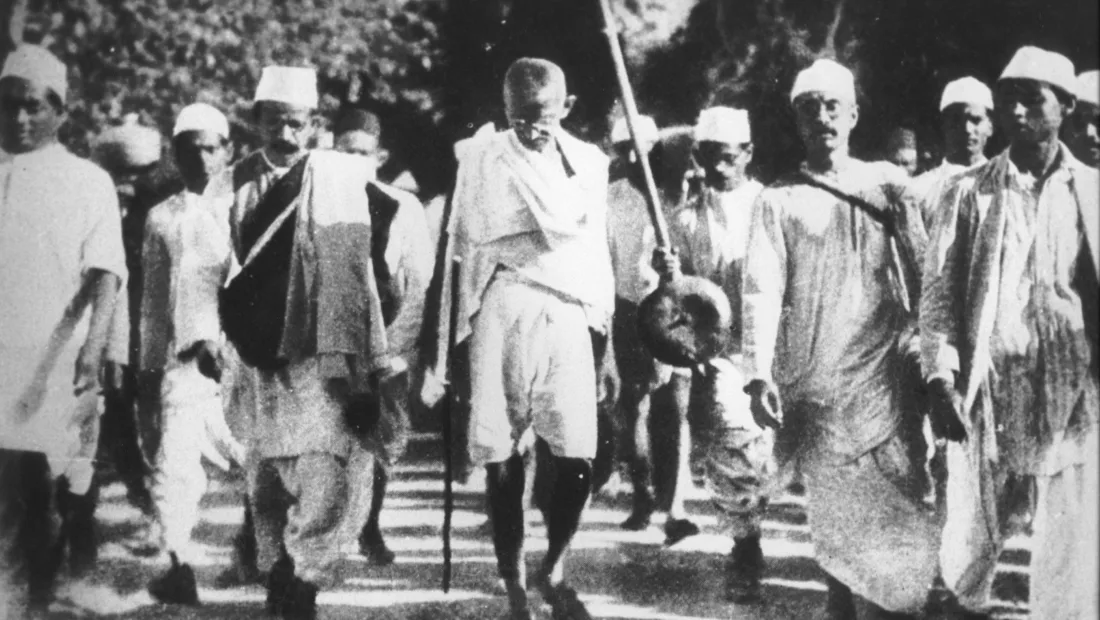
A persistent criticism of Gandhian philosophy is that its absolute moral standards make it unworkable in the messy realm of real-world politics. In practice, Gandhi combined unwavering moral principles with remarkable strategic flexibility. He remained uncompromising in his commitment to Truth (Satya), Non-violence (Ahimsa), and ethical integrity, refusing to sacrifice these values for political advantage. At the same time, he demonstrated great pragmatism in action, using negotiation, mediation, and compromise whenever they did not undermine fundamental moral principles. This balance between moral conviction and tactical adaptability was evident in a series of major Satyagraha movements. From the agrarian struggles of Champaran and Kheda (1917-1918) to the Nagpur Flag Satyagraha, Borsad Satyagraha, Vaikom movement against untouchability, Bardoli Peasants’ Struggle, and Rajkot Satyagraha, Gandhi and his associates employed non-violent resistance to challenge injustice. The most iconic example was the Dandi Salt March (1930), where Gandhi transformed opposition to the British salt monopoly into a nationwide movement for freedom. Together, these campaigns demonstrated how principled non-violence, combined with strategic innovation, could become a powerful instrument for political and social change.
True Peace Is “Positive Peace,” Not Merely the Absence of War
In traditional international relations, peace is frequently defined in negative terms: the temporary absence of external military conflict, or a fragile truce maintained through armaments, mutual deterrence, and a balance of power. Gandhi dismissed this reliance on peace through fear, arguing that an order built on weapons and coercive threats is merely a state of suspended hostility.
Instead, Gandhi advocated for “Positive Peace”—a state of genuine peace through fraternity rooted in the ancient Vedic vision of Vasudhaiv Kutumbakam (the concept that the entire world is one family). Gandhi viewed human existence as an indivisible whole, emphasizing that social, economic, political, and spiritual life cannot be segmented into watertight compartments.
“Non-violence is the greatest force at the disposal of mankind. It is mightier than the mightiest weapon of destruction devised by the ingenuity of man.” — Mahatma Gandhi
Because war originates in the human mind, lasting security requires internal moral transformation alongside equitable social institutions. This perspective explains Gandhi’s deep scepticism toward international bodies like the League of Nations and the United Nations when they relied on state coercion and military power.
As a constructive alternative, Gandhi envisioned a World Federation of free, independent nations operating on principles of non-violent arbitration and cooperation. To handle international friction, he proposed an international non-violent service force—an unarmed body trained in non-violent methods that would resolve interstate conflicts through persuasion, mediation, and soul force rather than military aggression.
In an era defined by globalised conflicts, resource competition, and the constant shadow of nuclear weapons, humanity confronts the ultimate choice articulated by Gandhian philosophy: we must learn to live together through moral transformation and non-violent cooperation, or face collective destruction. Gandhi’s legacy proves that non-violence is neither a passive ideal nor a naive retreat from reality; it is a dynamic political instrument capable of dismantling systemic injustice, rebuilding economic fraternity, and fostering genuine positive peace. By grounding global security in human dignity and non-exploitative institutions, Gandhian thought provides an enduring roadmap for navigating the existential challenges of the modern world.
(Dr Rachna K Prasad, is Asst Professor Political science Delhi University. She can be contacted at drrachnaprasad24@gmail.com)