Sona Devi University concludes Hindi pakhwada, calls for Hindi-technology integration for global reach
THE JHARKHAND STORY NETWORK Jamshedpur, October 5: Hindi must be integrated with modern technology, education, research, science and innovation to establish it…
THE JHARKHAND STORY NETWORK
Jamshedpur, October 5: Hindi must be integrated with modern technology, education, research, science and innovation to establish it as a contemporary language of knowledge creation and give it a wider global reach, speakers said at the concluding ceremony of Hindi Pakhwada-2026 organised at Ghatshila-based Sona Devi University.
Vice-Chancellor Prof. Braj Mohan Pat Pingua, addressing the programme, described Hindi as a powerful language of knowledge, culture, sensitivity and communication.
He said the development of Hindi was not merely a linguistic exercise but also an important step towards strengthening India’s rich knowledge tradition and cultural consciousness.
Calling for greater use of Hindi among students and teachers, he stressed the need to connect the language with modern technology, education, research and innovation.
Hindi, he said, would become more effective globally only when it kept pace with technological advancement and the emerging knowledge-based world.
Hindi as a link between culture and national consciousness
University Chancellor Prabhakar Singh, who presided over the programme, described Hindi as an important link between Indian culture and national consciousness.
He said Hindi played a significant role in strengthening India’s unity by facilitating communication and social interaction among diverse communities.
Singh emphasised the need to preserve Hindi’s rich cultural heritage while adapting it to the requirements of younger generations, modern technology and innovation.

Recalling litterateur Vibhutibhushan Upadhyay, he said the real preservation of any language was possible not merely by respecting it but through its continuous and widespread use.
He urged students and members of the university community to use Hindi with pride and confidence and give the language new dimensions by integrating it with modernity and innovation.
Hindi has opportunities in digital age
The keynote address was delivered by Prof Jung Bahadur Pandey, former head of the Hindi Department at Ranchi University, on the theme “Hindi is the Gateway to the World.”
He highlighted Hindi’s rich literary tradition, widespread acceptance, vast vocabulary and growing global presence.
Prof Pandey said Hindi was not merely a medium of communication but also a carrier of knowledge, culture, sensitivity, thought and the Indian worldview.
Referring to the works of prominent Hindi writers, including Nirala, he underlined the social and cultural significance of Hindi literature.
He said the present era offered immense opportunities for Hindi and called upon the younger generation to connect the language with digital platforms, modern technology, research, science, artificial intelligence and knowledge creation.
Continuous efforts, he said, were required to establish Hindi as a language of modern knowledge and innovation.
Hindi’s changing role in communication
Sonam Gupta, a Doordarshan announcer from Ranchi, spoke about the changing role of Hindi in electronic and modern communication media.
She said digital platforms had opened new avenues for the expansion of Hindi and enabled the language to reach people across different parts of the world.
She observed that Hindi was no longer confined to books and traditional forms of communication and stressed the importance of preserving the warmth of human interaction while embracing the possibilities offered by modern communication technologies.
Former Indian Oil manager Pramod Ranjan Pandey emphasised the practical and official use of Hindi.
He said people should continue using Hindi in their everyday communication and professional lives irrespective of where they lived.
Promoting Hindi in technical and business environments, he added, could make communication simpler and more accessible while reinforcing cultural and linguistic identity.
Emphasis on correct use of Hindi
Naresh Kumar, Principal of ABM College, Jamshedpur, urged students to pay particular attention to correct grammar and writing.
He said effective communication became stronger through the accurate and proper use of language and encouraged students to read, write and express themselves effectively in Hindi.
Literary and cultural performances
The concluding ceremony also featured a series of literary and cultural performances.
Lata Mankar, Principal of SSA Academy, Jamshedpur, presented Saraswati Vandana followed by poetry recitation.
Ravikant Shubham, secretary of Ojas, Chatra, presented patriotic poetry and remembered revolutionary freedom fighter Khudiram Bose and other heroes of the freedom struggle. His performance evoked a strong sense of patriotism among the audience.
Poonam Singh Vatsala presented songs, romantic compositions and ghazals carrying messages of love, harmony, sensitivity and social cohesion. Her performance was warmly received by the audience.
Janab Sahib Nambajdi used poetry to highlight the sensitivity, beauty and expansiveness of Hindi and called for greater respect and wider use of the language.
Participants felicitated
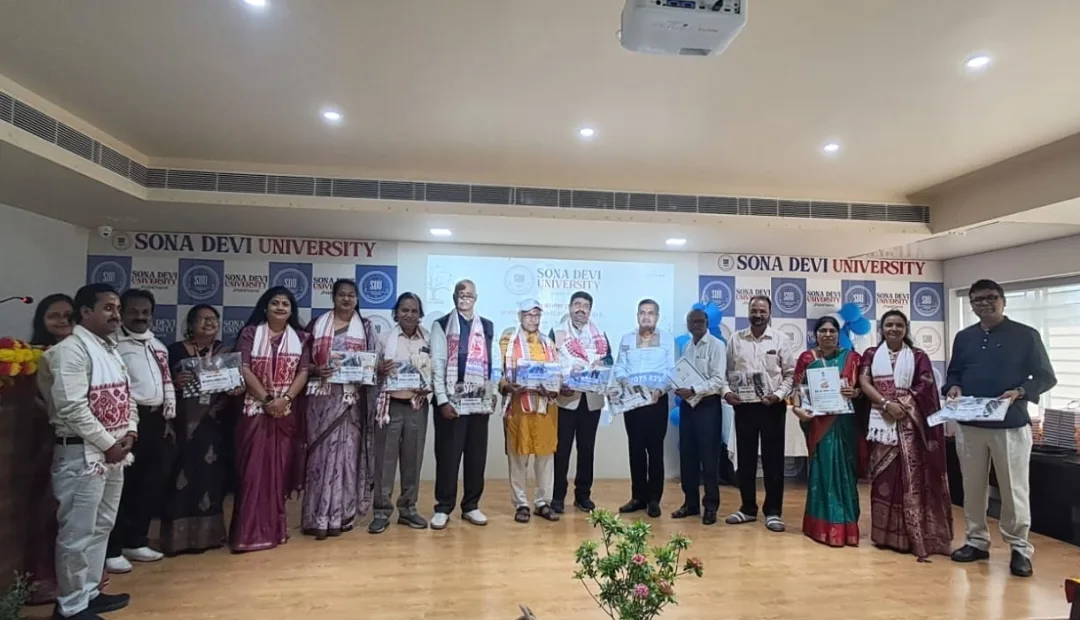
The concluding ceremony also saw the felicitation of participants who excelled in various competitions organised during Hindi Pakhwada-2026.
Students, teachers and employees of the university participated in literary, academic, linguistic and creative competitions.
Outstanding performers were presented with certificates and encouraged to remain actively involved in Hindi-related activities.
The programme concluded with a renewed commitment to promote the meaningful and practical use of Hindi in every sphere of life.
Kanchan Sinha, head of the History Department, proposed the vote of thanks and expressed gratitude to the chief guest, chairperson, distinguished guests, university officials, heads of departments, teachers, employees and students for their participation and support in making Hindi Pakhwada-2026 a success.