AIOS mid-term meet: Experts spotlight AI, robotic surgery and new frontiers in eye care
THE JHARKHAND STORY NETWORK Ranchi, September 26: Modern eye surgery, artificial intelligence, advanced diagnostics and preventive eye care dominated the second day…
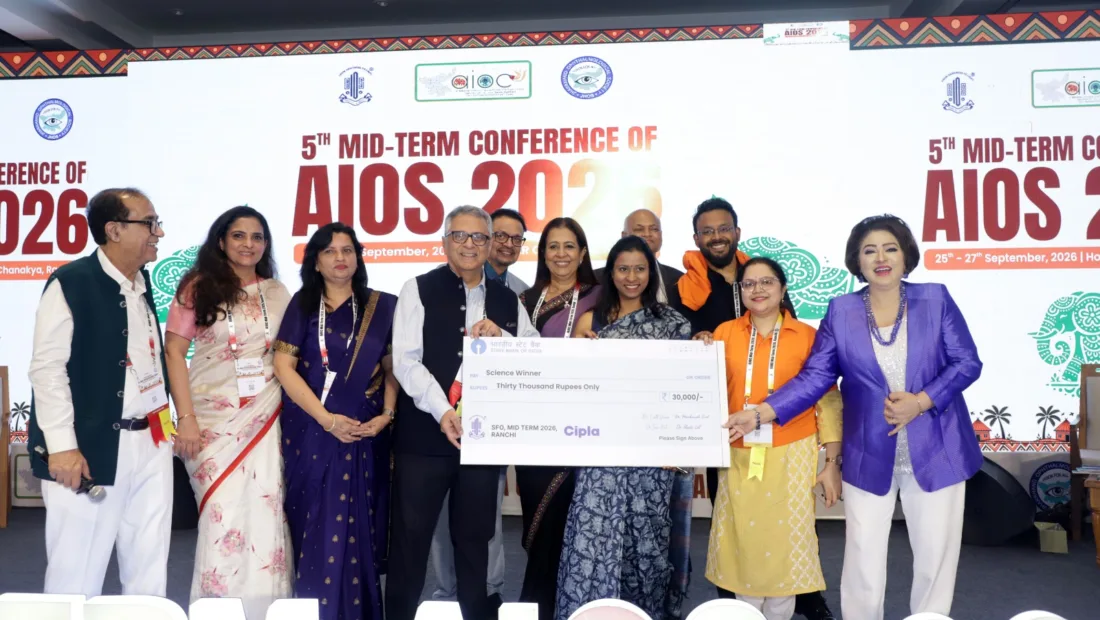
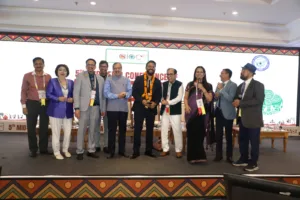
The winning Jharkhand team poses with the judges’ panel after emerging victorious in the Science & Fun Session at the AIOS Mid-Term Conference 2026 in Ranchi.
THE JHARKHAND STORY NETWORK
Ranchi, September 26: Modern eye surgery, artificial intelligence, advanced diagnostics and preventive eye care dominated the second day of the 5th AIOS Mid-Term Conference 2026 at Hotel Chanakya BNR, Ranchi, where leading ophthalmologists discussed emerging technologies and treatment approaches for complex eye disorders.

Organised jointly by the All India Ophthalmological Society (AIOS) and the Jharkhand Ophthalmological Society (JHOS), the three-day conference has brought together leading eye specialists from across the country. The scientific sessions focused on cataract surgery, retinal disorders, glaucoma, paediatric ophthalmology, myopia, artificial intelligence and surgical skill development.
AIOS President Prof. (Dr.) J. S. Titiyal, Honorary Secretary General Dr. Santosh G. Honavar, Scientific Committee Chairperson Prof. (Dr.) Namrata Sharma, Organising Chairman Dr. B. P. Kashyap and Organising Secretary Dr. Bharti Kashyap emphasised the need for continuous innovation, research and skill development in ophthalmology.
Cataract surgery: Technology assists, surgeon remains central
Speaking about cataract treatment, Dr. Chitra Ramamurthy, Vice-President of AIOS, said patients should not ignore changes in vision and should undergo timely eye examinations.
She said cataract may not always manifest only as blurred vision. Glare while driving at night, difficulty in bright light and reduced ability to distinguish colours and objects can also be warning signs.
Dr. Ramamurthy said cataract surgery is generally considered when declining vision begins to interfere with reading, work, driving, mobility or other routine activities and affects quality of life.
Discussing modern cataract surgery, she said phacoemulsification and femtosecond-laser-assisted procedures can help surgeons remove the cloudy natural lens and replace it with an intraocular lens. However, the decision-making, surgical control and ultimate responsibility remain with the surgeon, even when advanced technology is used.
She also discussed monofocal, multifocal, trifocal, EDOF and toric lenses, which can be selected according to individual patient requirements.

Dr. Ramamurthy clarified that cataract itself generally does not return after surgery. However, some patients can develop posterior capsule opacification (PCO), commonly called a secondary cataract, which can be treated with a YAG laser procedure.
White reflex in child’s eye can signal retinoblastoma
AIOS Honorary Secretary General Dr. Santosh G. Honavar highlighted the importance of recognising early signs of retinoblastoma, a potentially life-threatening eye cancer affecting children.
He said a white reflex in a child’s pupil, particularly noticed in photographs or ordinary light, should not automatically be dismissed as a camera-flash effect.
According to Dr. Honavar, retinoblastoma commonly affects children below five years of age and may involve one or both eyes. He said advances in treatment mean that removal of the eye is not automatically necessary in every case.
Depending on the location and extent of the tumour, treatment options can include chemotherapy, intra-arterial chemotherapy, intravitreal injections, laser therapy, cryotherapy, thermotherapy and plaque brachytherapy.
Parents should watch for warning signs including:
- White reflex or unusual white appearance of the pupil
- New-onset squint
- Persistent redness or swelling
- Reduced vision or eye pain
- Changes in the normal appearance or colour of the pupil or iris
Dr. Honavar advised parents to consult an ophthalmologist or ocular oncologist without delay if any such symptoms are noticed.
Eye donation gap remains a concern
Prof. (Dr.) Namrata Sharma, Chairperson of the National Eye Bank at RP Centre, AIIMS, New Delhi, and Chairperson of the AIOS Scientific Committee, highlighted the continuing need to increase awareness about eye donation.
She said India requires around one lakh corneal transplants annually, for which approximately two lakh eye donations are needed. She cited 66,395 eye donations in 2023-24 against a target of 75,000, while the target was raised to 80,000 for 2024-25.
She stressed that timely treatment can help preserve vision in patients with corneal disease or serious eye injuries.
Chemical injury? Wash the eye first
Senior ophthalmologist Dr. Harbans Lal advised people not to waste time searching for specific eye drops or treatment when a chemical enters the eye.
His key message was simple: wash the eye immediately with plenty of clean running water and then seek specialist medical care.
He also advised against rubbing the eye if a particle, stone or metal fragment enters it, as rubbing may push the foreign body deeper into the cornea. If it does not come out easily with water, people should not attempt to remove it themselves.
Myopia rising among children
Dr. Mohan Rajan, President-Elect of AIOS and senior cataract, glaucoma and refractive surgeon, warned against treating myopia merely as a routine spectacle-number problem.
He said prolonged use of mobile phones, tablets and books at very close distances, combined with inadequate outdoor activity, is contributing to increasing myopia among children.
Parents should seek an eye examination if a child sits unusually close to the television, holds books or screens close to the eyes, squints while viewing distant objects, complains of headaches or eye strain, or has difficulty seeing the classroom board.
Dr. Rajan said progressive myopia can increase the length of the eyeball and raise the risk of serious eye conditions later in life, including retinal detachment, glaucoma, early cataract and myopic macular degeneration.
He advised children to spend at least one to two hours outdoors daily and follow the 20-20-20 approach during prolonged near work—after every 20 minutes of close-up activity, look at something at least 20 feet away for 20 seconds.
He said myopia-control spectacles, low-dose atropine drops and Ortho-K may be considered under specialist guidance where appropriate.
Glaucoma can progress without warning
Dr. Rajan also stressed the need for greater awareness about glaucoma, particularly among people over 40.
He said glaucoma can initially damage the optic nerve without pain or noticeable symptoms, while the resulting vision loss can be irreversible. He therefore emphasised the importance of regular eye examinations rather than waiting for symptoms to appear.
Advanced science and hands-on training
The conference featured scientific sessions on cataract and intraocular lens technology, vitreoretinal surgery, diabetic retinopathy, artificial intelligence in ophthalmic diagnosis, paediatric ophthalmology and myopia management.
Young ophthalmologists also participated in Surgical Skill Transfer Courses (SSTC), Diagnostic Skill Transfer Courses (DSTC) and other hands-on training programmes.
Academic competitions including Residents Rumble, Court Martial and the Ajanta Quiz provided young doctors with opportunities to test their clinical knowledge and decision-making skills.
The conference is aimed at strengthening the exchange of modern ophthalmic knowledge and surgical skills while helping make advanced and safe eye care more accessible to patients in Jharkhand.