







SUMAN K SHRIVASTAVA
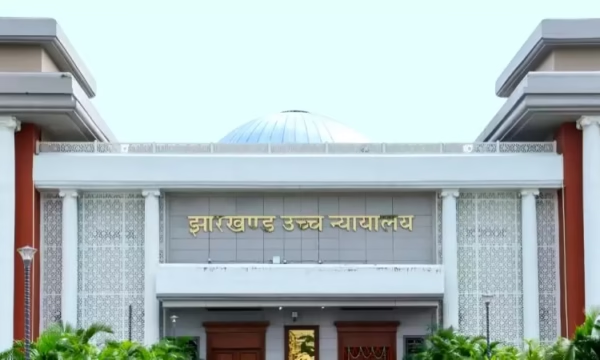
Ranchi, March 30: In a significant judgment with wide implications for land acquisition disputes in Jharkhand, the High Court at Ranchi has enhanced compensation for acquired land in the NTPC Keredari Coal Mining Project from ₹11,000 to ₹15,783 per decimal. The ruling, delivered by Justice Anubha Rawat Choudhary on Monday, settles a batch of 118 first appeals arising out of land acquisition cases in Village Tarhesa, District Hazaribagh.
The case revolves around 84.80 acres of raiyati land acquired for NTPC Limited under the Right to Fair Compensation and Transparency in Land Acquisition, Rehabilitation and Resettlement Act, 2013. Initially, the District Land Acquisition Officer had fixed compensation at ₹4,823 per decimal. This was later enhanced by the trial court to ₹11,000 per decimal. However, both NTPC and the landowners challenged that decision, leading to the present judgment.

Dispute Over Compensation and Legal Interpretation
The central legal question before the High Court was whether the compensation determined by the trial court complied with Section 26 of the 2013 Act, which governs how the “market value” of acquired land should be calculated.
NTPC argued that compensation should be reduced and sought to introduce additional sale deeds from 2015–2016 to show lower land prices. It also contended that the relevant three-year period for valuation should be calculated from April 29, 2016—the date when fresh acquisition proceedings were initiated.
The claimants, on the other hand, argued that the correct reference point was June 12, 2019—the date of notification under Section 11 of the Act—and that compensation should be calculated based on sale deeds from the preceding three years.
Court’s Reasoning: Clear Rejection of NTPC’s Approach
The High Court firmly rejected NTPC’s arguments, holding that:
- The cut-off date for determining market value must be the date of notification under Section 11, i.e., June 12, 2019.
- Therefore, the relevant period for evaluating sale deeds is June 12, 2016, to June 11, 2019, not earlier years as claimed by NTPC.
- The concept of “calendar year” under the General Clauses Act cannot override the specific scheme of Section 26 of the 2013 Act.
The Court observed that accepting NTPC’s argument would exclude recent sale transactions and distort the actual market value at the time of acquisition, which is contrary to legislative intent.
Additional Evidence Rejected
NTPC’s attempt to introduce additional sale deeds from 2015–2016 was dismissed. The Court noted that:
- These documents fall outside the legally relevant three-year window.
- Hence, they are irrelevant for determining compensation.
- Allegations of “suppression of evidence” by claimants were also rejected.
Method of Calculation: Why ₹15,783 per Decimal?
The Court carefully applied Section 26(1)(b) of the Act, which requires:
- Considering sale deeds of similar land in nearby areas
- Taking the top 50% of highest-value transactions
- Calculating the average value
Out of 16 sale deeds presented by the claimants:
- 14 fell within the relevant period
- The top 7 highest-value sale deeds were selected
- Residential land rates were converted into agricultural rates (halved), in line with prevailing valuation norms
This led to a final computed average of:
₹15,783 per decimal
The Court criticised the trial court for arbitrarily reducing the rate to ₹11,000 without proper justification, stating that once the statutory formula is applied, courts cannot deviate without valid reasons.
Circle Rate Argument Dismissed
NTPC also relied on circle rates (₹2,620 per decimal for agricultural land), but the Court ruled that:
- Circle rate is only one method under Section 26(1)(a)
- Since the sale deed method under Section 26(1)(b) yielded a higher value, it must prevail
- Therefore, the circle rate had no practical relevance in this case
Final Outcome
- Compensation increased to ₹15,783 per decimal
- NTPC’s appeals dismissed
- Claimants’ appeals allowed
- Claimants remain entitled to all statutory benefits under the 2013 Act
Wider Significance for Jharkhand
This judgment carries major significance in Jharkhand, where land acquisition for mining, power, and infrastructure projects frequently leads to disputes over compensation.
By strictly enforcing Section 26 of the 2013 Act, the High Court has:
- Reinforced that market value must reflect actual recent transactions, not outdated or selective data
- Limited the ability of acquiring bodies like NTPC to rely on older, lower-value sale deeds
- Strengthened the position of landowners seeking fair compensation
In a state where tribal and rural land rights are particularly sensitive, the ruling sends a clear message: compensation must be transparent, evidence-based, and aligned with current market realities.