Black Box to Open Book: Vatsal Soin’s Latest 0→1 Invention Patent Filings to Screen Artificial Intelligence Now, Superintelligence Later
VATSAL SOIN Today, Artificial Intelligence often works like a black box: people see only the outcome. Two filed Arché Inventions are designed…
VATSAL SOIN
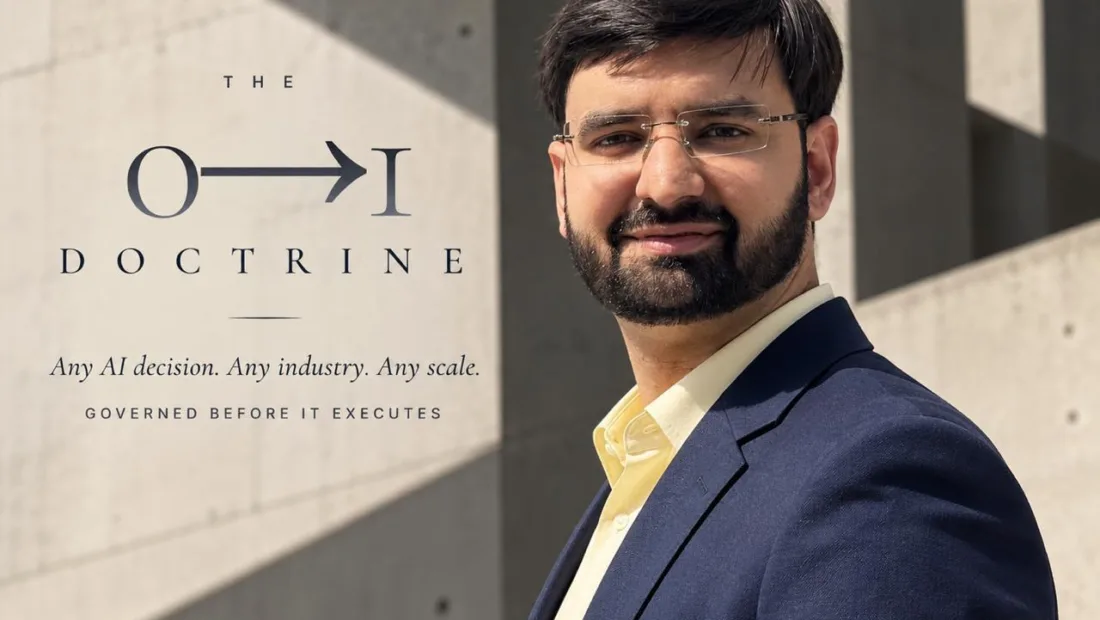
Today, Artificial Intelligence often works like a black box: people see only the outcome. Two filed Arché Inventions are designed to turn each decision into an open book, with a page for everyone involved. A person sees which need fell short and what could work instead. A supplier sees the gap in its offer. A regulator gets proof without private data. An AI agent gets reasons it can act on. And a whole community sees the bigger pattern across many decisions, without anyone’s private data being exposed.

| MEET THE TWO INVENTIONS
Picture every request an AI handles, a loan, a delivery, a robot’s next move, as a question with many parts. The 0→1 Doctrine is designed to place each part, whether a human’s need, a supplier’s ability or a regulator’s limit, at a point between 0 and 1, so all of them can be compared on one scale before the AI acts. Every governed decision ends in a sealed record. Its companion, BBAT (Band-Based Archive Triage), works on data already stored. It sorts records using only their labels, and it reads the sealed records of AI agents for patterns no single record reveals. |
WHO GETS TO READ THE DECISION?
AI now approves, routes and refuses faster than any office, and many recent calls for oversight come back to one question: who can read the decision afterwards? The Doctrine’s filing names the gap plainly. Users cannot safely share raw details, suppliers get only vague signals of what is needed, and regulators lack one way to verify without intrusive access.
ONE DECISION, MANY PAGES
An open book here does not mean everyone sees everything. Both filings rest on selective disclosure: proofs and summaries travel, while raw personal and supplier data stay home. The book opened is the decision, not the inner workings of the AI, and each reader, human or non-human, gets its own page.

THE HUMAN WHO ASKED
A human asking for a service is designed to learn more than yes or no. Each need, such as size, timing, budget or safety, is compared on its own, so the answer can show which one fell short and which alternative route still fits. Raw details stay on the human’s side; only ranges move.
THE SUPPLIER WHO OFFERED
A supplier gets a diagnostic of its own. The Doctrine’s Asset Capability Token is designed to flag missing prerequisites, overload risk, downtime, expired certificates or territorial limits before an offer is matched. Reverse discovery works the other way round: starting from what a supplier can do, it finds the needs that capability could serve.
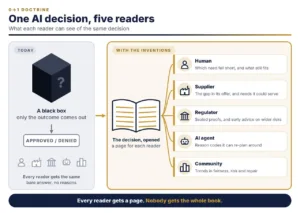
Figure 1. One AI decision, five readers, each given its own page.
THE REGULATOR WHO OVERSEES
A regulator can confirm that the agreed rules were applied without collecting private files. Above single cases sits EMERGE, the Emergent Meta-Environmental Response and Governance Envelope. It is designed to advise on wider environmental, operational and safety conditions without editing any individual decision or taking part in the act. Oversight gains foresight without opening a citizen’s file.
THE AI AGENT THAT ACTED
When the requester is itself an AI agent or a robot, the reasons must be readable by software. Refusals are designed to carry reason codes, and constraint messages can travel back up the chain, from live operation to design, when conditions change. The agent receives something it can re-plan around, instead of a bare stop.
THE COMMUNITY THAT LIVES WITH IT
Cities and communities need the wide view. RECAP, the Regenerative Evaluation and Civic Accountability Protocol, is designed to issue Global Insight Receipts: sealed digests of system health, fairness and sustainability trends, risk patterns and repair outcomes, released under selective-disclosure rules. A council can see how a whole service behaves while each resident’s details stay private.
FAIRNESS, READ BEFORE THE ACT
Fairness debates often begin after a decision lands. The Doctrine builds fairness assessment and ethics layers into the decision path itself, alongside explainability structures. That moves the question earlier: was this measured against the agreed rule before anything happened? The rule is still written by humans. The inventions are designed to show that it was followed.
MANY AGENTS, ONE PATTERN
Some risks live in no single record. BBAT’s Cross-Agent Aggregation Detector is designed to read only sealed receipts, with no agent identity, raw value or action content, and look for clusters in timing, topic or counterparty that match pre-registered warning patterns. A breach goes to human oversight and is never settled automatically.
ONE AGENT, SLOW DRIFT
Another quiet risk is creep: one agent edging, step by step, toward the limit of what it may do, with each step acceptable alone. BBAT’s Single-Agent Trajectory Detector is designed to read that agent’s receipts in order. If the drift crosses a threshold set by the sector’s authority, a sealed notice reaches that authority before the agent acts again.
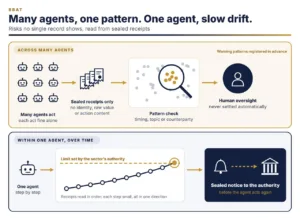
Figure 2. BBAT reads sealed receipts for patterns across many agents and drift in one.
NOW, AND LATER
Superintelligence is not here, and neither filing claims to build it. What the filings describe still looks ahead: BBAT’s pattern reading is designed to work regardless of an agent’s capability, autonomy or architecture. A more capable agent leaves the same kind of receipts, so the same readers can keep reading, whatever arrives next.
QUESTIONS ON READERS’ MINDS
| Can an outside party verify a BBAT decision?
Yes. A privacy-preserving verification interface is designed to return a sealed session receipt to a party that has no access to the stored content. |
Is the source of a reading checked too?
BBAT includes a provenance attestation step, designed to confirm where a measurement came from before it is turned into a band. |
| Who decides which patterns count as warnings?
Humans do. Warning patterns are registered in advance, and drift thresholds are declared by the sector’s governance authority. |
Does a supplier expose its figures?
Its raw figures stay private. A supplier-side engine applies the same normalisation used for users, so only comparable ranges are shared. |
| Can a service, not only a product, be read this way?
Yes. The filing’s examples include digital services, where needs such as latency and bandwidth are banded and matched to cloud or AI providers. |
Can a human step into a single decision?
Operators can work in the loop, signing off decisions, or on the loop, supervising and intervening only when a boundary requires it. |
| Does everyone need the same system?
The framework is described for cloud, edge, offline-first and air-gapped settings, across industrial, commercial and civic use. |
Do the two have to be adopted together?
Each works independently. The Doctrine reads decisions; BBAT reads stored data and agent receipts. Together, the picture is fuller. |
CLOSING NOTE
A black box asks for faith. An open book gives each reader a page: the human, the company, the government, the AI. Nobody reads blind.
LIVE www.0to1doctrine.com
This can be tested, live, via API, governed against ungoverned, side by side.
THE INVENTOR
Systems theorist, inventor, and serial entrepreneur Vatsal Soin holds grants in the US, Japan, India and more; filings span six continents; latest grant, AI footwear, August 2026. Inventions: footwear, apparel fit, Sharable Size Cards, digital twins, robotics, global governed data, archive triage, quantum-resilient cryptography, AI governance. SIM–RMIT and NTU alumnus. Every prior invention was a step; 0→1 is the destination.
SELECTED REFERENCES
Granted: US Patent 12,446,652 B2 · Japan Patent 7560909 · India Patents 454081 and 599317. Filed: PCT/IN2025/051943 · US 19/489,595 · India 202511115781 · Australia AU2022450649 · India 202611113867 (23 September 2026) · PCT/IN2026/052042 (1 October 2026).
DISCLAIMER
Informational only. Not certified. No endorsement implied. Not investment advice. Examples are illustrative, not field results. Vatsal Soin · © 2026 All Rights Reserved.