







NESHA ORAON

While on deputation with the Jharkhand government and serving as Director (Panchayati Raj), I conceptualised the “Hamari Parampara, Hamari Virasat” initiative. It was designed with the guidance of tribal elders and traditional leaders to document, protect, and preserve the religious, cultural, and social heritage of India’s tribal communities.
Today, the Chhattisgarh High Court’s landmark judgment in WPPIL Nos. 83 & 86 of 2025 has reaffirmed the same principles that inspired this initiative. The Court ruled that Gram Sabhas in PESA (Panchayats Extension to Scheduled Areas) regions have the constitutional right to protect their traditional religion, worship practices, and social customs.

It also held that the “Oath Certificates” issued under the “Hamari Parampara, Hamari Virasat” scheme and the notice boards put up by Gram Sabhas restricting conversion activities are legally valid. This is more than a judgment—it’s a restoration of faith in tribal self-governance and cultural autonomy.
Jharkhand’s creation finds recognition in Chhattisgarh
The “Hamari Parampara, Hamari Virasat” scheme was born in Jharkhand, conceptualised under my leadership in the Panchayati Raj Department with the cooperation of tribal communities and approved under the Rashtriya Gram Swaraj Abhiyan (RGSA) of the Government of India.
Its goal was simple yet profound: to help Gram Sabhas document and safeguard their traditional religion, festivals, worship systems, songs, and ancestral customs. The pledge at the heart of the scheme was not against any religion or community. It was an oath to uphold and preserve the indigenous faith systems that define tribal identity.
Ironically, while Chhattisgarh became the first state to officially adopt and implement the programme—and has now received judicial endorsement for it—Jharkhand, where the idea originated, halted the scheme midway after pressure from certain Christian-tribal groups, who feared that the scheme would strengthen the tribal religious identity.
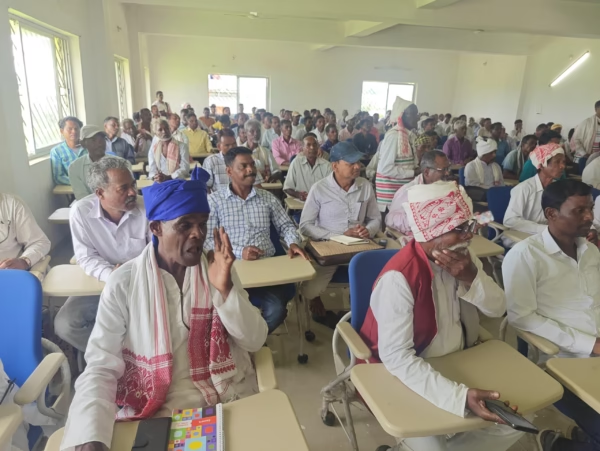
Incidentally, this has not dampened the spirit of the tribal elders. With my support, they have continued to pursue the project on their own and have completed documentation in three villages, covering the Oraon, Khadia, Munda, and Santhali communities.
Before its suspension, around 3,800 Gram Sabhas in Jharkhand had already taken the pledge and begun documentation work. The Chhattisgarh High Court’s decision now provides a legal and moral foundation for Jharkhand to revive and strengthen it.
What the Court has said—and why it matters
The Chhattisgarh High Court, in its judgment dated October 28, 2025, examined the validity of Gram Sabha resolutions and notice boards placed in several villages in Kanker district. These Gram Sabhas had declared their rights under Section 4(d) of the PESA Act, 1996, and Section 6(10) of the Chhattisgarh State PESA Rules, 2022, to protect their cultural and religious identity.
The Court upheld their actions as lawful and constitutional, clarifying that Article 25 of the Indian Constitution guarantees every citizen the right to profess and propagate religion, but not to convert others through force, inducement, or deception.
It further stated that the Gram Sabhas had not restricted anyone’s entry or residence but had only prohibited conversion-related activities within their villages. Thus, both the Gram Sabha resolutions and the state circular dated August 14, 2025, were found to be within constitutional bounds.
By dismissing the petitions and directing complainants to approach the Gram Sabha or the Sub-Divisional Officer under PESA Rules, 2022, the Court reaffirmed the autonomy of local tribal institutions.
Implications for Jharkhand and other PESA states
This ruling is not confined to Chhattisgarh; it has nationwide significance, especially for other PESA states like Jharkhand, Madhya Pradesh, Maharashtra, and Odisha.
In Jharkhand, where tribal self-rule has deep historical roots, Gram Sabhas have occasionally asserted similar rights. Recently, in Lal Khatanga village (Namkum block), the Gram Sabha passed a resolution opposing a “Mukti Mahotsava,” which it viewed as promoting conversion and disrupting peace. Despite the resolution, the event was conducted from November 3–5, 2025.
The Chhattisgarh High Court’s decision now provides judicial clarity and confidence for Gram Sabhas in Jharkhand to act within constitutional limits to protect their faith, land, and traditions.
A call to revive Jharkhand’s own vision
The spirit of PESA lies in empowering tribal communities to govern themselves and protect their identity. The Chhattisgarh judgment embodies this spirit—it upholds the constitutional promise of Gram Swaraj envisioned for India’s tribal heartlands.
For Jharkhand, this is a moment of introspection and opportunity. The “Hamari Parampara, Hamari Virasat” scheme should not remain frozen in files. It must be revived, documented, and implemented with renewed commitment, ensuring that tribal religion and culture continue to thrive with dignity.
This judgment has shown that protecting tribal faith is not about exclusion—it is about affirmation, continuity, and constitutional justice.
The right to preserve and protect one’s religion is a fundamental right guaranteed to all communities. Preserving tribal religion is not about rejecting religious conversions, but about upholding the right of a community to safeguard and maintain its ancient heritage and faith.
A community that protects its roots, protects its future.
(The writer, an IRS officer, is known for her deep connection to her tribal roots and her active efforts to promote and preserve indigenous culture. Hailing from Jharkhand, she has been an advocate for the recognition of tribal traditions, sustainable development, and women’s empowerment in rural areas.)
