
Decomposed carcass of adult elephant found in Latehar forest, possible human-wildlife conflict under probe
THE JHARKHAND STORY NETWORK Daltonganj, October 29: The carcass of an adult male elephant was found in the Vishunpur jungles of Marang…
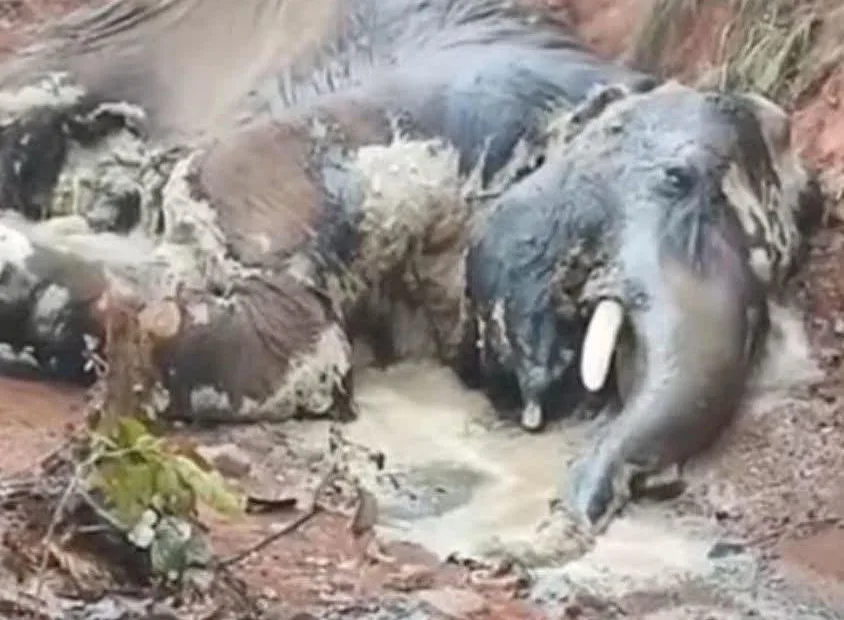
The carcass of an adult male elephant was found in an advanced stage of decomposition in the Vishunpur jungles of Marang Loiya panchayat in Latehar district.
THE JHARKHAND STORY NETWORK
Daltonganj, October 29: The carcass of an adult male elephant was found in the Vishunpur jungles of Marang Loiya panchayat, under the Balumath police station limits in Latehar forest division, on Wednesday evening, October 28, forest department sources said.
The carcass was in an advanced stage of decomposition, suggesting that the elephant may have died several days before it was discovered. Forest officials are investigating the circumstances surrounding the death, including the possibility of human-elephant conflict.
Elephant Estimated to Be 30–40 Years Old
Latehar Divisional Forest Officer (DFO) Prawesh Agarwal told this correspondent on Thursday that the elephant was believed to have died four to eight days earlier, based on the condition of the carcass.
“The elephant is feared to have died between 4 and 8 days ago as its decay, decomposition and putrefaction were in an advanced stage.”
The elephant was a male, estimated to be between 30 and 40 years old, Agarwal said. One of its tusks had become embedded in the soil, apparently following the impact of its fall, while the other remained visible.

Quoting forest personnel, Agarwal said, “The elephant was limping over the last many days.”
He suggested that the animal might have suffered from infected wounds on its legs.
Infected Wounds Suspected as Possible Cause of Death
Giving his assessment, Agarwal said, “It’s feared pus got formed in the pockets of wounds. It proved fatal.”

A veterinary surgeon explained the potential danger posed by such injuries: “Pus-filled wound or cavity in an elephant is most life-threatening, as it turns into septicemia and osteomyelitis where the elephants find it too hard to take even one step forward.”
Elephants may sustain leg injuries through various means, including encounters with hard or pointed objects. Forest personnel and local trackers also pointed to the possibility of injuries linked to human-elephant conflict, which can arise when elephants damage standing crops or houses.
However, the cause of death has not yet been established, and officials said the post-mortem examination report would be crucial in determining what happened.
“Let the post-mortem examination report come first. It will tell us about the probable cause of death of this elephant.”
Human-Elephant Conflict Angle Not Ruled Out
When asked whether the elephant’s prolonged limping and the apparent absence of timely intervention could indicate a case of human-elephant conflict, the DFO said, ” It can’t be any ruled out. There is a strong possibility of it. Our team would find out.”
On questions about why forest patrol personnel had not detected the carcass earlier, Agarwal said, “It will be looked into. The carcass was in dense forest and in an earthen pit.”
Forest sources said the carcass was buried in the protected forest on Thursday. Carcasses of wild animals are generally buried rather than burned in such locations.
Latehar DC Expresses Concern
Latehar Deputy Commissioner Sandip Kumar expressed concern over the discovery of the carcass several days after the elephant’s death.
“It’s too sad to learn about the death of the elephant lying unnoticed for days. The concerned department must look into it.”
Local police officer Anubhav Sinha said forest personnel rarely inform the police about wildlife deaths.
“Forest personnel seldom tell us about casualties of wildlife. I got this information not from the forest personnel but from the locals only Wednesday evening.”
Forest Department Orders Detailed Inquiry
Head of Forest Force (HoFF) Sanjeev Kumar said he had directed the Latehar DFO to investigate the incident in detail, including the possible human-elephant conflict angle.
“I have directed the DFO Latehar to delve deep into this episode. Let there be a popular network of information and communication.”
Emphasising the importance of coordination with local communities, he added, “The forest team should win trust of the locals. It can be achieved through proper communication.”
He further said, “I have asked the DFO to ask forest beat personnel to explain the late discovery of the carcass of the elephant. It’s high time forest patrol be prioritised most.”
The Balumath block witnessed a fatal human-elephant conflict incident in the early months of 2026, when an elephant was killed by a live electric fence reportedly installed by a maize grower to keep elephants away from crops.
The latest incident has renewed questions about wildlife monitoring, timely intervention and coordination between forest officials and local communities. The exact cause of the elephant’s death will be determined through the ongoing investigation and post-mortem findings.