Global Tiger Day: Three Palamu Tiger Reserve frontline staff honoured by NTCA for village relocation efforts
Daltonganj, July 30: Even as the Palamu Tiger Reserve (PTR), once home to 22 tigers when it was brought under Project Tiger in…
Daltonganj, July 30: Even as the Palamu Tiger Reserve (PTR), once home to 22 tigers when it was brought under Project Tiger in 1974, continues to grapple with a tiger population in single digits, Global Tiger Day offered a rare moment of encouragement for its frontline workforce.
The dwindling tiger population over the past decade has remained a matter of concern despite sustained conservation efforts by PTR officials and staff. Against this backdrop, the recognition of three frontline personnel by the National Tiger Conservation Authority (NTCA) has come as a morale booster for the reserve.

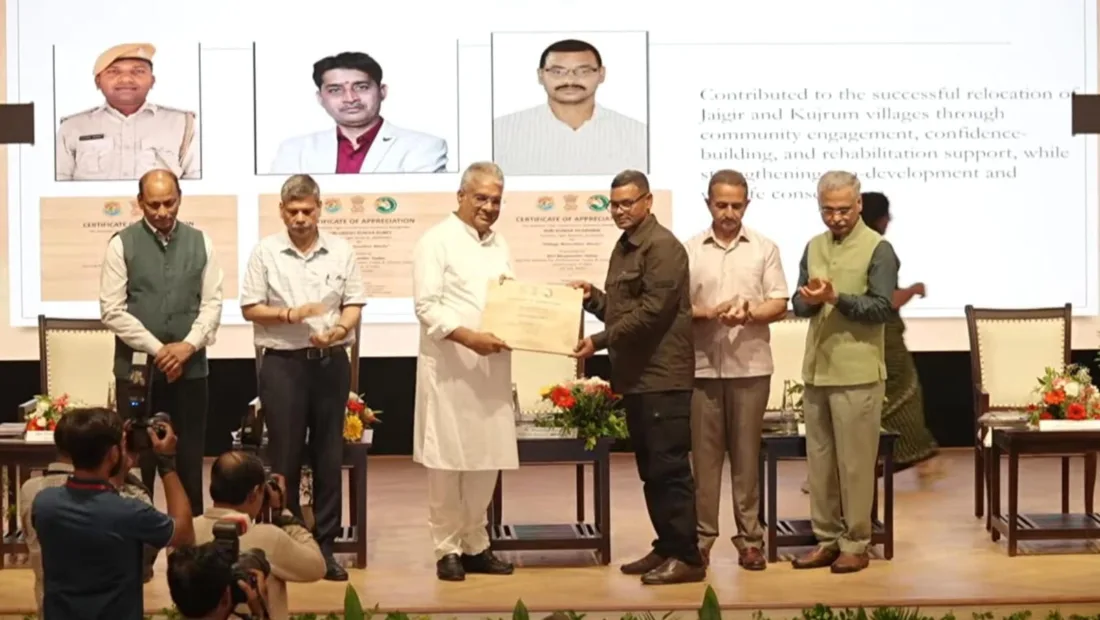
On the occasion of Global Tiger Day, observed annually on July 29, the NTCA selected three frontline staff members of the Palamu Tiger Reserve for its Awards for Excellence in the category of Village Relocation, according to official sources.
Assistant Inspector General of Forests, NTCA, Md Sajid Sultan, in a letter dated July 24 to the Chief Wildlife Warden of Jharkhand, informed the state government about the selection and directed that the awardees confirm their participation and reach New Delhi by July 28.
This correspondent has accessed the letter.
The awardees are Range Officer Umesh Dubey, Field Attendant Kumar Dharmveer and Forest Guard Gaurang Swansi, all posted in the South Division of the Palamu Tiger Reserve.

The awards were presented in New Delhi on Global Tiger Day by Union Minister for Environment, Forest and Climate Change Bhupender Yadav.
According to Kumar Ashish, Deputy Director of the South Division of PTR, the three officials played a pivotal role in facilitating the voluntary relocation of 22 families from Jaigir village in the Garu East Range to Polpol under Sadar block in Palamu district in 2025.
“Our three frontline staff selected by the NTCA—Umesh Dubey, Kumar Dharmveer and Gaurang Swansi—had already reached New Delhi to receive the awards,” Ashish said.

The relocated families, comprising around 160 people, had lived inside the tiger reserve. Sources said the three awardees were instrumental in building trust among the villagers and persuading them to opt for relocation after years of engagement.
“The biggest challenge was earning the confidence of the villagers. It took several years of sustained dialogue before they agreed to relocate voluntarily,” a source said.
Ashish said the award recognises the trio’s dedicated and balanced efforts in carrying out the relocation process.
Officials said the NTCA confers Awards for Excellence in several categories, including village relocation, anti-poaching and forest fire management.
Relocation was voluntary, says PTR
Global Tiger Day 2026 carries the theme, “Securing the Future of Tigers with Indigenous Peoples and Local Communities at the Heart,” with the message, “Their survival is in our hands.”
Responding to concerns that relocation could be viewed as displacement, Ashish stressed that the process in PTR is entirely voluntary.
“It is a voluntary relocation. PTR never uses coercion or pressure. There is absolutely no question of forceful eviction,” he said.
“It is entirely the villagers’ decision to move out. No force is applied at any stage. The 22 families of Jaigir chose relocation after a series of Gram Sabha deliberations and in their own larger interest.”
Ashish said living inside the core or buffer area of a tiger reserve often deprives residents of access to essential public infrastructure.
“Roads, electricity, schools, health centres, drinking water, irrigation and other basic civic amenities cannot be developed inside a tiger reserve. As a result, life becomes extremely difficult until families choose to relocate,” he said.
Recalling one family’s experience, Ashish said a resident struggled to find a suitable groom for his daughter because prospective families were unwilling to send their sons to a remote hilltop village nearly 1,000 metres above the plains with virtually no basic amenities.
Residents of Jaigir also had to descend nearly 1,000 metres to the plains even for everyday necessities such as buying a box of matches, officials said. That family eventually became the first to relocate to Polpol.
Asked whether more villages inside the tiger reserve could be relocated in the future, Ashish said the decision would rest entirely with the villagers.
“There are a little over half a dozen villages inside the PTR. If and when the villagers themselves decide to relocate, without any pressure, temptation or coercion, the PTR will facilitate their resettlement through the approved compensation package, including cash or land, as per government norms,” he said.