







DR RACHNA K PRASAD

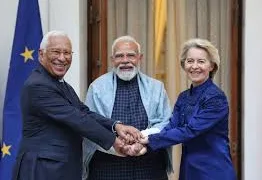
The signing of the India–European Union Free Trade Agreement (FTA) on January 27, 2026, is not just another trade pact—it is a strategic milestone that redefines India’s role in global commerce. Negotiations that began as far back as 2007 under the Bilateral Trade and Investment Agreement (BITA) stalled in 2013, leaving years of inconclusive engagement. It was only with the relaunch in May 2021, under a sharper, outcome-driven approach, that momentum returned. The eventual conclusion in 2026 is being hailed internationally as the “mother of all deals,” and Prime Minister Narendra Modi himself framed it as a pact for an “Ambitious India,” “Aspirational Youth,” and an “Aatmanirbhar India.”
Scale and significance of the partnership
The scale of this partnership is staggering. India, now the world’s fourth-largest economy, and the EU, the second-largest, together account for nearly one-third of global trade and about one-quarter of global GDP. Bilateral goods trade in 2024–25 stood at $136.5 billion, with India exporting $75.8 billion worth of goods to the EU. Services were equally significant, with Indian exports valued at $46 billion. This agreement is also part of a broader strategy: since 2021, India has concluded eight major FTAs, signalling a decisive shift towards accelerated global engagement.

Tariff liberalisation and services access
At the heart of the FTA lies tariff liberalisation. Over 99% of Indian exports by trade value will now enjoy duty-free access from day one, with duties eliminated on more than 70% of tariff lines immediately. This single provision is expected to boost $75 billion worth of exports, enhancing competitiveness overnight.
For services, the gains are equally profound. India secured predictable market access to 144 subsectors, including IT/ITeS, professional services, and education. Crucially, the agreement also facilitates mobility for Contractual Service Suppliers (CSS) and Independent Professionals (IP), ensuring smoother pathways for Indian talent to work in Europe.
Addressing non-tariff barriers
Non-tariff barriers, often more obstructive than tariffs, are directly addressed. The FTA introduces stronger regulatory cooperation, transparency, and streamlined customs procedures. Clear disciplines for Sanitary and Phytosanitary (SPS) measures and Technical Barriers to Trade (TBT) reduce compliance friction—a long-standing challenge for Indian exporters.
Winners across manufacturing sectors
The sectoral impacts are striking. Textiles and apparel, a cornerstone of India’s manufacturing economy, stand to gain enormously. The EU is India’s second-largest market for these products, yet exporters have long faced disadvantages compared to competitors like Bangladesh, Vietnam, and Turkey. With zero-duty access, India now achieves parity. Current exports of $7.2 billion could expand into a market worth nearly $263.5 billion.
Leather and footwear also benefit. Duty-free import of specified inputs for manufacturing shoe uppers, combined with an extended export timeline from six months to one year, improves operational efficiency. The Council for Leather Exports projects two to three lakh new jobs from these measures.
Automobiles, agriculture and competitive pressures
The automotive sector faces a more complex adjustment. The FTA introduces a quota-based liberalisation package. EU manufacturers gain access to the Indian market with higher-priced models, giving consumers more choice. At the same time, “Make in India” vehicles gain reciprocal access to Europe. Yet the competitive pressures are real—shares of major Indian car manufacturers fell by up to 5% immediately after the announcement, reflecting market anxieties.
Agriculture and processed foods also stand to benefit. Exports of tea, coffee, and spices will gain competitiveness, while sensitive domestic sectors like dairy, poultry, and certain fruits and vegetables are safeguarded. Labour-intensive exports such as gems, jewellery, and marine products—worth $33 billion—are poised to gain preferential access. On the other hand, machinery and high-tech goods from Europe, including optical and medical equipment, will flow more freely into India. This offers opportunities for Indian industries to access advanced technology but also raises competitive challenges for domestic manufacturers.
Geopolitical ripple effects
The geopolitical implications are equally significant. Pakistan, which relied heavily on preferential access to the EU under the Generalised Scheme of Preferences Plus (GSP+), faces a major setback. Its $9 billion in annual exports and up to 10 million associated jobs are now at risk. One former Pakistani commerce minister described the situation as the end of the country’s “zero-tariff honeymoon.”
Global powers are watching closely. The United States has expressed discomfort, viewing the deal as a strategic move by the EU that undermines existing U.S. tariff policies. China, however, appears less concerned, largely because European companies have extensive manufacturing bases in China. This creates a potential backdoor: goods branded as European but produced within Chinese supply chains could enter India under preferential terms.
The road ahead for India
The FTA is ambitious, but its success depends on how India leverages it. Commerce and Industry Minister Piyush Goyal urged Indian companies to expand capacities, increase investments, and move beyond reliance on the domestic market. The agreement is not just about immediate gains—it is about positioning India as a confident shaper of 21st-century trade rules.
In conclusion, the India–EU FTA is a landmark pact that transcends commerce. It unlocks unprecedented access to European markets, empowers key domestic industries, and reshapes India’s global standing. Yet challenges remain—domestic sectors must adapt to sharper competition, regulatory frameworks must be strengthened, and businesses must seize opportunities rather than retreat. If India can navigate this post-FTA landscape with urgency and foresight, the agreement will serve as a powerful engine for growth, anchoring the nation’s ambitions for Viksit Bharat @2047.
(The writer is Assistant Professor of Political Science at Delhi University with over 20 years of teaching experience. She holds a PhD from Delhi University on Forest Land Rights of Tribals in Jharkhand and has cleared UGC-JRF. Her academic interests include human rights, tribal and Dalit studies, multiculturalism, Gandhian thought, development, and environmental politics. She has authored several books on political theory, rights, governance, and contemporary India, including works on India’s G20 Presidency and modern political leadership.)
