
India marks 77th Constitution Day: Revisiting the vision, values and living ideals of the Constitution
DR RACHNA K PRASAD India observed the 77th Constitution Day, popularly known as , on November 26, commemorating the adoption of the…
DR RACHNA K PRASAD

India observed the 77th Constitution Day, popularly known as , on November 26, commemorating the adoption of the Constitution by the Constituent Assembly in 1949. The occasion serves not only as a reminder of a historic milestone in India’s political journey but also as an opportunity to reflect on the democratic principles and constitutional values that continue to shape the world’s largest democracy.

As the country marks the 77th anniversary of the Constitution’s adoption in 2026, attention turns to the vision of its framers and the extent to which the promises of justice, equality and liberty have been translated into everyday realities.
The Constitution represents the culmination of India’s long struggle for independence, equality, justice and self-governance. It established a political system in which sovereignty rests with the people rather than a monarch, colonial authority or privileged institution.
The Government of India formally designated November 26 as Constitution Day in 2015, during the 125th birth anniversary year of Dr B. R. Ambedkar, who chaired the Drafting Committee. Before this recognition, the day was observed in legal circles as National Law Day. Since 2015, educational institutions, government departments, universities and civil society organisations have marked the occasion through readings of the Preamble, constitutional awareness programmes and public discussions.
The making of the Indian Constitution
The making of the Indian Constitution remains one of the most remarkable exercises in democratic institution-building in modern history.

The Constituent Assembly was established under the framework of the Cabinet Mission Plan of 1946, with an initial membership of 389 representatives. Following the Partition of India, its membership was reduced to 299.
The Assembly held its first meeting on December 9, 1946, with Dr Sachchidananda Sinha serving as its temporary chairman. On December 11, 1946, Dr Rajendra Prasad was elected its permanent president.
An important intellectual foundation for the Constitution was laid by Jawaharlal Nehru through the Objectives Resolution, which he introduced on December 13, 1946. Adopted on January 22, 1947, the resolution articulated the fundamental aspirations of the emerging nation, including sovereignty, democracy, equality and justice. These principles later found expression in the Preamble.

The Drafting Committee was established on August 29, 1947, under the chairmanship of Dr Bhimrao Ramji Ambedkar. Although the committee had seven members, Ambedkar played a particularly significant role in bringing together diverse constitutional ideas, legal principles and institutional experiences.
The Draft Constitution was introduced before the Constituent Assembly on November 4, 1948. Its provisions were subsequently examined through extensive debates, discussions and amendments.
The entire constitution-making exercise took 2 years, 11 months and 18 days. The Assembly held 11 sessions over 165 sitting days, reflecting the detailed deliberations that went into framing the country’s foundational legal document.
Several specialised committees also examined different aspects of governance and constitutional administration. Nehru chaired the Union Powers Committee and the Union Constitution Committee, while Sardar Vallabhbhai Patel headed the Provincial Constitution Committee and the Advisory Committee on Fundamental Rights, Minorities and Tribal and Excluded Areas. Dr Rajendra Prasad led important committees dealing with procedural and organisational matters.
Their collective contribution helped establish a constitutional framework that sought to accommodate national unity while recognising India’s regional, social, cultural and linguistic diversity.
Ambedkar’s vision of equality and social justice
One of Dr B. R. Ambedkar’s most significant contributions was his emphasis on equality, individual liberty, social justice and constitutional safeguards for historically disadvantaged communities.
He believed political independence would remain incomplete without social and economic transformation. The Constitution therefore established legal protections against discrimination and untouchability, guaranteed equality before the law and provided safeguards for vulnerable sections of society.
It also created constitutional remedies through which citizens could approach the judiciary when their fundamental rights were violated.
Ambedkar’s understanding of democracy extended beyond elections and parliamentary institutions. He argued that political democracy could not survive without social democracy. Liberty, equality and fraternity, in his vision, were inseparable principles that had to guide everyday social life.
A country could not claim to be genuinely democratic if political equality existed alongside deep-rooted social discrimination and economic inequality.
His ideas remain relevant as India continues to address challenges associated with caste-based discrimination, unequal opportunities, gender disparities and social exclusion. Constitution Day provides an opportunity to remember Ambedkar not merely as the chairman of the Drafting Committee but also as a thinker who placed human dignity at the centre of democratic governance.
From adoption in 1949 to becoming a Republic in 1950
The Constitution was formally adopted on November 26, 1949, but came into full effect on January 26, 1950. Certain provisions, including those specified under Article 394, came into force immediately upon adoption, while the remaining provisions commenced on January 26, 1950.
The choice of January 26 carried historical significance. During the Lahore session of the Indian National Congress in December 1929, under the presidency of Jawaharlal Nehru, the resolution of Purna Swaraj, or complete independence, was adopted.
January 26, 1930, was subsequently observed as Independence Day by the national movement. By bringing the Constitution into full effect on the same date in 1950, the framers connected the establishment of the Republic with the aspirations of the freedom struggle.
Thus, November 26 commemorates the adoption of the Constitution, while January 26 marks the establishment of India as a republic.
A framework for democratic governance
At the time of its adoption, the Indian Constitution consisted of 395 Articles divided into 22 Parts and eight Schedules, making it the lengthiest written national constitution of its time.
It provided for a parliamentary system in which the executive remains collectively responsible to the Lok Sabha. It established a federal structure distributing legislative and administrative responsibilities between the Union and the states, while also giving the Centre certain stronger powers to protect national unity and security.
An independent judiciary, headed by the Supreme Court, was established to interpret the Constitution, uphold the rule of law and protect fundamental rights.
One of its most transformative features was the introduction of universal adult franchise. Every adult citizen was given the right to vote without discrimination based on caste, religion, gender, education or economic status.
This was a remarkable democratic commitment for a newly independent country facing widespread poverty, illiteracy and social inequalities. The framers recognised every citizen as an equal participant in the democratic process, irrespective of wealth or educational qualifications.
Fundamental Rights, Duties and the Preamble
The Constitution establishes a balance between individual rights and the responsibilities of the state.
Fundamental Rights, contained in Part III, protect citizens against discrimination, arbitrary state action and violations of personal liberty. The Directive Principles of State Policy, contained in Part IV, guide governments towards building a welfare-oriented society through policies relating to education, public health, social security, economic justice and equitable distribution of resources.
Fundamental Duties, incorporated through the 42nd Constitutional Amendment in 1976, remind citizens of their responsibilities towards the nation, its institutions, cultural heritage and fellow citizens.
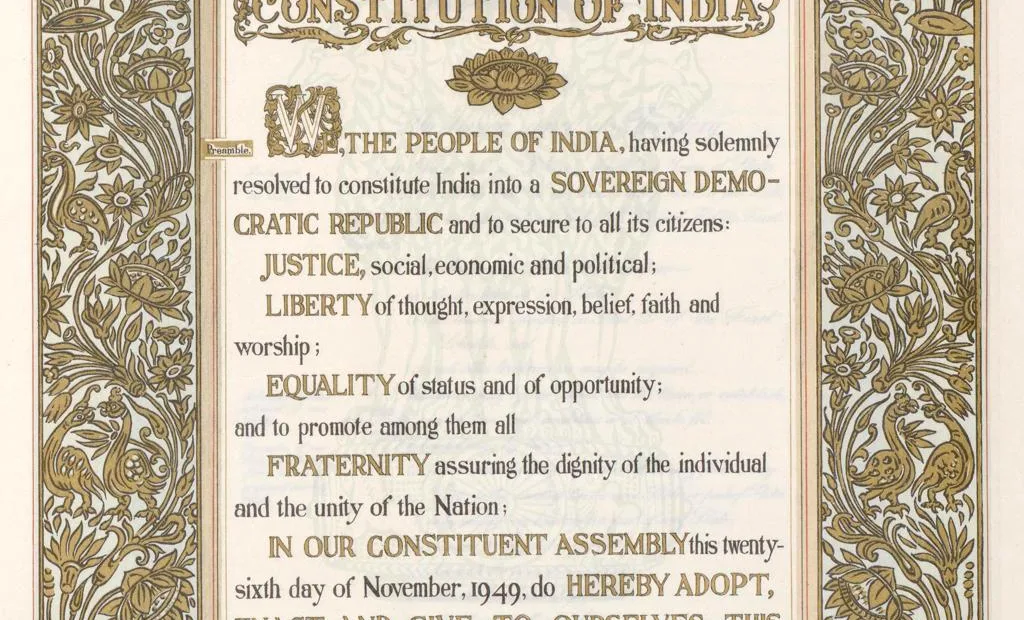
The Preamble occupies a central position in understanding the philosophy of the Constitution. Beginning with the words “We, the People of India”, it establishes that the authority of the Constitution originates from the citizens themselves.
It declares India to be a sovereign, socialist, secular and democratic republic and promises justice, liberty, equality and fraternity to all citizens. The words socialist, secular and the expression concerning the integrity of the nation were incorporated through the 42nd Constitutional Amendment Act of 1976.
These ideals are not merely symbolic expressions. They represent the moral and political commitments that should guide the functioning of the state and its institutions.
Justice demands fairness in social, economic and political life. Liberty protects freedom of thought, expression, belief, faith and worship. Equality ensures equal status and opportunity, while fraternity promotes individual dignity and national unity.
Constitutional promises and challenges before India
The strength of a Constitution cannot be measured only by the quality of its written provisions. It must also be assessed by how effectively its principles are implemented.
More than seven decades after its adoption, India continues to face challenges in realising the constitutional vision. One major concern is the lack of constitutional awareness among ordinary citizens.
While electoral participation remains a defining feature of Indian democracy, many people are not sufficiently familiar with their fundamental rights, constitutional remedies and civic responsibilities. Greater constitutional literacy through schools, universities, community programmes and public institutions is essential to ensure that citizens understand not only their rights but also the mechanisms available to protect them.
Social and economic inequality remains another significant challenge. Caste discrimination, gender inequality, unemployment, poverty and unequal access to education, healthcare and justice reveal the continuing gap between constitutional promises and social realities.
The principle of equality before the law must be supported by meaningful opportunities that enable every individual to participate in national development.
Democratic institutions must also function with independence, transparency and accountability. The relationship between the legislature, executive and judiciary requires mutual respect and institutional balance, while the protection of fundamental rights must remain a priority even when the state exercises its authority in the interests of public order and national security.
Constitutional morality and the responsibility of citizens
Constitutional morality, a concept strongly emphasised by Dr Ambedkar, remains central to the functioning of a healthy democracy.
It requires public representatives, institutions and citizens to respect constitutional procedures, democratic values and the limits of their respective powers. It also demands tolerance towards dissent, respect for diversity and commitment to the rule of law.
In a country as diverse as India, cooperative federalism is equally important. The Union and state governments must work together in a spirit of mutual trust and constitutional responsibility, recognising that national development depends on effective cooperation between different levels of government.
Ultimately, Constitution Day should not be treated merely as an annual ceremonial occasion or an opportunity to repeat the words of the Preamble. It should inspire citizens to examine the functioning of democracy, question injustice through constitutional means and contribute responsibly to public life.
The Constitution provides the framework, but its success depends on the conduct of institutions and the participation of the people. Every citizen, irrespective of social or economic background, has a role in protecting its values and strengthening democratic culture.
As India commemorates the 77th anniversary of the adoption of its Constitution, the most meaningful tribute to the Constituent Assembly and its architects would be to transform constitutional ideals into lived realities.
The vision of justice, liberty, equality and fraternity must find expression in government policies, institutional behaviour and everyday social relationships. The Constitution is not simply a document that established the Republic in 1950; it is a living commitment that continues to guide India’s democratic journey.
Its enduring strength lies not only in the wisdom of its framers but also in the collective determination of its people to uphold its principles and pass them on to future generations.