India’s Gen Z: Turning youth aspirations into democratic strength
DR RACHNA K PRASAD ndia stands at a remarkable demographic and democratic moment. Few countries in the world possess a youth population…
DR RACHNA K PRASAD

ndia stands at a remarkable demographic and democratic moment. Few countries in the world possess a youth population of India’s scale, diversity and ambition. For decades, the country’s demographic dividend has largely been discussed through the language of economic growth, employment and productivity. Yet its significance goes much further. India’s young population is also becoming an extraordinary democratic resource. It represents new ideas, technological confidence, entrepreneurial energy and a willingness to participate more directly in national life.
Generation Z, broadly referring to those born between 1997 and 2012, will become increasingly important to the country’s democratic future. By then, almost the entire adult segment of this generation will be eligible to vote. Gen Z could constitute roughly 30 percent of the electorate, with another five to six crore young citizens entering the electoral process as first-time voters. In states such as Uttar Pradesh and Bihar, their electoral presence will be particularly significant.
This should not be viewed merely through the calculations of electoral politics. It represents something much larger: a generational renewal of Indian democracy.
Young Indians and Rising Expectations
Young Indians today have grown up in a country very different from what previous generations experienced. They have witnessed rapid digitalisation, expanding infrastructure, greater global visibility for India, the spread of smartphones, digital payments, startup culture and new opportunities in entrepreneurship and technology. They are more connected to national and international developments than any previous generation of Indian citizens.
Consequently, they also expect more from public institutions.

This expectation should be understood as a sign of democratic confidence rather than alienation. Citizens demand better services when they believe institutions have the capacity to deliver them. The task before government is therefore to convert rising expectations into deeper participation in the democratic process.
A significant transformation has already taken place in the relationship between citizens and the state. Digital governance has reduced many of the traditional distances between the two. Platforms for digital payments, direct benefit transfers, online certificates, grievance systems and citizen participation have accustomed young Indians to interacting directly with institutions. Government is increasingly experienced not merely through offices and files, but through smartphones and digital interfaces.
This transformation has important political consequences. Young citizens increasingly expect transparency, speed and accessibility from governance. The political culture of Generation Z is therefore more issue-oriented and interactive. Many young voters do not simply inherit the political preferences of their families. They examine questions relating to employment, education, infrastructure, national security, technology, entrepreneurship, corruption, environment and opportunities for social mobility.

Such independent political behaviour can strengthen Indian democracy. It encourages governments and political organisations to compete on performance, governance and policy outcomes.
Youth Aspirations and the Changing World of Work
At the same time, economic aspirations remain central to the youth question. Employment and employability continue to require sustained attention, particularly because India is simultaneously experiencing technological disruption and a transformation in the nature of work. Artificial intelligence, automation, platform economies, startups and the gig economy are changing traditional employment structures across the world.
At the same time, young citizens are becoming politically active through a new grammar of participation.
Earlier political mobilisation depended heavily upon established organisations, political parties, student bodies and local networks. Today, digital platforms allow citizens to organise around issues almost instantaneously. A concern may begin with a social media post, develop into a network, attract public attention and eventually become a matter requiring institutional response.
This digital-to-institutional pathway should not automatically be viewed as a threat to governance. It can function as an early warning mechanism for democracy. Social media can reveal problems before they become large political crises. Responsible governments can use these signals to identify grievances, communicate facts and improve administrative responsiveness.
The challenge lies in ensuring that digital mobilisation does not replace institutional dialogue.
Examinations, Recruitment and Institutional Accountability
This is particularly important in matters concerning examinations, recruitment and educational opportunities. For millions of Indian families, competitive examinations represent pathways of mobility. The integrity of these systems therefore carries enormous social importance. When irregularities occur, young citizens expect swift investigation and visible accountability.
The government’s responsibility is twofold. It must strengthen technological and administrative safeguards against malpractice while simultaneously communicating clearly with affected candidates. Transparency about investigations, timelines and corrective measures can prevent administrative problems from becoming crises of confidence.
Accountability should therefore be viewed not as an admission of institutional weakness but as evidence of institutional strength.
Building Intergenerational Political Partnership
India’s democratic institutions have repeatedly demonstrated an ability to absorb enormous social change. Universal adult franchise, peaceful transfers of power, the expansion of political participation among previously marginalised communities, the rise of regional leadership and the increasing political participation of women all demonstrate the adaptability of Indian democracy. Integrating Generation Z represents the next stage of this democratic evolution.
Political representation must consequently evolve alongside demographic change.
The average age of MPs in the 18th Lok Sabha remains considerably higher than the average age of the Indian population. This does not diminish the value of experienced political leadership. Democratic institutions require historical memory, administrative understanding, negotiation skills and political judgement. Experience remains indispensable.
The objective should therefore not be to replace experienced leadership with younger leadership. India should instead create stronger mechanisms of intergenerational partnership.
Experienced leaders possess institutional knowledge. Younger leaders bring technological familiarity, new communication styles and direct understanding of emerging economic and social realities. Bringing these strengths together can produce more effective governance.

Universities as Training Grounds for Democratic Leadership
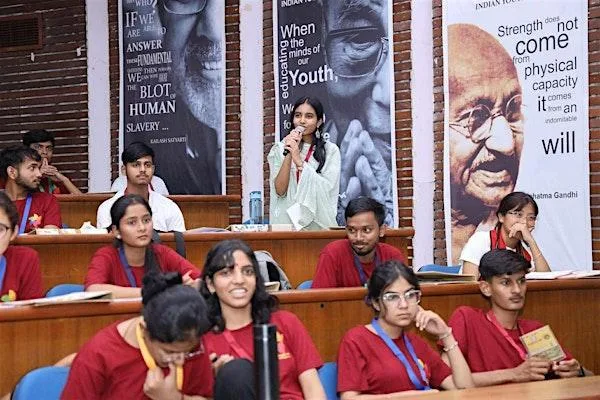
Indian campuses should be viewed as training grounds for democratic citizenship and national leadership. Student politics, at its best, teaches young citizens how to debate, organise, negotiate, represent others and accept responsibility. These are valuable democratic skills.
However, democratic participation must coexist with academic responsibility.
A duty-oriented approach to student leadership can provide this balance. Freedom of expression and intellectual disagreement are essential to universities. At the same time, students, teachers and administrators share responsibility for protecting the academic character of institutions.
Constructive student leadership should therefore move beyond slogans alone. Student representatives should increasingly develop data-backed proposals, participate in structured consultations and contribute solutions to institutional problems.
Using Digital Platforms for Youth Participation
India’s digital public infrastructure provides an important foundation for such participatory democracy.
Platforms such as MyGov have demonstrated that governments can invite citizens directly into consultations, competitions, innovation challenges and policy discussions. The Election Commission’s cVIGIL application similarly illustrates how technology can enable citizens to participate directly in protecting electoral integrity.
These initiatives represent an important change in the philosophy of governance. The citizen is no longer merely the recipient of government services. Increasingly, the citizen can become a participant in governance.
For Generation Z, this model should be expanded considerably.
Government ministries, municipalities and public institutions could regularly identify specific governance challenges and invite young citizens to develop solutions. Universities could partner with municipal governments on waste management, public transport, environmental sustainability, water conservation and urban planning. Technology students could participate in digital governance challenges. Social science students could contribute to policy evaluation and community research.
Such mechanisms would create a generation that does not simply criticise governance from outside but understands the complexity of governing from within.
Digital Literacy and Constitutional Values
Digital literacy must accompany this expansion of participation.
Young Indians possess extraordinary access to information, but digital abundance also creates vulnerabilities. Misinformation, manipulated videos, algorithmic echo chambers and emotionally charged content can distort democratic discussion. The response should not be excessive control over legitimate expression. It should be greater intellectual resilience.
Schools and universities should teach young citizens how to verify information, understand sources, identify manipulated content and distinguish evidence from opinion. Constitutional literacy should accompany digital literacy. Young citizens should understand not only their fundamental rights but also democratic institutions, constitutional duties and the responsibilities that accompany citizenship.
This is where the idea of a duty-oriented democratic culture becomes particularly valuable.
India’s democratic future cannot rest upon rights alone or duties alone. The two must reinforce each other. Citizens have the right to question institutions, and institutions have the responsibility to respond. Citizens also have a duty to engage responsibly, respect democratic disagreement and protect public institutions from violence and misinformation.
Creating a Permanent Framework for Youth Participation
The government can facilitate this relationship by creating credible channels through which youthful energy enters policymaking.
Youth advisory councils, policy hackathons, district-level innovation forums, university-government partnerships, digital consultations and mentorship programmes could create a continuous pipeline from participation to policy. This is particularly important because India’s demographic dividend is geographically and socially diverse. The aspirations of a technology professional in Bengaluru may differ from those of a competitive examination aspirant in Patna, a farmer’s daughter in Haryana, an entrepreneur in a tier-two city or a university student in Delhi. A national youth strategy must recognise this diversity while providing a common framework of opportunity.
The deeper question is whether India can create a democratic architecture capable of converting youthful aspiration into national capacity.
Considerable foundations have already been created through digital governance, infrastructure expansion, entrepreneurship programmes, skilling initiatives, citizen participation platforms and India’s rapidly developing innovation ecosystem. The next phase should deepen these achievements by strengthening institutional accountability, improving employment pathways, widening leadership opportunities and creating permanent mechanisms for youth participation.
Generation Z should not be regarded as a constituency that government must merely manage. Nor should youthful activism automatically be interpreted as confrontation with the state. Young Indians should increasingly be treated as partners in the continuing project of nation-building.
India possesses something many ageing societies no longer have: millions of young citizens entering adulthood with ambition, technological familiarity and rising expectations. Properly channelled, this energy can become one of the country’s greatest strategic strengths.
The demographic dividend will ultimately be realised not simply when young Indians find employment, but when they acquire a meaningful stake in India’s economic, institutional and democratic future.
The task of government is therefore not to contain youthful aspiration but to give it direction, opportunity and institutional expression. The responsibility of young citizens, in turn, is to combine their demand for change with informed participation, constitutional values and commitment to the larger national interest.
Young citizens move from being beneficiaries of development to becoming architects of India’s future. In that transformation lies the real promise of India’s demographic dividend. The strength of the Republic will ultimately depend not only on how effectively it governs its young citizens, but on how successfully it enables them to participate in governing, innovating and building the India they will inherit.
Dr Rachna K Prasad, is Asst Professor Political science Delhi University. She can be contacted at drrachnaprasad24@gmail.com.