






SUMAN K SHRIVASTAVA
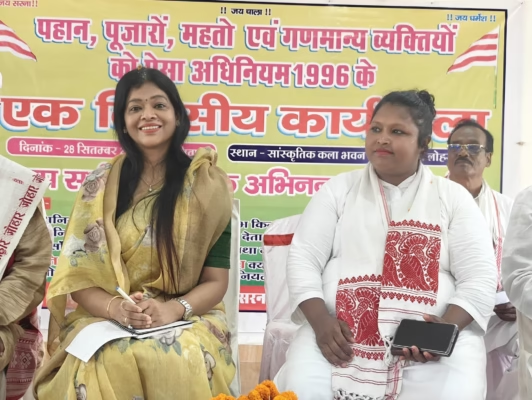
 Ranchi, Sept 29: A new wave of tribal assertion is taking shape in Jharkhand, led by Indian Revenue Service (IRS) officer Nesha Oraon, who is spearheading a campaign to protect Adivasis’ age-old traditions and distinct cultural identity.
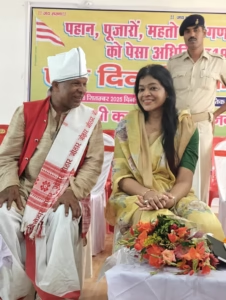
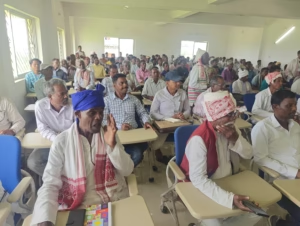
On Monday, five tribal communities in Lohardaga district formally launched what they call the “second chapter of the Paramparik Ulgulan (Cultural Revolution)”, following an earlier movement that began in Khunti. The initiative seeks to defend customary laws, spiritual practices, and indigenous governance systems that have shaped tribal society for centuries.

At the heart of the movement is a call to resist outside interference, particularly efforts to introduce a “Model Gram Sabha” in Khunti’s Jiuri village. According to the organisers, this experiment—backed by non-customary tribal groups (Gair-Rudhijanya Adivasi Sangathan)—undermines the authority of customary institutions, imposes the Panchayati Raj structure on traditional Gram Sabhas, and sidelines traditional Adivasi leaders, defined under customary laws, in favour of educated or converted tribals.
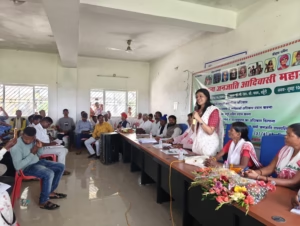
“Traditional customs connect society with nature, ancestors, and gods. For thousands of years, these systems have been handed down by our forefathers. It is now our responsibility to preserve and carry them forward,” participants declared at a workshop attended by representatives from the Munda, Ho, Santhal, Oraon, and Khadia communities.
The Rudhijanya Adivasi Samanvya Samiti (Customary Tribals Coordination Committee), comprising office bearers of traditional tribal bodies, is driving this campaign. Its members include leaders and activists from multiple tribes, with Nesha Oraon serving as Patron. The committee has openly rejected attempts to alter customary systems, calling them an intrusion into constitutional rights.
Significantly, the movement has also taken a strong position against Christian converts within tribal society, arguing that those who do not believe in the traditional gods and ancestors cannot govern or represent customary institutions. Leaders point to a Supreme Court ruling that, in their view, affirms this stance.
From Bureaucrat to Advocate of Tribal Rights
Nesha Oraon, a 2008-batch IRS officer and daughter of senior Jharkhand politician Rameshwar Oraon, is no stranger to the complexities of tribal governance. During her deputation as Director of Panchayati Raj, Jharkhand, she played a central role in framing rules under the PESA Act (Provisions of the Panchayats Extension to Scheduled Areas, 1996)—a legislation designed to empower Gram Sabhas in tribal regions.
Her tenure also saw the launch of an ambitious programme titled “Hamari Parampara, Hamari Virasat” (Our Tradition, Our Heritage), supported by the Government of India. It aimed to document tribal customary systems, traditions, and cultural heritage to preserve them for future generations. However, the project struggled to move forward after her tenure ended, leaving the vision of systematic documentation of tribal heritage incomplete.
Even so, her broader efforts in the Panchayati Raj department left a strong imprint. She oversaw initiatives to strengthen grassroots governance, reopen defunct panchayat buildings, and clarify rights over land, forest produce, and traditional institutions. She also led public consultations and workshops to educate communities about PESA, emphasising that Gram Sabhas must remain the cornerstone of tribal self-governance.
Although her deputation ended in April 2025, with her return to the Central Board of Direct Taxes, Nesha Oraon (She is currently posted as Additional Income Tax Commissioner in Ranchi) has continued to champion Adivasi rights in a personal capacity. Her latest initiative positions her not only as a bureaucrat but also as a public advocate working to shield tribal traditions from what she and her supporters describe as external encroachment.
A Rebellion Rooted in Tradition
The declaration in Lohardaga echoes a long history of tribal uprisings in Jharkhand, many of which originated in Khunti—the birthplace of legendary leaders like Birsa Munda. Today’s conservative tribal leaders see themselves as carrying forward that legacy, this time through legal awareness workshops, cultural reaffirmation, and public resistance to institutional changes.
“We will not allow interference in our traditional heritage,” Nesha vowed. “Our identity is spiritual, not racial. We have our own gods, ancestors, and customs, and no external system can replace them,” she added.
As Jharkhand continues to debate how PESA should function in practice, this “Cultural Revolution” underscores the tension between modern governance structures, religious conversions, and the enduring strength of tribal customs. With Nesha Oraon at the forefront, the campaign is rapidly emerging as both a cultural and political statement in defence of Adivasi identity.
