






SUMAN K SHRIVASTAVA
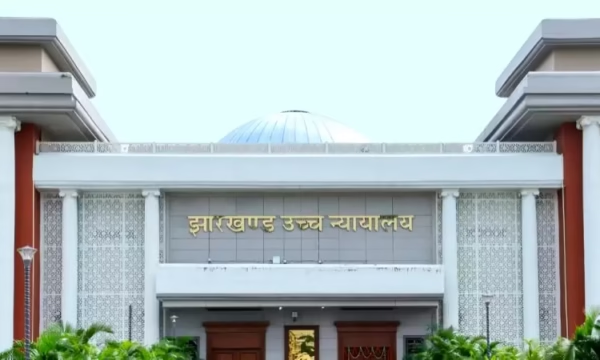
 Ranchi, Feb 26: In a significant ruling aimed at strengthening environmental governance and public health safeguards, the Jharkhand High Court on Thursday issued a detailed 19-point compliance framework for effective implementation of the Bio-Medical Waste Management Rules, 2016, before disposing of a Public Interest Litigation (PIL) pending since 2012.
A division bench comprising Chief Justice M.S. Sonak and Justice Rajesh Shankar held that while sustained judicial monitoring was necessary to overcome administrative inertia, the statutory framework in the state is now sufficiently robust, and primary responsibility must rest with designated authorities.

State-Level Nodal Officer, Digital Tracking Mandatory
Among the key directions, the court ordered the State Government to designate a State-Level Nodal Officer, not below the rank of Secretary, within 30 days to ensure inter-departmental coordination and monitoring of biomedical waste compliance.
The Jharkhand State Pollution Control Board (JSPCB) has been directed to maintain and regularly update a district-wise inventory of all healthcare facilities generating biomedical waste and all authorised Common Bio-Medical Waste Treatment Facilities (CBMWTFs).
The court also mandated full implementation of barcoding and digital traceability systems across the chain of generation, collection, transportation and treatment of biomedical waste.
Surprise Inspections, Coercive Action for Violations
The High Court directed the JSPCB to conduct periodic and surprise inspections of healthcare facilities and treatment plants. It clarified that violations of the 2016 Rules constitute contraventions under the Environment (Protection) Act, 1986, and may attract suspension, closure, environmental compensation or prosecution.
A publicly accessible digital dashboard reflecting district-wise compliance status, inspections conducted and enforcement action taken must also be developed.
District Monitoring Committees under the 2016 Rules must be made functional within 60 days wherever inactive.
Strict Oversight at District Level
Deputy Commissioners and District Magistrates have been directed to ensure that biomedical waste is not mixed with municipal solid waste. They must periodically review compliance in coordination with Civil Surgeons, JSPCB officials and urban local bodies.
ALSO READ: President Murmu lays foundation for ₹100-crore Jagannath temple in Jamshedpur
Healthcare facilities with more than 30 beds must constitute Bio-Medical Waste Management Committees. Smaller facilities must designate responsible nodal officers, with contact details displayed publicly.
The court also ordered the JSPCB to conduct a statewide gap analysis within three months to assess treatment capacity, infrastructure gaps and geographical coverage.
PIL Filed Over Open Dumping in 2012
The PIL was filed in 2012 by the Jharkhand Human Rights Conference, raising serious concerns over open dumping of infectious biomedical waste in Ranchi, Dhanbad and Jamshedpur.
At the initial stage, the High Court found a lack of consolidated data, poor coordination between authorities and unsafe disposal practices posing grave public health risks.
Over the years, the court monitored compliance, ordered statewide surveys, sought reports from Deputy Commissioners and intervened in specific cases, including conditions at RIMS, Ranchi.
Infrastructure Expanded During Litigation
The bench recorded that sustained judicial oversight led to measurable improvements. From only one operational Common Bio-Medical Waste Treatment Facility at the beginning of the litigation, the state now has six operational facilities across Ramgarh, Lohardaga, Dhanbad, Pakur and Deoghar, with another under construction at Giridih.
Training programmes, improved segregation practices and stronger institutional coordination between the Health Department and JSPCB were also noted.
Article 21 and Constitutional Duty
The High Court emphasised that biomedical waste management is intrinsically linked to the right to life under Article 21 of the Constitution, which includes the right to a clean and pollution-free environment.
Referring to Supreme Court judgments including Subhash Kumar v. State of Bihar, M.C. Mehta v. Union of India, and T.N. Godavarman, the bench observed that judicial intervention becomes necessary when executive inaction undermines statutory protections.
However, it reiterated that courts cannot function as continuing administrators once an effective institutional framework is in place.
ALSO READ: Rights and duties in India: Why balancing both is essential for nation building
Monitoring Ends, Accountability Continues
Disposing of the PIL, the court clarified that its directions are facilitative and aimed at strengthening coordination and enforcement under existing law. It held that continued judicial supervision is neither warranted nor consistent with the doctrine of separation of powers.
At the same time, the bench made it clear that any person aggrieved by future violations remains free to seek remedies under the law.
The Registry has been directed to circulate the order to key departments and district authorities. The JSPCB must upload the complete order on its official website within two weeks for public access and compliance dissemination.
With these observations and directions, the 14-year-old PIL stands formally closed.