






SUMAN K SHRIVASTAVA
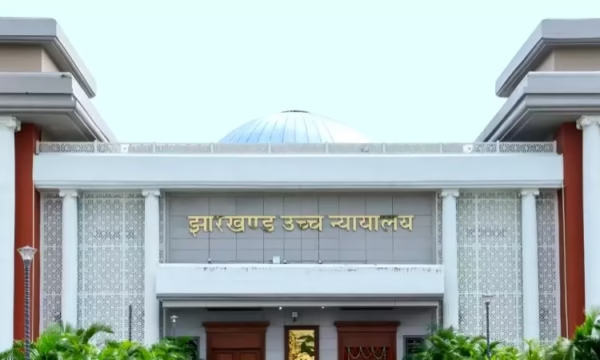
Ranchi, April 1: In a significant judgment on public health infrastructure, the Jharkhand High Court has directed the state government to make dedicated burn units fully functional in all district hospitals and medical colleges within 120 days, highlighting serious deficiencies in burn care facilities and calling it a violation of the right to health under Article 21.
The order came in a Public Interest Litigation (W.P. PIL No. 920 of 2021) filed by Onkar Vishwakarma, concerning a 2021 kerosene fire tragedy in Hazaribagh that led to multiple deaths and severe burn injuries.
Court Flags Systemic Failure in Burn Care
A division bench comprising Chief Justice M. S. Sonak and Justice Rajesh Shankar observed that the issue goes beyond a single incident and exposes a “state-wide paralysis” in specialised burn care infrastructure.

The court noted that even years after sanctioned projects under the National Programme for Prevention and Management of Burn Injuries (NPPMBI), several burn units remain non-functional due to a lack of equipment, staff, and proper monitoring.
It also pointed to inconsistencies in the state’s affidavits, including mismatched data on operational burn units and a lack of clarity on infrastructure created with public funds.
Right to Health Cannot Be “Illusory”
Emphasising constitutional principles, the court held that the right to life includes access to timely and specialised medical care.
Citing key Supreme Court rulings, including Paschim Banga Khet Mazdoor Samity vs State of West Bengal and Parmanand Katara vs Union of India, the bench said the state cannot cite financial constraints to deny emergency healthcare.
The court observed that burn injuries require specialised treatment, and treating patients in general wards without proper facilities undermines dignity and survival chances.
ALSO READ: Sunil Ambekar at IIM Ranchi highlights RSS@100 vision, focus on Panch Parivartan
Key Directions to Jharkhand Government
The High Court issued a series of time-bound directions to strengthen burn care across Jharkhand:
- Establish and operationalise dedicated burn units in all districts within 120 days
- Ensure the availability of trained doctors, nurses, and paramedical staff
- Provide essential equipment, medicines, and infection-control systems
- Treat burn patients only in specialised units, not general wards
- Set up and activate a State Monitoring Committee for regular review
- Conduct training and capacity-building for healthcare personnel within 90 days
The Director-in-Chief, Health Services, has been made the nodal authority for implementation.
Compensation: Victims Can Seek Relief Through Legal Routes
While the court did not grant direct compensation in the PIL, it clarified that victims and their families can seek compensation under the Victim Compensation Scheme (Section 357-A CrPC / Section 396 BNSS).
The District Legal Services Authority (DLSA), Hazaribagh, has been directed to assist victims in filing claims, and courts have been asked to decide such cases within a stipulated time frame.
Background: 2021 Hazaribagh Kerosene Tragedy
The PIL was filed after a 2021 incident in Hazaribagh where allegedly adulterated kerosene supplied through the Public Distribution System caused a fire, resulting in four deaths, including a child, and injuries to several others.
Laboratory reports indicated the kerosene had a dangerously low flash point of 13.5°C, far below the safety standard of 35°C. The petitioner also highlighted the lack of treatment facilities and the shortage of medicines at Sadar Hospital.
Larger Public Health Concern
The court referred to national and global data showing India has one of the highest burdens of burn injuries, with thousands of deaths annually. It stressed that failure to operationalise burn units despite allocated funds reflects a gap between policy and implementation.
Calling for urgent reforms, the court said a welfare state must ensure not just infrastructure on paper but functional, life-saving healthcare systems.