







SUMAN K SHRIVASTAVA
Ranchi, July 15: In a significant ruling impacting thousands of aspiring teachers, the Jharkhand High Court has directed the Jharkhand Staff Selection Commission (JSSC) to reinstate candidates holding a two-year Bachelor of Education (B.Ed.) degree into the ongoing recruitment process for primary school assistant teachers.
The judgment offers much-needed clarity and relief after a series of inconsistencies in eligibility criteria led to confusion and legal challenges surrounding Advertisement No. 13/2023, which announced 26,001 vacancies across government schools.

Senior lawyer Ajit Kumar represented these aggrieved teacher aspirants.
Portal Glitch Fuels Legal Challenge
The controversy began when JSSC’s recruitment portal initially listed “two-year B.Ed” as a selectable qualification in the application drop-down menu. However, it was later abruptly removed without explanation. Candidates who relied on the initial option and had already submitted applications were left in limbo.
Also Read: Jharkhand News: CBI arrests three CCL officials in extortion case
Adding to the confusion, prior recruitment drives had recognised the two-year B.Ed. course as valid. Several applicants subsequently received notices stating their applications were invalid due to “unavailable” qualifications, despite having followed the portal’s instructions and holding valid Jharkhand Teacher Eligibility Test (JTET) certificates.
The JSSC later issued email communications advising affected candidates to resubmit their applications using alternate options and to include handwritten explanations. Relying on these assurances, many complied, only to face rejection during the document verification phase.
Court Rejects Arbitrary Exclusion
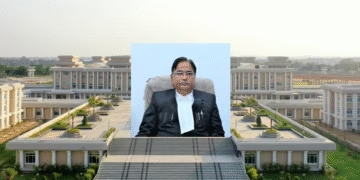
A single bench headed by Justice Deepak Roshan, delivering the judgment on July 14, found the JSSC’s actions arbitrary, particularly since the official recruitment advertisement did not explicitly exclude two-year B.Ed. degrees. It highlighted that the criteria specified “a minimum of 50% in graduation or equivalent and a one-year B.Ed. course,” but imposed no upper limit or prohibition on longer programmes.
The court also pointed to binding guidelines from the National Council for Teacher Education (NCTE), which mandated a two-year B.Ed. courses in its 2014 regulations and 2019 notification. It observed that both central regulations and previous court rulings had affirmed the legal validity of such degrees.
Quoting NCTE’s authority as the apex body for teacher education, the court stated that the exclusion of two-year B.Ed. holders were not only illogical but also in clear violation of binding norms.
Supreme Court’s CTET Ruling Misapplied
The legal complexity deepened when a prior High Court order allowing CTET-qualified candidates from neighbouring states to apply was overturned by the Supreme Court in January 2025. However, the apex court’s judgment focused solely on the ineligibility of CTET and other state TET candidates, not on the nature of B.Ed. qualifications.
Despite this narrow scope, the JSSC allegedly misinterpreted the ruling, issuing notices that led to the exclusion of valid JTET holders with a two-year B.Ed. degrees. The High Court strongly criticised this misapplication, calling it a violation of the principles of promissory estoppel and legitimate expectation.
All Eligible Candidates Must Be Verified
Allowing the writ application, the court ordered JSSC to immediately call the Petitioners for document verification. It further directed the Commission to include all similarly placed candidates who were excluded solely based on their two-year B.Ed. degrees.
However, the court clarified that participation in the verification stage does not guarantee appointment. Selection would depend on overall merit and fulfilment of other eligibility conditions.
Wider Implications
This ruling is expected to bring relief to a large pool of candidates caught in administrative limbo. It serves as a reminder that regulatory clarity and procedural consistency are essential, especially in high-stakes public recruitment.
Legal experts see the judgment as a strong affirmation of candidate rights and a cautionary note to recruiting bodies to honour their published criteria and assurances.
