






SUMAN K. SHRIVASTAVA
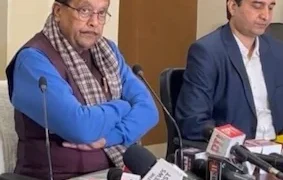
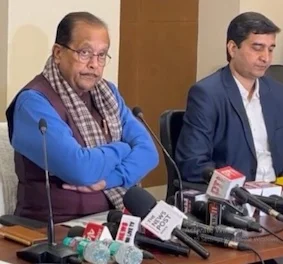
 Ranchi, April 10: With the Jharkhand treasury scam spreading across multiple districts and the amount involved continuing to rise, Finance Minister Radhakrishna Kishore on Friday called for a two-pronged probe into systemic failures and possible criminal conspiracy behind the illegal withdrawals.
In a letter to the Finance Secretary, the minister stated that the issue must be examined from two distinct angles: first, the exploitation of loopholes in the withdrawal system, and second, the commission of criminal acts through such illegal transactions.
Multi-District Spread Raises Concern
The minister pointed out that cases initially detected in Bokaro and Hazaribagh have now also surfaced in Palamu. All three cases are linked to the Police Department.

He cautioned that similar instances may exist in other districts and cannot be ruled out. Given the common departmental link, he stressed the need to examine whether an organised syndicate or coordinated criminal intent is behind these withdrawals.
Palamu Inquiry Underway
In the case of Palamu, the minister said that an inquiry report has been sought from the Deputy Commissioner. He noted that the actual situation will become clear only after the report is submitted.
DDO Accountability Questioned
The minister expressed concern that no accountability has yet been fixed on Drawing and Disbursing Officers (DDOs), despite their central role in the payment process.
He highlighted that DDOs are fully aware of:
- sanctioned and working staff strength
- number of employees to be paid
- salary amounts
- bank account details and IFSC codes
- budget allocation and expenditure
Under Rule JTC-17 of the Jharkhand Treasury Code, DDOs are required to certify all these details and bear responsibility for any incorrect payments. Only after such certification does the treasury process payments.
Call for Statewide Probe
In light of these issues, the minister has called for a comprehensive investigation across all districts, focusing on both systemic weaknesses and criminal culpability.
He also directed that the Home Secretary and Director General of Police be informed to verify how long accountants have been posted in different districts, indicating concern that prolonged postings may have enabled manipulation.
The letter underscores the need for a deeper examination of both administrative lapses and potential organised wrongdoing in the state’s treasury operations.
Over ₹30 Crore Fraud Detected
So far, fraudulent withdrawals exceeding ₹30 crore have been uncovered—₹4.29 crore in Bokaro and over ₹27 crore in Hazaribagh. The figure is expected to rise further as investigations continue.
Modus Operandi: Pattern of Fraud
Investigations have revealed a consistent pattern:
- Retired personnel shown as active by altering records
- Fake salary bills generated repeatedly
- Funds diverted to personal or relatives’ bank accounts
- Multiple withdrawals using different vouchers for the same period
- Duplicate and overlapping bills processed without detection
In Bokaro, an accountant manipulated records of a retired havildar and carried out 63 fraudulent transactions over 25 months, transferring funds to his wife’s account.
In Hazaribagh, the scam continued for nearly 14 years. Large sums were routed into the accounts of constable Shambhu Kumar through fake billing, with investigators also finding involvement of other constables and family members. The accused allegedly used the money to acquire luxury vehicles and properties.
e-Kuber System Under Scrutiny
The scam has exposed serious vulnerabilities in the state’s online treasury system, e-Kuber. Despite digitisation, weak validation, poor data integrity, and a lack of real-time checks, fraudulent entries and duplicate bills were allowed to pass through multiple levels without detection.