
Neeley Aakash Ka Sach: Shibu Soren, Jharkhand, and politics of exclusion from power
Shibu Soren, the central figure of the Jharkhand movement, spent decades fighting for a separate state. Yet, after Jharkhand was created,…
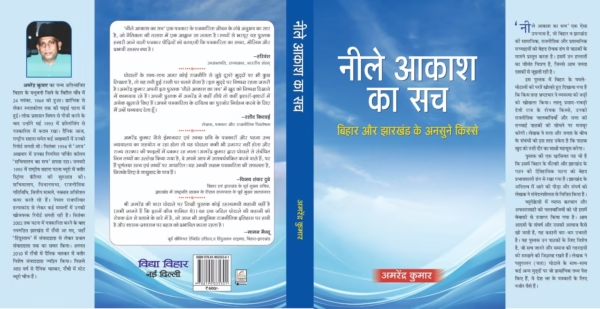
Shibu Soren, the central figure of the Jharkhand movement, spent decades fighting for a separate state. Yet, after Jharkhand was created, the manner in which he was kept away from power remains one of the most troubling chapters in Indian politics. Senior journalist Amarendra Kumar’s book ‘Neeley Aakash Ka Sach’ confronts this contradiction directly. It examines how power is negotiated behind closed doors and how leaders who spearhead mass movements are often sidelined once the goal is achieved.
The book looks at the politics of Bihar and Jharkhand not merely as a sequence of events, but as a system of decisions, strategies, and exclusions. In the context of Jharkhand, it highlights the political cost of statehood.
‘Bihar Vibhajan aur Jharkhand Gathan’: From Movement to State Power
The book opens with the chapter ‘Bihar Vibhajan aur Jharkhand Gathan’, which traces the background of the Jharkhand movement, the long struggle, and the political manoeuvring that led to the creation of the state.
This was the period when Bihar Chief Minister Lalu Prasad repeatedly stated that Jharkhand would be formed only over his dead body. Political circumstances later changed, equations shifted, and the separate state came into existence.
The book raises a critical question: when Jharkhand was formed, who would lead it? It explains how senior BJP leader Kariya Munda narrowly missed becoming the first Chief Minister, how Babulal Marandi emerged instead, and how Shibu Soren—the axis of the Jharkhand movement—was kept away from power.

Shibu Soren: Leader of a Movement, Kept Away from Authority
Amarendra Kumar documents the political games played against Shibu Soren. The book shows how a leader who carried the Jharkhand movement to the grassroots was sidelined at the moment of state formation.
It examines what Shibu Soren sought at the time, the assurances made, and how political parties pursued their own interests. This section highlights a recurring political reality: the paths of a movement and power rarely align.
1996 and a Missed Prime Ministership
A major section of the book focuses on the unstable national politics of 1996. The United Front of non-BJP and non-Congress parties struggled to agree on a Prime Ministerial candidate.

During this period, Bihar Chief Minister Lalu Prasad Yadav came very close to becoming Prime Minister. He had prepared his strategy and positioned himself carefully. However, shifting alliances allowed H.D. Deve Gowda to take the top post. Deve Gowda did not last long, and Inder Kumar Gujral later became Prime Minister. The book narrates this episode in detail.
‘Pashupalan Ghotala aur Lalu Prasad’: Power Versus Law
The chapter ‘Pashupalan Ghotala aur Lalu Prasad’ examines the biggest corruption scandal in Bihar’s political history. The author explains how Lalu Prasad initially refused to order an FIR against the mafia involved and how pressure eventually forced him to act.
This chapter shows how institutions bent before political authority and how the scandal permanently altered Bihar’s politics.
Power, Business, and Secret Systems
Chapters such as ‘Gupt Fund ka Gupt Upyog’, ‘Khan aur Udyog’, and ‘Sharab par Khel’ expose the nexus between power, bureaucracy, and business houses. They demonstrate how natural resources, government schemes, and public funds were used for private interests—first in Bihar and later in Jharkhand.
The Human Side of Politics
The book is not limited to conspiracies and corruption. The chapter ‘Lalu Prasad aur Rabri Devi ke Rochak Kisse’ highlights the human and dramatic aspects of politics. The anecdote of Lalu Prasad and Rabri Devi eating sattu and chura during the 2001 Darbhanga floods shows simplicity as well as political symbolism.
Did Jharkhand Learn Anything?
In ‘Bihar ke Ghotalon se Nahin Seekha Jharkhand Ne’, the author delivers a stark assessment. The new state repeated Bihar’s mistakes. Corruption, misuse of secret funds, and power struggles weakened public faith.
Chapters like ‘Paani ke Pipe mein Behta Bhrashtachar’ and ‘Raghubar Das, Meinhardt aur Rajyapal ka Sanyog’ reveal invisible political forces operating at the highest levels.
‘The Guardians: Babulal se Hemant Tak’
The final chapter, ‘The Guardians: Babulal se Hemant Tak’, sums up Jharkhand’s political journey. It evaluates the role of successive chief ministers and the ongoing tension between governance and political manoeuvring.
‘Neeley Aakash Ka Sach’ is not merely a book about Bihar and Jharkhand politics. It is a sharp journalistic account of how movements collide with power and how ideals are compromised once the state is formed.
In the context of Shibu Soren, the book leaves readers with a disturbing question: are leaders who build mass movements destined to become inconvenient after success?
Amarendra Kumar’s work reminds us that the political sky may look blue from above, but beneath it lie deep and persistent shadows.