
Nepal’s Himalayan disaster is a warning about climate change and ecological neglect
DR RACHNA K PRASAD When the mountains begin to move, the real question is not whether nature is taking revenge, but whether…
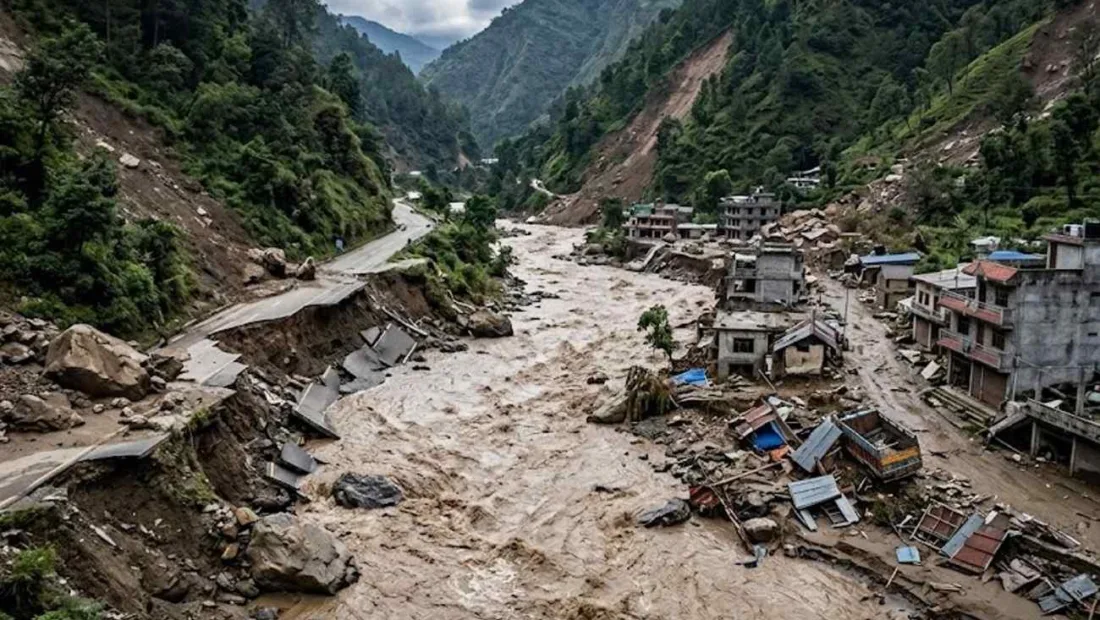
Bhotekoshi valley after the disaster
DR RACHNA K PRASAD

When the mountains begin to move, the real question is not whether nature is taking revenge, but whether humanity is finally confronting the consequences of disturbing a fragile ecological balance.

There are moments when nature seems to speak with terrifying force. Mountains collapse, rivers abandon their familiar courses, glaciers break apart, and settlements that have existed for generations disappear within minutes. In such moments, the language of statistics—rainfall, temperature, cubic metres of water and economic losses—seems strangely inadequate.
The catastrophe that struck Nepal’s Bhotekoshi region in August 2026 was one such moment. A massive rock-and-ice collapse in the Himalayan landscape sent an enormous mass of debris towards the valley below. Rivers swelled with frightening speed. Settlements, roads, bridges and livelihoods were swept into a landscape of mud and destruction.
Behind the casualty figures were families waiting for people who would never return, survivors trying to recognise places where their homes once stood, and communities confronting the possibility that ancestral land itself had become unsafe.
It is tempting to describe such destruction as “nature’s revenge.” The phrase captures something emotionally powerful. For centuries, modern civilisation has treated mountains, rivers, forests and glaciers as resources to be conquered, diverted, extracted and developed. When those same ecological systems become sources of catastrophe, it can feel as though nature is striking back.

But nature does not seek revenge.
What we call nature’s revenge may actually be something more disturbing: consequences.
The Nepal tragedy therefore asks us to look beyond one flood or one collapsed mountain. It reveals several uncomfortable truths about climate change, development and the increasingly unstable relationship between human civilisation and the natural world.

Climate change is not the whole explanation—but it cannot be ignored
After every major environmental catastrophe today, the question appears almost immediately: Was this caused by climate change?
The answer requires caution.
The immediate trigger of the Bhotekoshi catastrophe involved a complex rock-and-ice collapse in an extraordinarily dynamic geological environment. The Himalayas are young mountains. Earthquakes, landslides, avalanches and floods occurred there long before industrialisation began altering the global climate.
It would therefore be scientifically careless to claim that climate change alone caused a particular mountain to collapse. But the opposite conclusion—that climate change has nothing to do with the changing risks facing the Himalayas—is equally difficult to defend.
The environmental background is changing. Rising temperatures affect glaciers, snow cover and permafrost. As frozen material retreats or thaws, slopes can become unstable. Glacial lakes can expand. Extreme rainfall interacting with steep terrain can produce landslides and destructive floods. One event can trigger another, producing what disaster researchers describe as cascading hazards.
A glacier does not exist separately from a mountain. A mountain does not exist separately from rainfall. A river does not exist separately from settlements constructed along its banks.
This interconnectedness is precisely what makes the Himalayan crisis so serious.
Climate change need not “cause” every disaster directly to increase the conditions under which disasters become more dangerous.
Waiting for perfect scientific attribution before strengthening resilience would therefore be a dangerous luxury. Science must remain cautious about causation, but governments cannot afford to be cautious about preparation.
Nepal and the cruel arithmetic of climate injustice
There is another reason the Nepal tragedy should trouble the international community. Nepal has contributed only a tiny fraction of the greenhouse gases accumulated in the atmosphere. Yet it stands on the front line of climate vulnerability.
This is the great contradiction of the climate crisis: those who contributed least are frequently among those asked to suffer most.
For wealthy countries, climate change may mean expensive adaptation projects, higher insurance premiums or infrastructure upgrades. For a poor mountain community, it can mean the disappearance of a village. And disaster does not end when floodwaters recede.
A developing country must divert scarce public money towards reconstructing roads, schools, bridges, electricity networks and health facilities. Money that might have financed education, healthcare, employment or poverty reduction instead goes towards rebuilding what has already been built once.
The disaster therefore creates an invisible second tragedy: lost development.
A bridge destroyed by a flood is not merely the price of another bridge. It represents the hospital that may not be upgraded, the school that may not be constructed and the welfare programme that may remain underfunded.
Worse still, vulnerable countries may have to borrow to reconstruct infrastructure destroyed partly within a global climate environment they did little to create. This is why the debate about climate finance must move beyond charity.
Climate-vulnerable countries are not simply asking wealthy nations to be generous. They are raising a question of responsibility.
If the prosperity of industrialised societies was built partly through generations of carbon-intensive development, while the environmental costs are disproportionately falling upon countries with very small historical emissions, climate finance becomes a matter of justice. Nepal makes that inequality painfully visible.
Loss and damage is about more than money
International climate negotiations increasingly recognise the idea of loss and damage: some climate-related destruction cannot simply be prevented through adaptation, and vulnerable countries need support when irreversible losses occur.
Nepal’s experience demonstrates why this principle matters. But there is a danger in reducing loss and damage to financial accounting.
How much is an ancestral village worth?
What price should be assigned to a centuries-old cultural landscape buried beneath sediment? How does an economist calculate the value of a family graveyard, a sacred place, a community’s collective memory or the psychological security of knowing that the mountain above your home has always protected you?
Some losses can be reconstructed. A bridge can be rebuilt. Electricity lines can be restored. A damaged road can be resurfaced. Others cannot.
A person lost beneath debris cannot be replaced by compensation. A displaced indigenous community may receive new houses without recovering its relationship with ancestral land. Children who experience catastrophic disasters may carry psychological scars long after the physical infrastructure has been repaired.
This is why climate justice cannot be understood purely through balance sheets.
The international Loss and Damage architecture will ultimately be judged not by the elegance of diplomatic declarations but by what happens when a country actually needs help. Does assistance arrive quickly? Is it sufficient? Can affected communities access it? Does it create more debt? Does it recognise cultural and non-economic losses?
Those questions matter far beyond Nepal.
Development cannot continue to fight geography
There is another uncomfortable truth. Not every dimension of disaster can be blamed on global climate change. Local development choices matter.
A natural hazard becomes a human catastrophe when settlements, roads, hospitals, schools and critical infrastructure are placed in areas where the risks are poorly understood or simply ignored. This is particularly important in mountainous countries.
Development is necessary. Nepal needs roads, electricity, hydropower, housing, tourism and connectivity. Telling a developing society simply to stop building is neither realistic nor fair.
The real question is how development occurs.
A road cut into an unstable slope without adequate engineering may create vulnerability. Unregulated construction near rivers increases exposure. Weak building standards can transform earthquakes into mass-casualty events. Poor drainage can magnify flooding.
The lesson is not that development must stop. It is that development which ignores ecology eventually becomes economically self-defeating.
This requires a different understanding of infrastructure. Resilience is not merely stronger concrete.
It means hazard-sensitive land-use planning, enforceable building codes, environmental assessment, slope monitoring, evacuation routes, resilient hospitals and schools, community shelters and infrastructure designed around future climate conditions rather than yesterday’s averages.
“Build Back Better” should not mean reconstructing the same vulnerabilities more efficiently. It should mean refusing to rebuild yesterday’s mistakes.
Information can save more lives than concrete
Perhaps the most practical lesson from Nepal concerns something invisible: information.
In a fast-moving mountain disaster, minutes matter. A sophisticated warning issued at a national headquarters is almost useless if the shepherd, shopkeeper, teacher or family living beside the river never receives it.
Early-warning systems therefore have to reach the last mile.
Bangladesh offers an instructive example. Decades of experience with cyclones encouraged investment not only in physical shelters but also in community preparedness, warning networks, evacuation systems and local volunteers. Mountain regions require their own version of this approach.
Glaciers, rivers and weather systems do not recognise political borders. Yet scientific information often remains divided by them.
The Himalayan ecological system connects Nepal with India, China, Bhutan and other parts of South Asia. Hydrological information, satellite monitoring, glacial observations, rainfall forecasts and seismic data should therefore be treated as shared life-saving resources.
A dangerous development detected upstream should not become someone else’s surprise downstream.
Technology can help enormously. Satellites, remote sensors, artificial intelligence, automated river gauges and mobile alerts can provide increasingly sophisticated warnings. But technology alone is insufficient.
A warning saves nobody unless people trust it, understand it and know what to do next.
The most advanced sensor in the Himalayas must ultimately connect with the most vulnerable person in the valley.
Nature’s revenge—or humanity’s reckoning?
There is something profoundly humbling about a mountain disaster.
Modern civilisation has become accustomed to imagining itself as master of nature. We tunnel through mountains, dam rivers, remove forests, expand cities and alter landscapes at extraordinary speed. Technological achievement can create the illusion that ecological limits have disappeared.
Indian philosophical traditions understood Prakriti not simply as an external storehouse of resources but as an interconnected order within which human beings themselves exist. That distinction matters.
If humanity imagines itself outside nature, environmental restraint appears to be a sacrifice. If humanity understands itself as part of nature, restraint becomes self-preservation.
This does not mean romanticising the natural world. Nature has always been capable of enormous destruction. Earthquakes, floods, volcanoes and avalanches existed before humans changed the climate.
But human choices increasingly determine how exposed societies are when natural forces strike—and climate change is altering the environmental background against which those forces operate.
Perhaps, then, “nature’s revenge” is the wrong expression.
Nature does not hate us. A river does not punish. A glacier does not remember our emissions. A mountain does not decide to retaliate.
Yet consequences accumulate.
When forests disappear, when warming accelerates, when settlements spread into hazardous landscapes, when warnings are ignored and when development is planned as though ecological limits do not exist, the bill eventually arrives.
A warning from the Himalayas
Nepal’s tragedy should therefore be understood as more than a national disaster. It is a warning from one of the planet’s most fragile and important ecological regions.
The Himalayas are often described as the water towers of Asia. Their glaciers, snowfields and rivers sustain hundreds of millions of people far beyond the mountain valleys themselves. What happens in these high-altitude environments eventually affects agriculture, energy, water security, migration and human settlements across borders.
The lesson from Bhotekoshi is therefore not that humanity should fear nature. It is that humanity must rediscover humility before it.
Governments must build resilience before catastrophe rather than merely announce relief after it. Wealthier nations must recognise that climate responsibility does not stop at their borders. Developing countries must ensure that the understandable pursuit of economic growth does not reproduce ecological vulnerability. And scientific information must travel across borders faster than the hazards themselves.
Above all, we must abandon the assumption that environmental destruction happens somewhere else, to someone else.
The Himalayas are telling us otherwise.
The mountain is not taking revenge.
The mountain is revealing consequences.
And if humanity refuses to listen, Nepal’s tragedy may not remain an exceptional catastrophe. It may become a glimpse of the world we are creating—one in which the speed of environmental disruption repeatedly outruns the speed of politics, preparedness and compassion.
The real question, therefore, is not whether nature is taking revenge. It is whether humanity will understand the warning before another mountain moves.
(Dr Rachna K Prasad is Asst Professor, Political Science, Delhi University. She can be contacted at drrachnaprasad24@gmail.com.)