






SUMAN K SHRIVASTAVA
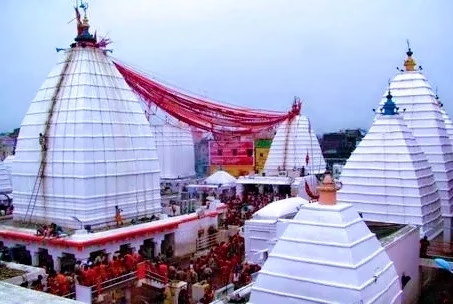
 The story of Baba Baidyanath Dham in Deoghar, one of the twelve Jyotirlingas of Lord Shiva, is not only a tale of faith and pilgrimage but also of law, custom, and relentless courtroom battles. At the centre of these disputes stands the office of the Sardar Panda, or Ojha—the chief priest of the temple. While the position commands reverence, its succession and responsibilities have been marked by a series of litigations dating back to the eighteenth century. Over time, these disputes have defined the legal character of the temple, tested the doctrine of primogeniture, and shaped how the shrine is managed today.

Hereditary Office and the Doctrine of Primogeniture
The seat of the Sardar Panda has traditionally been hereditary, following the Doctrine of Primogeniture—passing to the eldest male heir in the family of Ramadutta Ojha. This hereditary arrangement lent stability but also sparked prolonged disputes whenever succession was contested.
The Burdwan Case of 1897–1901
The first landmark litigation came in 1897, when Umeshananda Dutt Jha and two others filed Title Suit No. 18/1897 before the District Judge of Burdwan under Section 539 of the Civil Procedure Code, 1882. The plaintiffs sought the removal of the then Sardar Panda, Sailajananda Dutt Ojha, alleging dereliction of duty, and requested the framing of a management scheme for the temple.

The case proceeded with Sailajananda as the principal defendant, later joined by his son, Paramprokasanand Jha, and grandson, Bhabapritanand Jha. After a lengthy trial, Sri Jogesh Chandra Mitter, Additional District Judge of Burdwan, delivered his judgment on 4 July 1901, which became a cornerstone in the temple’s legal history.

The Court observed that the plaintiffs, though Musrifs (temple officials assisting in rituals), had a valid legal interest in temple management. It relied on historical documents such as the Ekrarnama executed by Ram Dutt Jha in 1791 and Mr. Borden’s 1860 report, both of which established that Musrifs played an important role in conducting puja and were entitled to remuneration from temple funds.
Most significantly, the Court declared Baidyanath Temple to be a public religious trust. It noted that while Ojhaship was hereditary, the hereditary character did not alter the temple’s public nature. The surplus of offerings, after meeting ritual and maintenance expenses, did not belong to the Ojha personally but to the temple trust.
Sailajananda Ojha’s conduct also came under judicial scrutiny. The Court recorded multiple instances of neglect and breach of trust, including allegations that he had substituted a sacred Punchbuddan of gold donated by Maharaja Joy Mongal Singh with one of inferior quality. Such acts, the Court said, were sacrilegious and inconsistent with the duties of a chief priest. Sailajananda was removed, and Umeshananda Dutt Jha took charge under the newly framed management scheme.
Succession Battles of the 20th Century
The death of Umeshananda in 1921 reopened the question of succession. His adopted son Manadananda Dutt Jha claimed the position, but so did Bhabapritanand Jha, grandson of Sailajananda through a predeceased son.
The case, known as Manadananda Jha v. Tarkaananda Jha, raised questions of legitimacy, adoption, and eligibility. However, by the time the matter reached final judgment in 1928–29, Bhabapritanand had crossed the minimum age threshold of forty years, a requirement under the Burdwan scheme. Both the District Judge (15 May 1928) and the Calcutta High Court (Appeal No. 375 of 1928, decided on 14 January 1929) upheld his claim. Thus, the doctrine of primogeniture prevailed, confirming that the eldest qualified male descendant was entitled to Ojhaship.
The Bihar Hindu Religious Trust Act and the Supreme Court
The mid-twentieth century brought new legal challenges with the enactment of the Bihar Hindu Religious Trust Act, 1950. Bhabapritananda Ojha argued that the Act did not apply to Baidyanath Temple. The Patna High Court in 1953 initially accepted this contention.
However, the matter reached the Supreme Court in State of Bihar v. Bhabapritananda Ojha. The apex court reversed the Patna High Court’s decision, holding that Baidyanath Temple was indeed a public religious trust situated within Bihar, and therefore subject to the Act. The Court also clarified that earlier schemes framed by the Burdwan and Calcutta courts did not negate Bihar’s jurisdiction.
This ruling decisively brought Baidyanath Dham under the regulatory framework of the Bihar Religious Trust Board, altering its management structure.
Post-1970 Disputes

Following Bhabapritanand Ojha’s death in 1970, another round of litigation ensued. Bhavapritanand Ojha died issueless. Ajitanand, his descendant from his brother Indranand Ojha, filed a suit before the Civil Judge (Senior Division), Deoghar, seeking recognition as successor to the Ojhaship and recovery of the Bhitarkhand premises.
The court reaffirmed that succession was governed strictly by the rule of primogeniture under the Burdwan scheme. The Hindu Succession Act, 1956, was declared inapplicable, as Ojhaship was an office of trust, not partible family property. Thus, only the eldest son of the last Sardar Panda, provided he was at least forty years old and otherwise qualified, could succeed.
Jharkhand Era and Institutional Reform
With the creation of the new state of Jharkhand in 2000, demands grew for modernising temple management. A writ petition before the Jharkhand High Court sought improved facilities and beautification on par with Tirupati and Vaishno Devi.
It was revealed during proceedings that the Bihar Government had earlier entrusted management to the Deputy Commissioner, Deoghar, as a one-man committee. The High Court, after hearing multiple stakeholders, constituted a High-Power Committee (later known as the Management Board) to oversee temple administration.
Legislative Intervention: The 2015 Act
The culmination of decades of legal battles and administrative experiments came with the Baba Baidyanath Dham–Basukinath Shrine Area Development Authority Act, 2015 (Jharkhand Act 06 of 2016). The Act provided a statutory framework for:
Development and regulation of the shrine area.
Organisation of the annual Shrawani Mela, one of the largest congregations of Shiva devotees.
Beautification and infrastructural improvements in and around Baidyanath Dham and Basukinath.
This legislative step marked a shift from hereditary disputes towards institutional and state-backed management.
Conclusion
From the Kabuliat of 1791 to the Supreme Court judgment of 1953, and finally to the Jharkhand legislation of 2015, the history of Baba Baidyanath Dham reveals how law and faith intersect in complex ways. The office of the Sardar Panda, once fiercely contested in courts, now exists alongside a broader statutory and administrative framework designed to balance hereditary traditions with the demands of modern governance.
What began as disputes over succession within one family has, over two centuries, evolved into a legal journey that shaped the governance of one of India’s most sacred Jyotirlingas.
(The book is also available on Amazon)
