






THE JHARKHAND STORY NETWORK
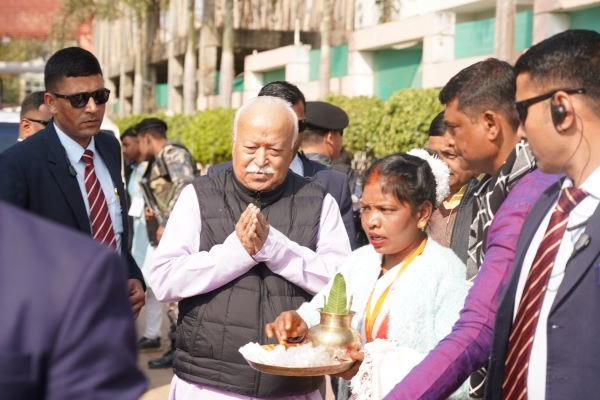
Ranchi, January 24: RSS Sarsanghchalak Mohan Madhukar Bhagwat on Saturday said that Sarna is a form of worship and not a separate religion, cautioning that social divisions weaken society and make it vulnerable to exploitation. Addressing a Janjati Samvad Karyakram here, Bhagwat said the issues faced by the Adivasi (tribal) community are national, and their resolution requires collective responsibility.

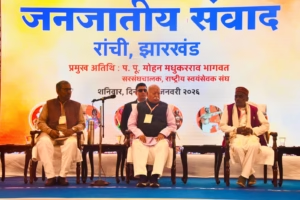
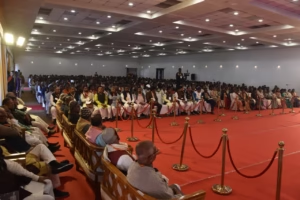
The programme was organised to facilitate a direct dialogue with tribal communities on social, cultural, educational, economic, and constitutional concerns. It was held in two sessions, allowing community representatives to present ground realities and interact with the RSS chief.
Tribal Voices Raise Key Concerns
During the first session, representatives from various tribal communities highlighted several long-standing issues, including religious conversion and its social impact, lack of quality and affordable education, substance abuse among tribal youth, illegal encroachment on tribal land, weak implementation of the PESA Act, and the erosion of traditional Adivasi colonies and cultural identity.

A tribal student from Ghatsila said the absence of adequate scholarship facilities in universities forces many deserving Adivasi students to drop out of higher education due to financial constraints.
A woman representative expressed concern over the high rate of religious conversion in her district, stating that sustained local efforts had helped bring back 35 members of the tribal community. She stressed the need for vigilance, awareness, and social unity.
Another tribal representative said several areas in Ranchi, once recognised as Adivasi colonies, have gradually disappeared due to demographic and administrative changes. He alleged that in some cases, non-Hindu individuals marry Adivasi women to occupy tribal land, while Adivasi women are often projected during elections but excluded from real decision-making.
A woman social worker said the lack of education lies at the root of many tribal problems. She noted that Vidya Bharti, affiliated with the RSS, is providing affordable education in remote areas, while alleging that missionary organisations offer low-cost education and influence children ideologically, leading to cultural alienation.
Bhagwat on Sarna, Dharma and Unity
In the second session, Bhagwat responded to questions from participants. He said Indian society must work collectively because, despite diversity, the nation is one. Emphasising unity in diversity, he said Indian civilisation has existed since Sanatan times, with different forms of worship but shared values.
Clarifying the Sarna issue, Bhagwat said Sarna is a way of worship, not a separate religion, and warned that fragmentation would weaken society. He said Hinduism is not the name of a particular worship system but a way of living together.
He explained that the term “Hindu” emerged later, but its essence lies in jal (water), jungle (forests), and kheti (agriculture). The Vedas and Upanishads, he said, emerged from harmony with nature, while the Atharva Veda reflects respect for diversity and Mother Earth.
Bhagwat said dharma means inherent nature (swabhav) and that humanity is the highest religion. He stressed that no one should remain hungry and that Indian social life is rooted in service, altruism, and respect for all creation.
Adivasi Issues Are National Issues
Addressing tribal concerns, Bhagwat said the problems of Adivasi society are the problems of the entire nation, comparing them to pain in one part of the body affecting the whole. He described Vanvasi communities as trustees of forests and land, whose consent and participation are essential.
He warned that societies are weakened through internal division, enabling exploitation by external forces. He said the Sangh does not seek power, but works to keep society organised, aware, and strong. He assured that tribal concerns would be conveyed to the Prime Minister.
Focus on Education, Employment and Action
Bhagwat stressed the need for education, employment, cultural pride, and self-respect, outlining four guiding principles: awakening self-respect, self-protection and self-reliance, growth with continuity, and safeguarding education and employment.
Calling for value-based education for children up to 12 years, protection of land rights, respect for manual labour, and regular review meetings, he said discussion must lead to duty and sustained action.
Concluding, Bhagwat said that despite centuries of invasions, India remains Hindustan, and warned that if Adivasi society is uprooted, the nation’s civilisational foundation would weaken. He called for unity, perseverance, and constructive engagement.
