







THE JHARKHAND STORY DESK
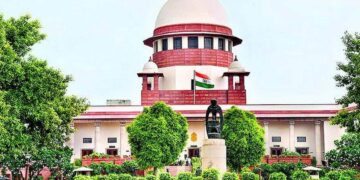
New Delhi, Dec 12: The Supreme Court on Thursday began hearing petitions challenging the constitutionality of the Places of Worship Act, 1991. A special bench consisting of Chief Justice Sanjiv Khanna, Justice PV Sanjay Kumar, and Justice K.V. Vishwanathan is hearing the case.
The apex court directed all courts in the country to refrain from issuing any interim or final orders, including survey orders, in ongoing cases involving existing religious structures.

“As the matter is sub-judice before this court, we deem it fit to direct that while suits may be filed, no suits would be registered and proceedings undertaken till further orders of this court. In the pending suits, courts would not pass any effective interim order or final orders, including orders of survey,” the bench ordered.
Centre asked to reply in four weeks
In the matter, Solicitor General Tushar Mehta, representing the central government, informed the court that the government would file an affidavit in the case.
In this regard, the CJI directed the central government to file its response and provide a copy to the petitioners. The Supreme Court has asked for the response to be submitted within four weeks. It also stated that the hearing of the case cannot proceed until the central government files its response.
Also Read- Jharkhand HC stays 75% reservation for locals in private companies in state
New cases cannot be filed
In this context, the Supreme Court also issued a directive that no new cases can be registered during the hearing of the Places of Worship Act, 1991.
Chief Justice Sanjiv Khanna said that “no new petitions can be filed until the next hearing.” The Supreme Court also instructed all petitioners to be fully prepared with their arguments for the next hearing, so that the case can be resolved as quickly as possible.
The Places of Worship Act, 1991 aims to prevent the conversion of any place of worship and ensures the preservation of its religious character as it stood on August 15, 1947, along with related or incidental matters.
The Act preserves the status of religious sites as they were on August 15, 1947, and prohibits any changes to them. However, the law excludes the Ram Janmabhoomi-Babri Masjid dispute in Ayodhya from its provisions as the Ayodhya dispute was excluded from its scope.
During the hearing, the Supreme Court referred to the judgment related to the Ram Janmabhoomi dispute and mentioned that several issues have been raised before the court, which will be thoroughly examined.
