







THE JHARKHAND STORY NETWORK
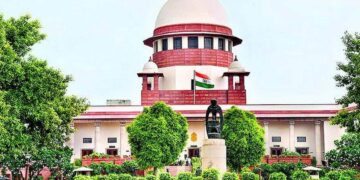
New Delhi, February 20: In an extraordinary intervention, the Supreme Court of India on Friday directed the appointment of judicial officers to oversee the adjudication of claims and objections in the Special Intensive Revision (SIR) of electoral rolls in West Bengal, citing a “trust deficit” between the State government and the Election Commission of India (ECI).
A Bench comprising Chief Justice of India Surya Kant and Justices Joymalya Bagchi and Vipul M. Pancholi observed that the ongoing “blame game” and “allegations and counter-allegations” between the two constitutional authorities had created extraordinary circumstances warranting extraordinary measures.
Judicial Officers to Replace EROs in Disputed Process
The Court said it would request the Chief Justice of the Calcutta High Court to nominate serving and former judicial officers in the rank of Additional District Judge or District Judge to revisit and dispose of pending claims categorised under “logical discrepancy”.

These judicial officers will effectively perform the functions of Electoral Registration Officers (EROs) for the limited purpose of adjudicating disputed claims. They will be assisted by micro-observers from the ECI and State government officers already deployed for SIR duties.
ALSO READ: Jharkhand stays dry as western disturbance shifts away
The Bench acknowledged that entrusting the task to judicial officers was itself an exceptional step and noted that interim arrangements may be required to manage pending cases in regular courts.
Final Voter List to Be Published on Schedule
The Court permitted the ECI to publish the final voters’ list on February 28 where the revision process has been completed, while allowing supplementary lists to be issued subsequently.
It further directed that District Collectors and Superintendents of Police must provide full logistical support to the judicial officers and would be deemed on deputation for ensuring compliance with court directions. The Director General of Police was asked to file a supplementary affidavit detailing action taken on complaints of threats against SIR officials.
State and ECI Trade Allegations
The hearing saw sharp exchanges between the State government and the ECI over compliance with earlier court directions to provide adequate Group B officers for SIR duties.
Senior Advocates Kapil Sibal and Menaka Guruswamy, appearing for the State, maintained that sufficient officers had been deputed. However, Senior Advocate Dama Seshadri Naidu, for the ECI, contended that officers of the rank of Sub-Divisional Magistrate (SDM), who are competent to pass quasi-judicial orders, had not been provided.
Senior Advocate Shyam Divan, representing West Bengal Chief Minister Mamata Banerjee, alleged that the ECI had introduced “Special Roll Observers” who were scrutinising files cleared by EROs. The ECI denied the claim, asserting that such observers were part of the process from the beginning.
Expressing dissatisfaction, the Bench indicated that judicial supervision was the only viable solution given the friction. “Since there is an element of hesitance from both sides, we will appoint judicial officers,” the Court observed, a move accepted by all parties.
Background to the Dispute
The Court had earlier directed that only EROs could pass final orders on claims and objections, and that micro-observers could merely assist them. It had also asked the State to make available Group B officers for SIR duties and directed the State’s DGP to respond to concerns regarding alleged threats to election officials.
With mounting disagreements over compliance, the Court stepped in to ensure transparency and fairness in the revision of electoral rolls — a process crucial ahead of impending elections in the State.
