







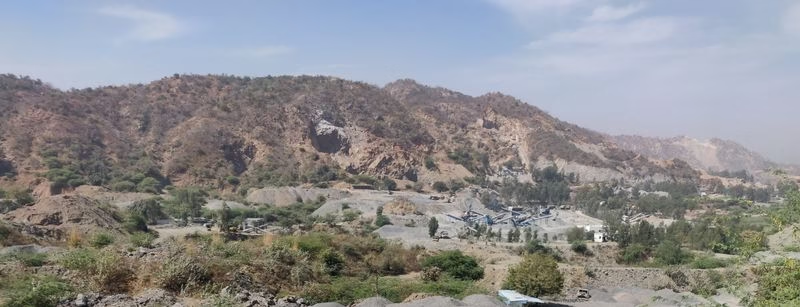
THE JHARKHAND STORY DESK

New Delhi, Dec 29: The Supreme Court has put in abeyance its November 20 ruling that had accepted the Central Environment Ministry’s definition of the Aravalli Hills and Range, a move that had raised concerns over potential regulated mining across much of the region.
The vacation bench, comprising Chief Justice of India Surya Kant and Justices J.K. Maheshwari and A.G. Masih, directed the formation of a new expert committee to review key issues related to the definition of the Aravallis.

Also Read- President Murmu inaugurates Ol Chiki Centenary in Jamshedpur
The bench also issued notices to the Centre and the four Aravalli states—Rajasthan, Gujarat, Delhi, and Haryana—seeking their responses in a suo motu case initiated by the court regarding the matter.
This development follows growing criticism from environmentalists and opposition parties over the potential ecological impact of the Centre’s definition.
The controversy stems from the Union Ministry of Environment, Forest and Climate Change’s (MoEF&CC) recently notified definition of the Aravalli Range, which classifies the hills based on a minimum height of 100 metres.
The definition had triggered fears that large portions of the Aravalli region could be opened to regulated mining, potentially harming the ecological balance.
On December 24, the MoEF&CC had also directed all four states to impose a complete ban on granting new mining leases across the Aravallis. This order aims to protect the geological continuity of the 670-kilometre-long mountain range, which stretches from Delhi through Haryana and Rajasthan to Gujarat, and to prevent unregulated mining activities.
Also Read- Stolen infant from SNMMCH Dhanbad recovered; three arrested
The Aravalli Range, India’s oldest fold-mountain belt, dates back approximately two billion years. Its highest point, Guru Shikhar in Mount Abu, Rajasthan, reaches 1,722 metres, underscoring the ecological and geological significance of this ancient ridge.
