








ILHAK AHMAD TANTRAY

Srinagar, Jammu and Kashmir: “Every family here has been engaged in willow work for generations,” said Sarwar Ahmad, 31, from Shallabugh village in Jammu and Kashmir’s Ganderbal district. “We make baskets, chairs, tables, everything. Earlier, our worry was plastic. Now, our worry is the weather.”
For generations, willow weaving has been entwined with daily life in Kashmir. Families have grown and shaped the wood into kangris (traditional firepots), baskets, furniture, and other household items. The craft provides steady work through the year, depending on the valley’s wetlands, lakes, and rivers for its supply of willow. But these ecosystems are now under strain as weather patterns grow increasingly erratic.

Extended dry spells are shrinking wetlands, while sudden heavy rains wash away young plantations. The effects are visible across Achar Lake, Shallabugh, and the nearby villages of Soura, Srinagar, and Ganderbal, where once-dense groves now stand scattered and uneven.
Willow is usually planted between February and March and harvested by November. It needs moist, well-drained soil, mild summers, cold winters, and temperatures around 25°C. These conditions are becoming less common in the valley.
Weather extremes
Sarwar explained that willow requires a stable temperature between 22°C and 25°C to grow well. But in recent years, Kashmir has seen harsher, longer heat periods. “This year the heat was much higher than before,” he said. Between June and August, temperatures hovered between 33°C and 37°C for weeks, far above the usual 28°C-32°C.
The impact was immediate. Branches broke under the heat, and the bark turned hard and brittle. “The fields dried up,” Sarwar said. “The roots suffered because willow needs moisture throughout its growth cycle.”
As canals ran dry and the Jhelum River receded, paddy fields withered and even drinking water grew scarce. Springs and ponds became crowded with people seeking relief until authorities restricted access because they were part of the water supply. Schools closed for several days, and local reports said some children fell ill. The India Meteorological Department issued repeated heatwave alerts, warning that the elderly and children were particularly at risk.
Then came the rain.
Also Read- Centre adds wildlife and waterlogging-related crop loss to PM Fasal Bima Scheme coverage
Kashmir’s normal annual precipitation is 1,122.6 mm, but so far in 2025, it has received only 654.8 mm, a significant deficit. Yet rainfall lingered beyond the usual monsoon period, with heavy, scattered downpours continuing into early autumn, said Latief Ahmad, a senior scientist at the Agrometeorology Department of Sher-e-Kashmir University of Agricultural Sciences and Technology, Kashmir told 101Reporters.
“The land where we grow willow must retain limited moisture,” Sarwar said. “But this year, the water level rose too high, and the roots stayed submerged for weeks. That affected the fiber quality and durability of the stems.”
The combination of extreme heat and excess rain also disrupted processing. “We boil the willow to remove its skin before starting work,” he said. “But the dry heat hardened the bark so much it couldn’t be peeled. A large quantity was lost before we could use it.”

Weakening balance
Rameez Ali Lone (35) another grower in Shallabug Ganderbal , called it “a difficult year.”
Many cultivators, he said, expect near-total loss of produce. “In August, the conditions eased a little, but by September, four days of heavy rain and local cloudbursts again flooded canals and fields,” he said. “Moisture is necessary for willow, but this time, there was more water than the land could handle. Every stage of our work depends on natural balance, and that balance is slipping away.”
Once a prized art form in Dargah Hazratbal, and still practiced in places like Ganderbal, Anchar, and Shallabugh, willow weaving no longer holds the same place it once did. Fayaz Ahmad Shaakhsaz, a weaver from Dargah Hazratbal, said the decline in willow cultivation has affected both the quality and quantity of raw material. “Farmers struggle with poor yields,” he said, “and that affects the durability and finish of what we make. The products don’t last as long.”
According to Latief, Kashmir’s rainfall pattern shows a clear shift. “The change is not just in how much rain falls, but when and how it falls,” he said. “Short, intense bursts, local cloudbursts, and untimely rain extending into October are becoming more common. It’s a sign that Kashmir’s climate is entering a more unpredictable phase, consistent with broader changes across the western Himalayas.”
Mohammad Muslim, Assistant Professor in the Department of Environmental Studies at the University of Kashmir, said willow cultivation has been hit particularly hard because of its high water requirements. “It needs around 75 litres of water per kanal annually at regular intervals,” he explained. “This year, the plants were exposed to hailstorms, gusty winds, and excessive rainfall. At times, the required water level was exceeded; at others, extreme heat damaged the bark. Once a willow stick is struck by hail, it breaks during processing and can’t be used.”
He added that the shifting rhythm of seasons is worsening the problem. “Prolonged heat toughens the bark… the very layer that must be peeled before processing,” Muslim said. “If such conditions continue, both willow cultivation and the craft it sustains will face lasting damage.”
Worried about livelihoods
In Shallabugh, Rameez cultivates willow on five kanals of land, about one-eighth of an acre. His groves provide income for his family and raw material for artisans across Ganderbal and Srinagar. In a normal year, each kanal yields about 1,200 kilograms of willow. This season, Rameez expects barely 800, a loss that will directly cut his earnings.
When the wood loses flexibility and smoothness, artisans feel it immediately. “A straight, strong stem can be shaped into durable baskets or furniture parts,” Rameez said. “This year, many stems were uneven. The impact goes beyond income, it also affects the craft.”
A healthy willow usually grows to about ten feet. This year, few reached that height. Most stopped between two and six feet, leaving artisans without enough material for larger products. “Shorter sticks can’t be used for bigger designs,” he said. “That means less production, fewer sales, and less work for everyone involved.”
Abdul Gani, a weaver from Srinagar, said they had kept the craft alive even when plastic goods flooded the market. “Now that buyers are returning, it’s the weather that makes production uncertain,” he said. “Floods and droughts reduce availability. Both the work and the future of the craft are in doubt.”
Also Read- ED cracks down on coal mafia; over 40 locations raided in Jharkhand, Bengal
Waseem Khanday (37) who buys willow from farmers in Shallabugh, has seen his costs rise and income fall. “In a normal year, farmers cultivate 1,200 to 1,600 kilograms per kanal,” he said. “This year, the yield dropped to around 800. That pushed up prices, and I couldn’t afford enough for my planned production.”
Without land of his own, Waseem’s livelihood depends on supply. “When willow was abundant, I earned around one lakh rupees a season,” he said. “Now, with reduced yield and quality, my earnings have halved.”
Rouf Lone, 33, from Habak Hazratbal, worked with willow wicker for 12 years before quitting. “When plastic came in, demand fell. Now, with willows scarce and expensive, it’s impossible to sustain a living,” he said. Rouf now sells clothes as a street vendor, earning Rs 500-Rs 600 a day. “Many willow artists have stopped working altogether,” he added. Still, he helps his elderly father with weaving whenever he can. “It’s part of our family’s identity,” he said. “But I don’t see a future in it for myself.”
Women lose wages
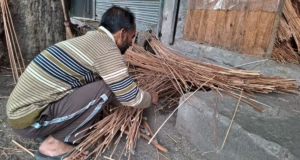
Women who prepare and process willow have also seen their income decline. Shahnaza, 45, from Shalbaf Mohalla near Anchar Lake in Srinagar, sorts and processes willow with three other women. “We earn about Rs 20 per kilogram,” she said. “But this year, farmers are reporting lower cultivation because the heat and hailstorms damaged many plants.”
Sorting and processing are both time-intensive. “It takes around 10 to 12 days to sort 1,000 kilograms,” she said. “Boiling and peeling 600 kilograms takes about eight to nine hours a day.”
In 2024, she earned about Rs 40,000 from sorting willow for one farmer. “This year, it will be less because there’s less willow to work with,” she said. Her co-worker Naseema, 37, added, “We only do household work and sort willow when it’s available. This year, we expect less work because many willows were damaged.”
For many artisans, the changes have already taken a toll. Manzoor Ahmad, 38, a willow wicker artist from Soura in Srinagar, fears the craft may disappear altogether. “If things keep going like this, there will be no willow artisans left in Soura,” he said. “The wood is scarce, prices are high, and we have no control over the weather.”
For Fayaz Ahmad Shaakhsaz, 42, a weaver from Dargah Hazratbal, the work still carries deep meaning. “This art is my life,” he said. “It not only provides for my family but also keeps me connected to the traditions of our community.”
(Ilhak Ahmad Tantray is a freelance journalist and a member of 101Reporters, a pan-India network of grassroots reporters.)
