Jharkhand Finance Minister presents ₹4,296 crore supplementary budget
THE JHARKHAND STORY DESK Ranchi, August 25: Amid a walkout by the BJP, Finance Minister Radhakrishna Kishore presented the supplementary budget,…
THE JHARKHAND STORY DESK
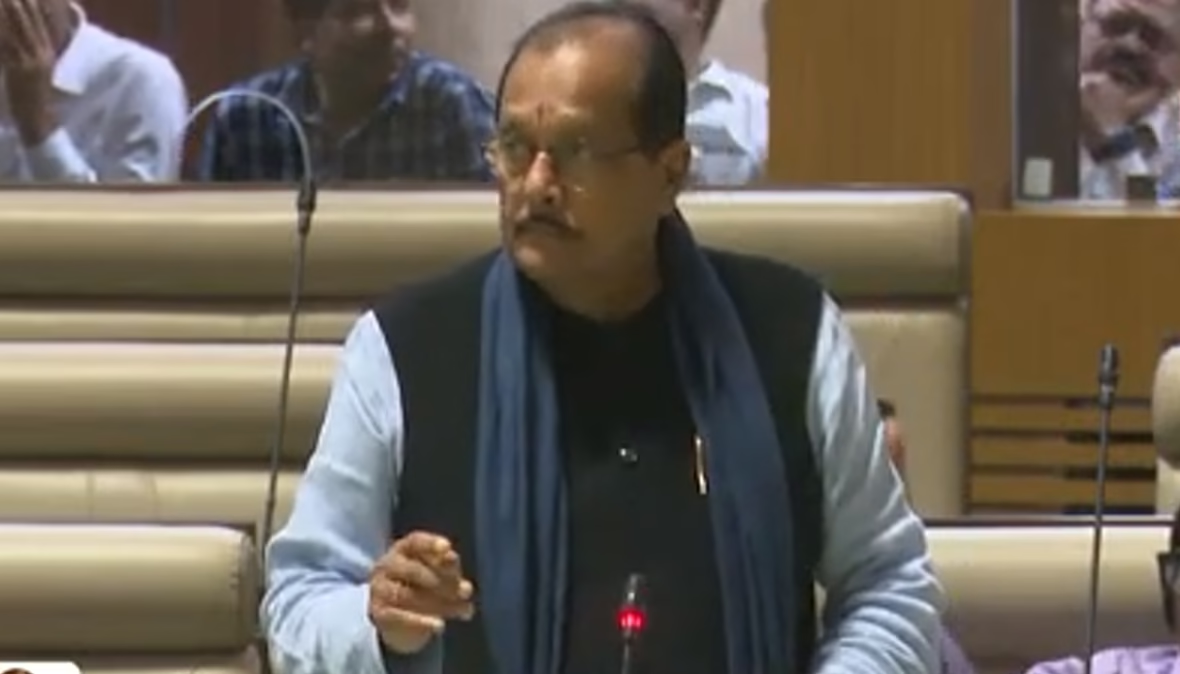
Ranchi, August 25: Amid a walkout by the BJP, Finance Minister Radhakrishna Kishore presented the supplementary budget, asserting that the Hemant Soren government’s financial management remains robust. He said the supplementary budget of ₹4,296.62 crore has been introduced to lay a foundation that brings relief and happiness to rural residents.
The House passed the supplementary budget through a voice vote. The minister informed that the main budget stands at ₹1,45,400 crore, with more than ₹38,000 crore allocated under establishment expenditures.
26% Expenditure in Four and a Half Months
The minister highlighted that the government has allocated more funds to establishment expenditure in the main budget. In the plan head, ₹23,799 crore has been spent in just four and a half months, which accounts for nearly 26.5% of the allocation—two to two-and-a-half percent higher than last year.
In terms of revenue collection, the state has achieved ₹33,707 crore—about 27% of the target—which the minister described as a major achievement. He noted that by August 2024–25, only ₹18,137.19 crore, or 23%, had been spent.

Also Read- Jharkhand Govt failed to submit utilization certificates for ₹1.33 lakh crore Central grant: CAG Report
State Can Borrow up to ₹18,000 Crore
According to the finance minister, the state’s financial management is so strong that it has not yet needed to borrow from the market. The fiscal deficit remains well below the 3% limit. If required, the state can borrow up to ₹18,000 crore from the market. “Our budget and planning are robust, tax management is effective, spending is under control, accounting and reporting are streamlined, and fiscal discipline is strong,” Kishore said.
However, he expressed concern that in the last four and a half months, the state has received only 17% of its share of central taxes.
Focus on Agriculture and Water Resources
The minister stated that the government has placed special emphasis on agriculture. From 2001 to 2018–19, agriculture spending amounted to ₹15,887 crore, which rose to ₹26,464 crore between 2019–20 and 2025–26.

Similarly, water resources have been a priority. Between 2001–02 and 2018–19, ₹30,173 crore was spent, while in the past six years alone, ₹11,069 crore has been utilized for irrigation management.
Why the Supplementary Budget Was Needed
Explaining the need for the supplementary budget, Kishore said it is necessary to provide additional funds to meet emerging requirements. The state expects ₹1,476 crore from the Centre, while ₹1,642 crore will come from surrendered funds.
The treasury will bear an additional burden of ₹1,177 crore, out of which ₹832 crore will be met through surrendered pension funds. This leaves a financial impact of ₹345 crore.
₹4,000 Crore from PL Accounts Deposited into Treasury
The finance minister also pointed out that the state has no shortage of funds. Keeping money idle in PL (personal ledger) accounts, he said, is not healthy financial practice. Between 2010–11, PL accounts held nearly ₹22,000 crore, of which ₹4,000 crore has been deposited into the treasury in the past four and a half months.
Also Read- Mongia Steel chairman files FIR over ₹20 lakh extortion bid in Giridih
1.5 Lakh Youth Employed in Five Years
Citing Labour Department data, Kishore said there are about 8 lakh registered unemployed youths in Jharkhand. Over the past five years, the government has provided employment to 1.5 lakh of them.
He acknowledged that excessive rainfall poses the biggest challenge at present, with nearly two lakh acres of crops damaged. Referring to the Maiyya Samman Yojana, he clarified that it is not a free seed distribution scheme but one aimed at ensuring dignity and respect for women.