Jharkhand HC upholds Mayor reservation policy, rejects plea on Dhanbad seat
Ranchi, Jan 27: The Jharkhand High Court has upheld the state government’s policy of classifying municipal corporations into “Varg Ka” and “Varg…
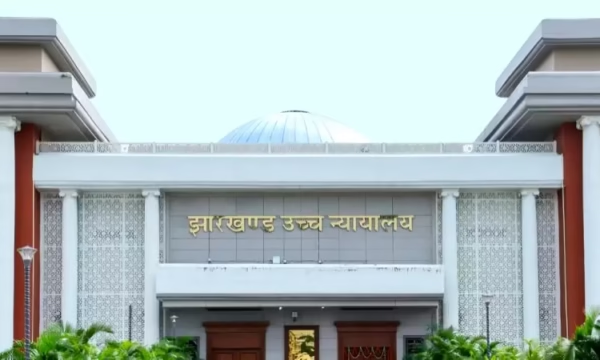
Ranchi, Jan 27: The Jharkhand High Court has upheld the state government’s policy of classifying municipal corporations into “Varg Ka” and “Varg Kha” for the purpose of reserving mayoral posts and dismissed a writ petition seeking Scheduled Caste (SC) reservation for the Mayor of Dhanbad Municipal Corporation.
A Division Bench comprising Chief Justice M.S. Sonak and Justice Sujit Narayan Prasad ruled that the classification and reservation framework adopted by the state is constitutionally valid and in line with Article 243T of the Constitution and the amended provisions of the Jharkhand Municipal Act, 2011.
Challenge to Mayor Reservation Policy
The petition, filed by Santanu Kumar Chandra, challenged the state’s decision to keep the Dhanbad Municipal Corporation mayor’s post under the unreserved category for the upcoming Urban Local Bodies elections, 2026, despite Dhanbad having the highest Scheduled Caste population among municipal corporations in Jharkhand.
The petitioner argued that after the 2022 amendment to Section 27 of the Jharkhand Municipal Act—removing the rotation system—the mayor’s post should be reserved strictly on the basis of the descending population of reserved categories.
‘Varg Ka’ and ‘Varg Kha’ Classification Under Scrutiny
The petition also questioned the legality of dividing nine municipal corporations into two categories—Varg Ka (Ranchi and Dhanbad) and Varg Kha (remaining seven corporations)—contending that such sub-classification has no constitutional backing under Article 243Q.
During the pendency of the case, the petitioner further challenged the Notifications dated January 8, 2026, issued by the State Election Commission, which implemented this classification and marked Dhanbad as unreserved.

Court Emphasises Constitutional Importance of Elections
The High Court underlined that elections are the soul of a democratic system, especially in the context of urban local bodies, which are institutions of self-government under Part IX-A of the Constitution.
The Bench observed that India’s democratic framework rests on regular, timely, and constitutionally compliant elections, and municipal elections are essential for governance “by the people through their elected representatives.” The court noted that delays or uncertainty in holding local body elections defeat the very purpose of the 74th Constitutional Amendment, which was enacted to restore local bodies to their rightful place in democratic governance.
The judges reiterated that once the constitutional and statutory framework for elections is in place, all authorities—including the State and the Election Commission—are duty-bound to ensure that the electoral process is not obstructed, diluted, or derailed.

Court Backs State, Election Commission
Rejecting the challenge, the High Court held that the state government acted within its constitutional and statutory powers. The Bench noted that Ranchi and Dhanbad are the only “million-plus” municipal corporations in Jharkhand and therefore form a distinct class for reservation purposes.
The court observed that the reservation policy was framed after completing the “triple test” mandated by the Supreme Court and based on recommendations of the Dedicated Commission for Backwards Classes, in compliance with earlier undertakings given before the apex court.
Rotation Policy No Longer Applicable
The court clarified that once the legislature consciously deleted the word “rotation” from Section 27 of the Act through the Jharkhand Municipal (Amendment) Act, 2022, no claim could be made on the basis of earlier rotational practices.
It also ruled that debates and assurances made on the floor of the Legislative Assembly cannot override the clear text of a statute once enacted.
No Arbitrariness or Constitutional Violation
The Bench held that the reservation framework maintains the 50% ceiling laid down by the Supreme Court in Indra Sawhney v. Union of India and does not violate Articles 14, 15, 16, 243Q or 243T of the Constitution.
The court further found no illegality in the State Election Commission’s notification implementing the policy for the 2026 municipal elections.
Writ Petition Dismissed
Concluding that the policy decision was backed by constitutional provisions, statutory amendments, and Supreme Court directives, the High Court dismissed the writ petition and all connected applications.