A 37-year dispute ends: Jharkhand HC rules adopted son alone owns Giridih property
Ranchi, Jan 29, 2026: Bringing an end to a long-running property dispute in Jharkhand, the Jharkhand High Court on Thursday ruled that…
Ranchi, Jan 29, 2026: Bringing an end to a long-running property dispute in Jharkhand, the Jharkhand High Court on Thursday ruled that a biological brother has no right to claim a share in property inherited by an adopted son, reinforcing settled principles of Hindu adoption and inheritance law.
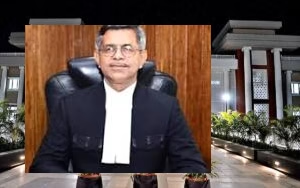
Delivering the judgment, Justice Anubha Rawat Choudhary dismissed a second appeal pending since 1995, thereby closing a legal battle that began with a partition suit filed in 1989 and spanned nearly 37 years of litigation over a Giridih property dispute.
Roots of the Dispute
The case traces its origins to 1944, when Man Kumari, a childless woman from Giridih, legally adopted Dwarika Prasad, an act that later became central to the property inheritance case. Under Hindu law, adoption completely transfers a child into the adoptive family, severing legal ties with the biological family.
Despite this, Dwarika Prasad’s biological brother, Bishwanath Prasad, later approached the court seeking partition of property, claiming that the house and land were treated as joint family property. His claim relied on an alleged agreement from 1948 and on his having lived in part of the house for several years.
Courts Examine Adoption and Ownership
While a trial court in Giridih initially accepted the claim, the first appellate court overturned the decision in 1994, holding that the property belonged exclusively to the adopted son. The matter then reached the Jharkhand High Court, where it remained pending for decades as parties passed away and their legal heirs were substituted.
Justice Anubha Rawat Choudhary, after examining the evidence, agreed with the appellate court and observed that the valid adoption deed of 1944 was never challenged within the limitation period, making it legally binding.

Living in the House Did Not Create Rights
The High Court also addressed the argument that long residence in the house created ownership. The Court held that living in two rooms of the property amounted only to permissive possession, not joint ownership. It further noted that payment of municipal taxes or utility bills does not establish title in a property ownership dispute.
The alleged 1948 agreement, relied upon by the claimant to prove shared ownership, was found to be unreliable and inconsistent, weakening the claim of joint Hindu family property.
Final Closure After Decades
With this judgment, the Jharkhand High Court brought final closure to one of the region’s oldest pending civil property cases, ruling that the Schedule-B property in Giridih belongs solely to the legal heirs of the adopted son.

The verdict underscores that adoption has lasting legal consequences and that inheritance rights flow from the adoptive family, not biological ties. For families involved in property partition cases, the ruling serves as a reminder that long possession or family arrangements cannot override clear legal adoption.