Jharkhand HC sets aside 1994 orders in East Singhbhum land dispute
Ranchi, March 18: The Jharkhand High Court has set aside a 1994 order passed by the Deputy Commissioner, East Singhbhum, in…
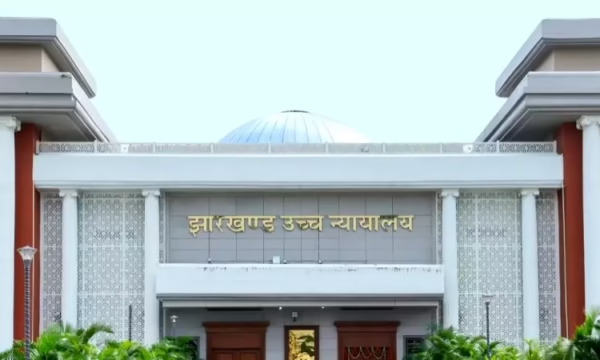
Ranchi, March 18: The Jharkhand High Court has set aside a 1994 order passed by the Deputy Commissioner, East Singhbhum, in a long-pending land dispute involving the Mahto family, holding that the earlier decisions suffered from legal errors.
Dispute Over Ancestral Land
The case was filed by Parimal Kumar Mahto, Rasik Lal Mahto, Utpal Kumar Mahto and Sarvendu Mahto over land in the Kanimohali area. They had challenged decisions by local revenue authorities that had gone against their claim.
The challenge was against the order dated November 22, 1994, in S.A.R. Appeal No. 28 of 1986-87, which had upheld an earlier order dated June 6, 1986, passed by the Land Reforms Deputy Collector (LRDC), Ghatshila, in a restoration case under the Chhotanagpur Tenancy (CNT) Act.
Key Reasons for Setting Aside Orders
Justice Sanjay Kumar Dwivedi found multiple grounds to quash the orders:
- Inordinate Delay: The restoration case under Section 71 of the CNT Act was filed around 45 years after the alleged cause, far beyond a reasonable time limit.
- Non-applicability of Section 46: The Court held that Section 46 of the CNT Act, which requires prior permission for land transfer, came into force only in 1947. Since the land was settled through a registered patta in 1939–40, this provision did not apply.
- Valid Title and Possession: The petitioners’ claim was supported by a registered patta executed by the then zamindar of Dhalbhum Estate in favour of their forefather, Gurucharan Mahto.
- Final Civil Court Decree: A title suit (No. 25 of 1950) had already been decided in favour of the petitioners’ family, and the decree had attained finality as it was never challenged.
- Record of Rights: The final publication of the record of rights in 1964 under Section 83 of the CNT Act recorded the name of the petitioners’ predecessor, strengthening their legal claim.
- Lack of Evidence from Respondents: The State and private respondents, including Somai Murmu and others, failed to produce documents to disprove the petitioners’ title.
Court Rejects Fraud Argument
The Court also rejected the argument that the land documents were fraudulent, citing Supreme Court judgments which held that such claims cannot be entertained after an unreasonable delay.

Final Verdict
The High Court quashed both the 1986 LRDC order and the 1994 appellate order, applying the principle of merger. The writ petition was allowed, granting relief to the petitioners.