Jharkhand records surge in liquor, mining revenue; govt plans push for more resources
Ranchi, April 4: Jharkhand has recorded significant gains in revenue collection in 2025–26, particularly from liquor and mining, even as the…
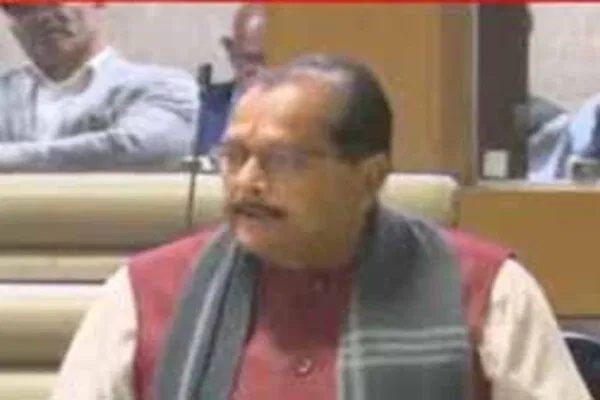
Radhakrishna Kishore
Ranchi, April 4: Jharkhand has recorded significant gains in revenue collection in 2025–26, particularly from liquor and mining, even as the state faces losses due to GST changes and reduced central support.

Revenue rises, but below expectations
Finance Minister Radha Krishna Kishore said the increase in revenue was due to administrative efforts and policy changes, though it still fell short of expectations.
He said the state suffered a loss of around ₹6,000 crore due to GST rationalisation and did not receive ₹5,000 crore in grant-in-aid from the Centre.
“With no possibility of a double-engine government in Jharkhand, we have to generate our own resources and not depend on central funds for development,” he said.
The government will soon hold meetings with revenue-generating departments to further boost collections.

ALSO READ: Thieves of Sahibganj: From tunnels to IPL thefts, India’s silent crime network returns
Liquor revenue crosses target for first time
For the first time, Jharkhand exceeded its liquor revenue target.
Against a target of ₹3,585.24 crore in 2025–26, the state earned ₹4,044.41 crore — 112.8% of the target.

This marks a major shift, as earlier governments had failed to meet liquor revenue targets despite multiple policy changes.
The turnaround came after the government revised its excise policy in 2025–26, rolling back state-run retail sales and allowing private players again. The number of liquor shops was also reduced from 1,453 to 1,230.
Between April and August 2025, revenue was generated under the 2022 excise policy, while from September onwards, private retail sales drove collections.
Break-up of liquor revenue:
- Excise transport duty: ₹3,456.72 crore
- Excise duty: ₹404.32 crore
- Additional excise duty: ₹81.28 crore
- Licence fee: ₹42.57 crore
- Lottery fee: ₹24.15 crore
- Bar licence fee: ₹35.35 crore
Mining remains biggest revenue source
The mining sector continued to be the backbone of Jharkhand’s revenue.
In 2025–26, the state earned ₹11,113.75 crore from mines and minerals, along with ₹7,485.66 crore through Jharkhand Mineral Bearing Land (JMBL) cess.
Dhanbad and Hazaribagh emerged as top contributors:
- Dhanbad: ₹1,689.24 crore revenue, ₹1,109.39 crore cess
- Hazaribagh: ₹1,228.06 crore revenue, ₹1,113.53 crore cess
Other major contributors included Ramgarh, Latehar and Bokaro.
However, districts like Koderma, Garhwa, Simdega, Dumka and Sahibganj reported low or negligible cess collection, mainly due to delays in renewal of mining leases.
Focus on new revenue streams
The finance minister said the government is exploring additional revenue sources. “We aim to achieve at least 20,000 crore to Rs 25,000 crore from the mining sector next year,” he said.
Closed mines may be repurposed for alternative uses, and iron ore waste lying around mining sites will be auctioned to generate income.
Policy shifts and challenges
The state’s excise policy has undergone multiple changes in recent years. The 2022 policy, which brought retail liquor sales under government control, led to a dip in revenue and was later scrapped following allegations of irregularities.
The revised 2025–26 policy, which restored private participation, has significantly improved revenue performance.