
Maize workshop begins at BAU, ICAR chief sets global vision
Ranchi, April 9: A three-day national workshop of maize scientists began at Birsa Agricultural University (BAU) on Thursday, bringing together experts…
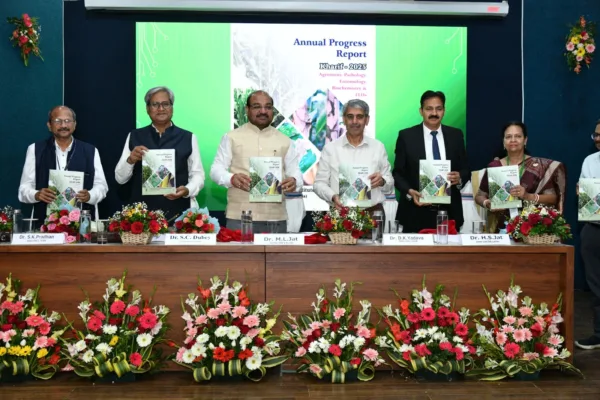
Ranchi, April 9: A three-day national workshop of maize scientists began at Birsa Agricultural University (BAU) on Thursday, bringing together experts from across the country to discuss research, productivity, and innovation in maize cultivation.

Dr Mangilal Jat, Secretary, Department of Agricultural Research and Education, Government of India, and Director General, ICAR, urged scientists to work collectively to make India a global hub for maize research, development, production, and innovation.
Focus on Data, Collaboration, and Innovation
Addressing the 69th Annual Workshop of the All India Coordinated Research Project on Maize, Dr Jat stressed the need for a strong data ecosystem, better coordination among research institutions, and promotion of public-private partnerships.
He said data should be systematically collected and used for accurate forecasting, rather than only for post-analysis. He also highlighted the need to develop crop varieties with higher nutrient-use efficiency, noting that natural resources are limited.
Dr Jat further emphasised investing in human capital by training scientists and exposing them to leading laboratories in India and abroad.

India’s Maize Productivity Improving, But Gap Remains
ICAR Deputy Director General (Crop Science), Dr DK Yadav, said maize productivity in India has increased from 2,567 kg/ha in 2014–15 to 3,590 kg/ha in 2024–25. The target is to reach 4,100 kg/ha by 2030–31.
However, he noted that this is still below the global average of 6,000 kg/ha. Countries like Brazil, with similar agro-climatic conditions, achieve around 5,500 kg/ha.
Over the past 11 years, India has developed 315 hybrid maize varieties, including sweet corn, popcorn, baby corn, biofuel-purpose, and biofortified types—113 by the private sector and 202 by the public sector.

Scope for Growth in Jharkhand and Bihar
BAU Vice Chancellor Dr SC Dubey highlighted the potential to increase maize productivity and cultivation area in Jharkhand and Bihar.
He said Jharkhand’s current productivity is 2.4 tons per hectare, compared to the national average of about 3.5 tons per hectare. He stressed the need to develop high-protein varieties (above 15%), strengthen quarantine systems, and improve collaboration with the private sector in seed production and extension.
Global Importance of Maize
ICAR Assistant Director General (Food and Fodder Crops), Dr SK Pradhan, said maize ranks first in global cereal production.
Global annual production stands at 1,299 million tons, compared to 740 million tons for wheat and 540 million tons for rice. He emphasised improving productivity in rainfed areas and developing climate-resilient varieties.
Ethanol and Farmer Recognition
Dr HS Jat, Director of the Indian Institute of Maize Research, Ludhiana, noted that 40% of India’s ethanol production comes from maize. He also presented the annual progress report during the welcome address.
More than 250 scientists from 37 agricultural universities and ICAR institutes are participating in the workshop.
On the occasion, two progressive farmers—Nand Kishore Sahu from Chanho block and Abhishek Mishra from Ranchi—were honoured for promoting innovative agriculture and improving farmers’ productivity and income.