
The 14-day truce: A tactical pause in a shifting global order
On March 30, 2026, the global system appeared to teeter on the edge of catastrophe. Oil prices surged to an alarming…
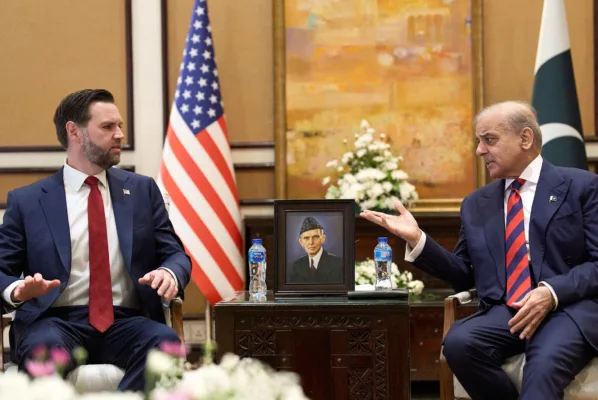
(L-R) U.S. Vice President JD Vance meets with Pakistan's Prime Minister Shehbaz Sharif during their meeting on April 11, 2026 at Islamabad, Pakistan.

On March 30, 2026, the global system appeared to teeter on the edge of catastrophe. Oil prices surged to an alarming 144 dollars per barrel, reflecting not just market anxiety but a deeper fear of systemic disruption. In Iran, the distribution of iodine tablets to over 175,000 citizens signalled that the threat of nuclear escalation was being taken seriously at the highest levels. Washington’s rhetoric hardened toward “unconditional surrender,” while Tehran framed the moment in existential terms—calling it, quite starkly, the “last night.”
And yet, within hours, the narrative underwent a dramatic reversal. The expected escalation did not materialize. Instead, the world was presented with a 14-day ceasefire between the United States and Iran.
At first glance, the truce seemed almost miraculous—a last-minute de-escalation that pulled the world back from the brink. But a closer examination reveals something far more calculated. This was not peace born of reconciliation; it was a strategic pause engineered by multiple actors, each pursuing their own interests under intense pressure.
This article unpacks the deeper realities behind the ceasefire—examining the roles of intermediary states, the transformation of maritime law into a strategic tool, the shifting balance of power in the Middle East, and the emergence of new geopolitical brokers. What emerges is not a story of resolution, but of recalibration.
Pakistan’s Role: Mediation or Managed Messaging?
The immediate headlines credited Pakistan with playing a decisive role in averting a global crisis. Prime Minister Shehbaz Sharif publicly called for a ceasefire, positioning Islamabad as a diplomatic bridge between Washington and Tehran. However, beneath this narrative lies a more complex and revealing dynamic.

A seemingly minor detail—a phrase reading “Draft Pakistan PM Message on X” appearing in Sharif’s communication—suggested that the message may not have been entirely organic. Rather than an independent diplomatic initiative, it pointed toward a carefully orchestrated communication strategy.
In this interpretation, Pakistan functioned less as an autonomous mediator and more as a channel for a pre-designed exit strategy. For Washington, the situation had reached a critical juncture. Conventional military options had not achieved decisive results, and nuclear escalation remained politically and strategically untenable. A direct withdrawal, however, risked appearing as a retreat under pressure.
By allowing a third party to initiate the call for de-escalation, the United States could reframe its actions as a response to an ally’s request rather than a concession to its adversary. Pakistan, in this context, provided diplomatic cover—a way to manage perceptions while altering course.

This episode highlights a broader trend in contemporary geopolitics: the increasing use of smaller or mid-level powers as intermediaries in high-stakes negotiations. These actors often serve as buffers, enabling larger states to navigate complex situations without incurring reputational costs.
Insight: In future crises, observers should pay close attention to the role of intermediary states. Their public actions may mask deeper alignments and pre-negotiated outcomes.
The End of Free Passage: Hormuz and the Transformation of Maritime Power
For decades, the Strait of Hormuz has been synonymous with the principle of free navigation. As one of the world’s most critical maritime chokepoints—through which approximately 20 percent of global oil supply passes—it has been underpinned by a tacit understanding: that major powers, particularly the United States, would ensure its openness.
The 14-day truce appears to mark a significant departure from this paradigm. At the heart of the issue lies the legal framework established by the United Nations Convention on the Law of the Sea (UNCLOS). Under earlier norms, a narrower territorial claim allowed for an international corridor through the strait. However, the expansion of territorial waters to 12 nautical miles has effectively eliminated that corridor. Given the narrow width of the strait, the maritime zones of Iran and Oman now overlap, placing the entire passage within sovereign jurisdictions.
This legal reality has profound implications. It transforms the Strait from an international commons into a space governed by national authority. In practical terms, this opens the door for the imposition of transit fees, regulatory controls, and, potentially, selective access.
The comparison with Turkey’s management of the Bosphorus Strait is instructive. There, transit is regulated and subject to certain conditions, including fees. However, the strategic significance of Hormuz far exceeds that of the Bosphorus, amplifying the potential impact of similar measures.
The endorsement of such an arrangement by the United States—particularly in the context of reconstruction funding—signals a recognition of this new reality. It also reflects a broader shift: from enforcing global norms to accommodating localized control.
Insight: Energy markets and shipping industries must now account for a structural increase in transportation costs and regulatory complexity. The era of assumed free passage is effectively over.
Iran’s 10-Point Victory List
Trump called Iran’s plan “workable.” In reality, it was a capitulation. The Farsi version explicitly asserts Iran’s right to enrich uranium. The English version softened the language.
The plan included:
- Recognition of enrichment rights.
- Removal of all sanctions.
- Compensation for damages.
- Withdrawal of US forces from the Gulf.
- Recognition of Iranian control over Hormuz.
- Ceasefire on all fronts.
This was a reversal of US policy. From unconditional surrender to unconditional concessions. One of the most striking aspects of the ceasefire is the set of conditions associated with Iran’s proposed framework. Publicly described as “workable,” the plan represents a significant departure from previous U.S. positions.
At its core is the recognition of Iran’s right to enrich uranium—a long-standing point of contention in international negotiations. Accompanying this are demands for the removal of sanctions, compensation for damages, and the withdrawal of U.S. forces from the Gulf region. Additionally, the framework asserts Iranian authority over the Strait of Hormuz and calls for a comprehensive ceasefire across all theatres.
The bilingual presentation of the plan—more assertive in its original language and more moderated in translation—suggests a deliberate effort to manage international perception while maintaining domestic legitimacy.
From a strategic perspective, the acceptance of these terms, even partially, represents a shift in bargaining dynamics. It demonstrates that sustained pressure, combined with favourable geopolitical conditions, can yield concessions from even the most powerful adversaries.
Insight: Future negotiations involving Iran are likely to be shaped by this precedent. The ability to extract concessions under pressure may embolden more assertive positions.
China’s Quiet Leverage: The Rise of a Dual-Role Power
While Pakistan occupied the visible role of mediator, another actor operated more subtly but no less decisively: China.
As the ceasefire negotiations unfolded, high-level coordination between Pakistani and Chinese officials underscored Beijing’s involvement. China’s influence over Iran—rooted in economic partnerships and long-term strategic agreements—positioned it as a key facilitator of the de-escalation process.
By encouraging Iran to accept a temporary pause, China achieved multiple objectives. It stabilized a region critical to its energy security, enhanced its reputation as a responsible global actor, and gained leverage in its broader relationship with the United States.
This dual role—as both a competitor and a collaborator—defines China’s contemporary foreign policy. It allows Beijing to engage in strategic balancing, leveraging its influence in one domain to advance its interests in another.
Insight: Analysts should view China not merely as a regional actor, but as a systemic player capable of shaping outcomes across multiple theatres simultaneously.
The Israel-Lebanon Exception: Limits of a Partial Peace
Despite the broad framing of the ceasefire, its scope was not universal. Israel’s decision to continue operations in Lebanon introduced an immediate and significant limitation.
This divergence highlights a critical challenge in multilateral conflict resolution: the difficulty of achieving comprehensive alignment among all actors. Even when major powers agree on de-escalation, regional dynamics can sustain localised conflict.
The continuation of hostilities in Lebanon underscores the fragility of the truce. It reveals that the agreement functions more as a bilateral pause than a comprehensive peace settlement.
Insight: Ceasefires that exclude key stakeholders are inherently unstable. Their durability depends on broader regional buy-in, which, in this case, remains absent.
The Strait of Hormuz: Geography as Strategy
The strategic importance of the Strait of Hormuz cannot be overstated. Its narrow geography, combined with its centrality to global energy flows, makes it a uniquely potent lever of influence.
The Strait is the world’s most critical chokepoint. Twenty percent of global oil flows through it. During the March crisis, anticipation of closure alone drove oil to 144 dollars per barrel.
The Legal Trap
- Pre-UNCLOS: 3-mile limit left an international corridor.
- Post-UNCLOS: 12-mile limit erased that corridor.
- Result: Every tanker is now inside sovereign waters.
Iran and Oman can legally demand recognition and tolls. Geography has become a weapon.
The recent crisis demonstrated how even the anticipation of disruption can have immediate global repercussions. The spike in oil prices reflected not just supply concerns, but a deeper recognition of vulnerability.
The legal framework governing the strait has transformed this vulnerability into a strategic tool. By aligning geography with law, coastal states can exert control in ways that were previously constrained.
Insight: The intersection of geography and legal sovereignty is emerging as a key domain of strategic competition.
Maritime Tolls and Strategic Control: A New Economic Lever
Iran justifies tolls as reconstruction funding. Strategically, tolls provide three levers:
- Revenue generation.
- Sovereign control.
- Strategic denial.
This mirrors Turkey’s Bosphorus tolls. But Hormuz is far more critical.
The potential introduction of maritime tolls in the Strait of Hormuz represents a significant innovation in economic statecraft. Beyond revenue generation, such measures provide mechanisms for regulating access, influencing behaviour, and exerting pressure.
Insight: The monetization of chokepoints is likely to become an increasingly prominent feature of international relations.
The Fragile Balance: A Pause, Not a Resolution
The ceasefire is not peace. It is a pause. The core issues remain unresolved.
- Geography gives Iran a kill switch.
- Law has weaponized sovereignty.
- China has gained leverage.
- Israel has already broken terms.
Trump called it a golden age. In reality, it is a tactical timeout. Two weeks to reload. Two weeks to reposition.
The 14-day ceasefire does not resolve the underlying tensions between the United States and Iran. Instead, it temporarily stabilizes a volatile situation, creating space for recalibration.
Key issues remain unresolved: the future of nuclear policy, the role of external powers in the region, and the broader architecture of security in the Gulf. The involvement of multiple actors with divergent interests further complicates the path forward.
In this context, the ceasefire should be understood as a tactical pause—a moment of reflection and repositioning rather than a definitive outcome.
Insight: The critical moment will come after the truce expires. The decisions made in its aftermath will determine whether the pause leads to de-escalation or renewed confrontation.
Conclusion: Lessons from a Controlled De-escalation
The 14-day truce offers a revealing glimpse into the evolving nature of global politics. It demonstrates how crises are managed not only through power, but through perception, negotiation, and strategic compromise.
Several key lessons emerge. First, diplomacy is increasingly mediated through indirect channels, with smaller states playing outsized roles. Second, legal frameworks and geographic realities are being leveraged as instruments of power. Third, the balance of influence is shifting, with new actors asserting themselves in traditionally dominated spaces.
Perhaps most importantly, the truce underscores the limits of traditional notions of dominance. Even the most powerful states must navigate constraints, adapt strategies, and, at times, accept outcomes that fall short of their initial objectives.
As the world moves beyond this temporary pause, the broader implications will continue to unfold. Whether this moment marks a turning point or merely an interlude remains to be seen.What is certain, however, is that the dynamics it reveals will shape the contours of global politics in the years to come.
(Dr Rachna K Prasad, is Asst Professor of Political Science at the University of Delhi. She can be contacted at drrachnaprasad24@gmail.com)