After 0.01-vote thriller, Jharkhand’s Rajya Sabha race hinges on numbers, strategy and suspense
Ranchi, June 16: As Jharkhand prepares to vote for two Rajya Sabha seats on June 18, political parties are leaving little to…
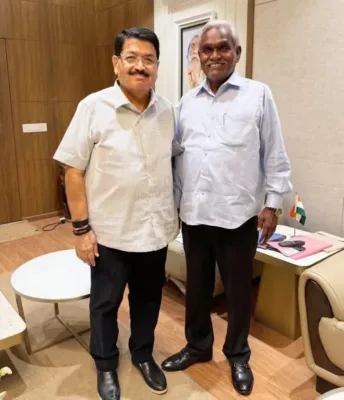
In Jharkhand, NDA-backed Rajya Sabha election candidate Parimal Nathwani met former Chief Minister and BJP leader Champai Soren at his residence after the latter failed to attend the NDA MLAs’ meeting on Monday.
Ranchi, June 16: As Jharkhand prepares to vote for two Rajya Sabha seats on June 18, political parties are leaving little to chance. MLAs are being housed in hotels, alliance managers are working overtime, and rival camps are engaged in an intense battle of perception.
On paper, the contest appears straightforward. The INDIA bloc has 56 MLAs in the 81-member Assembly, comfortably above the 28 votes required to elect a Rajya Sabha member. The NDA has only 24 legislators and lacks the numbers to secure a seat on its own.

Yet, few political observers are willing to predict the outcome with certainty.
The reason lies not only in the presence of a third candidate, NDA-backed Independent Parimal Nathwani, but also in Jharkhand’s history of producing some of the most dramatic Rajya Sabha results in the country.
Nathwani’s Entry Changed the Narrative
Until a few weeks ago, the election was widely seen as a routine exercise in which the INDIA bloc would comfortably secure both seats.
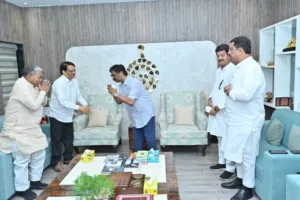
That perception began to change when industrialist and sitting Rajya Sabha member Parimal Nathwani met Chief Minister Hemant Soren shortly before formally entering the contest as an Independent candidate backed by the NDA.

The meeting triggered speculation across political circles.
While Congress leaders appeared increasingly uneasy about the implications of Nathwani’s candidature, the NDA became visibly more confident. The belief within BJP circles was that Nathwani was not entering the race merely to make up the numbers but because he believed a pathway to victory existed.
His candidature transformed what appeared to be a settled contest into a competitive battle for the second seat.

Since then, the political atmosphere has changed noticeably. Congress candidate Pranav Jha has been actively engaging alliance partners, including meetings with RJD leadership in Patna, while the BJP has gathered its legislators at Ranchi’s Radisson Blu Hotel ahead of polling.
The Significance of “61, Not 56”
Adding another layer to the intrigue was a JMM social media post claiming support from “61, not 56” MLAs.
The message was interpreted in multiple ways.
One reading was that the ruling alliance had managed to secure support beyond its official strength. Another interpretation was that the post was intended to reassure nervous alliance partners and project confidence amid growing speculation about cross-voting.
The tweet also suggested that the JMM is investing as much political capital in ensuring the victory of Congress candidate Pranav Jha as Congress itself.
Whether the figure reflects actual support or political messaging will become clear only after votes are counted.
The Arithmetic Appears Simple—But Isn’t
The Assembly has 81 members, and a candidate requires 28 first-preference votes to secure election.
The INDIA bloc’s strength is:
- JMM: 34
- Congress: 16
- RJD: 4
- CPI(ML): 2
Total: 56
The NDA’s strength is:
- BJP: 21
- AJSU: 1
- JD(U): 1
- LJP (RV): 1
Total: 24
At first glance, the ruling alliance appears well positioned to win both seats.
However, the challenge lies in distributing votes between its two candidates.
JMM candidate Baijnath Ram requires 28 votes and is virtually assured of election. The real contest revolves around Congress candidate Pranav Jha.
Political observers believe the JMM is unlikely to reduce Baijnath Ram’s tally to the bare minimum required for victory. Sources suggest the party may prefer to secure around 30 first-preference votes for its own candidate before diverting support elsewhere.
That calculation could make the second contest tighter than the headline numbers suggest.
Nathwani’s Route to Victory
Nathwani begins with the NDA’s 24 votes.
To reach the winning mark, he requires at least four additional first-preference votes.
Those votes can come through cross-voting, abstentions or support from legislators outside the NDA fold.
This is why every political development over the past week has been scrutinised.
Until recently, speculation centred on whether some RJD legislators might abstain or support Nathwani. Congress leaders responded by intensifying outreach efforts, culminating in Pranav Jha’s meeting with Tejashwi Yadav in Patna.
The BJP, meanwhile, has moved into election-management mode, housing MLAs at Radisson Blu and conducting detailed briefings to ensure votes are cast correctly.
History Warns Against Complacency
If there is one lesson from Jharkhand’s Rajya Sabha elections, it is that arithmetic alone does not guarantee victory.
In 2016, BJP candidates Mukhtar Abbas Naqvi and Mahesh Poddar won both seats despite opposition expectations of securing one berth. Naqvi’s surplus votes were transferred to Poddar, who eventually defeated JMM candidate Basant Soren by 0.64 votes. Two absent opposition legislators and one instance of cross-voting proved decisive.
The 2018 election produced an even more dramatic outcome.
Although the BJP had the numbers to remain competitive, its second candidate, Pawan Santhalia, lost to Congress’s Dheeraj Sahu by just 0.01 vote after the transfer of surplus votes from Sameer Oraon. It remains one of the closest Rajya Sabha contests in the country’s history.
Those results continue to serve as a reminder that Rajya Sabha elections are often decided not by broad political trends but by meticulous vote management.
June 18 Will Test Both Arithmetic and Alliance Discipline
The coming election is ultimately a test of whether declared numbers hold firm under political pressure.
The INDIA bloc insists it has the votes to elect both Baijnath Ram and Pranav Jha. The NDA believes Nathwani’s candidature has created enough uncertainty to make the second seat competitive.
The truth will emerge on June 18.
What is already clear, however, is that this election has evolved from a routine legislative exercise into a contest defined by strategy, perception, alliance discipline and the possibility of political surprises.
In a state where Rajya Sabha elections have previously been decided by absenteeism, cross-voting and even a margin of 0.01 vote, no camp is prepared to take victory for granted.