After 36 years apart, Jharkhand HC upholds divorce, awards wife Rs 40 lakh alimony
Ranchi, June 19: The Jharkhand High Court has upheld the dissolution of a marriage between a Jamtara couple who had been living…
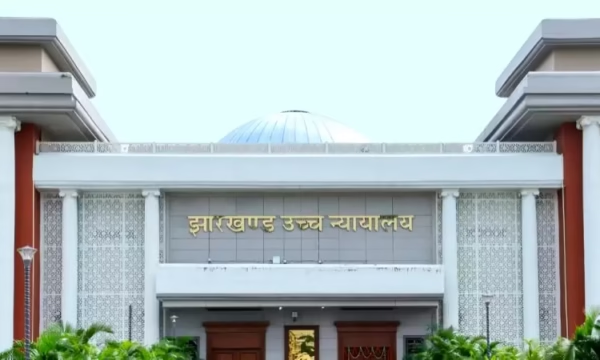
Ranchi, June 19: The Jharkhand High Court has upheld the dissolution of a marriage between a Jamtara couple who had been living separately for nearly 36 years, holding that the relationship had become a “dead wood marriage” with no possibility of reconciliation. At the same time, the court significantly enhanced the wife’s permanent alimony from Rs 10 lakh to Rs 40 lakh, taking into account the husband’s income, retirement benefits, and the wife’s financial dependence.
A Division Bench of Justice Sujit Narayan Prasad and Justice Sanjay Prasad dismissed an appeal filed by Sandhya Devi against a Family Court order that had granted divorce to her husband, Rajesh Kumar Singh, on the grounds of cruelty and desertion.
Marriage Had Broken Down Beyond Repair
The couple married in May 1984 and had a daughter. According to court records, they stopped living together around 1990 and remained separated ever since. During the intervening years, the wife initiated criminal and maintenance proceedings against her husband, while the husband continued paying maintenance as per court orders.
The High Court noted that despite decades of litigation, the parties had failed to resume cohabitation. It observed that there was no realistic possibility of reunion and that forcing them to continue in a legal relationship would serve no meaningful purpose.
Referring to Supreme Court precedents on long-separated couples, the Bench held that the marriage had become a “dead wood marriage”, devoid of emotional or practical value, and affirmed the Family Court’s decree of divorce.
Court Seeks Details of Husband’s Finances
While affirming the divorce, the High Court took a fresh look at the issue of permanent alimony after the wife argued that the Family Court’s award of Rs 10 lakh was inadequate.
To assess the husband’s financial capacity, the court impleaded the General Manager of Chittaranjan Locomotive Works (CLW) and directed submission of details relating to the husband’s salary, pension, and retirement dues.
The affidavit submitted by CLW revealed that Rajesh Kumar Singh, a Senior Technician (Motor Vehicle Driver), is scheduled to retire on August 31, 2026, and will receive substantial retirement benefits.
According to the affidavit, he is entitled to:

- Rs 11.52 lakh as commuted pension value
- Rs 15.27 lakh as retirement gratuity
- Rs 9.25 lakh as leave encashment
- Rs 63,790 under group insurance
- Rs 1.45 lakh in provident fund deposits
Besides these benefits, he will receive a monthly pension of Rs 29,300 plus dearness relief.
How the Court Calculated the Rs 40 Lakh Alimony
The High Court carefully examined the wife’s future financial needs and the husband’s post-retirement income.
The Bench noted that after including dearness relief, the husband’s monthly pension would be around Rs 48,000. It observed that allocating even one-third of that amount—approximately Rs 16,000 per month—towards the wife’s maintenance would translate into nearly Rs 23 lakh over a projected period based on her life expectancy.
The court also considered that the husband would receive retirement benefits of roughly Rs 38 lakh, while the wife, now aged about 55, had no independent source of income and would have to meet her living and medical expenses in the years ahead.
Taking into account rising inflation, increasing healthcare costs, the wife’s financial dependence, and the standard of living she would have enjoyed had the marriage continued, the court concluded that a lump-sum amount of Rs 40 lakh would be “just, fair and reasonable” for her sustenance.
Payment in Four Instalments
The court directed the husband to pay the Rs 40 lakh permanent alimony in four equal instalments within 12 months, with the first instalment to be paid within one month of the judgment.
The Bench also granted liberty to the wife to seek appropriate legal remedies if the payment schedule is not adhered to.
Significant Ruling on Long-Separated Couples
The judgment underscores the growing judicial recognition that marriages which have effectively ceased to exist for decades should not be preserved merely as a legal formality. At the same time, it reinforces the principle that a financially dependent spouse must be provided adequate financial security upon dissolution of marriage.